Updated: October 2, 2026
Greece › Entry Requirements
By Santorini Dave • dave@santorinidave.com
See Also
- Where to Stay in Athens
- Where to Stay in Santorini
- Where to Stay in Mykonos
- Where to Stay in Naxos
- Where to Stay in Paros
- Where to Stay in Crete
- Where to Stay in Corfu
- Where to Stay in Rhodes

My wife and I in Athens.
American, Canadian, British, Australian, and other visa-exempt tourists can visit Greece for up to 90 days in any 180-day period without a visa.
EES is operating now. The Entry/Exit System records the entries and exits of most non-EU travelers making short stays at external Schengen borders. There is no advance application.
ETIAS is not operating and applications are not open. The European Union has not announced a start date. There is currently nothing travelers need to apply for or pay for.
For most tourists, these are the important rules:
- Visa: Citizens of the United States, Canada, the United Kingdom, Australia, and many other countries do not need a tourist visa for stays of up to 90 days in any 180-day period.
- EES: The biometric border system is operating. Registration happens when you cross an external Schengen border.
- ETIAS: Not required as of October 2, 2026. Official applications are not open.
- Passport: It must have been issued within the previous 10 years when you enter and remain valid for at least 3 months after you plan to leave the Schengen Area.
- Length of stay: Greece and the other Schengen countries share the same 90-days-in-180 limit.
Do Americans Need a Visa for Greece in 2027?
American citizens traveling with a valid U.S. passport do not need a visa for tourism or business visits of up to 90 days in any 180-day period.
The same applies to citizens of Canada, the United Kingdom, Australia, New Zealand, Japan, South Korea, and many other countries.
The rule follows the passport you use, not where you live. A U.S. resident traveling on an Indian passport, for example, follows the requirements for an Indian passport holder.
Anyone planning to work, study, move to Greece, or stay longer than 90 days needs a different visa or residence permit.
EES and ETIAS: What Is the Difference?
- EES happens at the border. It digitally records the entry and exit of most non-EU visitors making short stays. It is operating now and requires no advance application.
- ETIAS will happen before the trip. It will be an online travel authorization for visa-exempt visitors. It is not operating yet.
EES also applies to many travelers using short-stay Schengen visas. ETIAS will apply only to travelers who do not need a visa.
The Entry/Exit System Is Operating Now
EES began its gradual introduction on October 12, 2025 and became fully operational at external borders on April 10, 2026. It digitally records entries and exits for most non-EU nationals making short stays in countries using the system.
What Happens the First Time You Use EES?
Your first EES crossing can take longer because your record needs to be created. You will present your passport and have a facial image taken. Visa-exempt travelers aged 12 or older will generally also provide fingerprints.
On later trips, your biometrics can be checked against the record already in the system. I would not combine a first EES registration with a very tight onward connection.
Children under 12 are not fingerprinted for EES, though their facial image and passport information can still be recorded.
What Happens at Passport Control in Greece?

Entering passport control at the international airport in Athens.
If Greece is where you first enter the Schengen Area, you will complete passport control and EES processing in Greece. Depending on the airport and your previous EES registration, you may use a self-service kiosk, automated gate, or staffed passport booth.
Border officials can ask for accommodation details, a return or onward ticket, and information about your trip.
Keep the address of your first hotel and your onward itinerary easy to find. I take screenshots before flying. They are quicker than searching through email while standing at passport control with unreliable airport Wi-Fi.
Where Do You Complete Immigration When Flying to Greece?
You’ll complete EES entry processing at the first airport where you enter the Schengen Area, not necessarily in Greece.
Examples:
- New York to Athens nonstop: Passport control is in Athens.
- Toronto to Frankfurt to Athens: Passport control is in Frankfurt.
- London to Paris to Santorini: Passport control is in Paris.
- Los Angeles to Rome to Mykonos: Passport control is in Rome.
- Paris to Athens: This is an internal Schengen flight, so there is normally no immigration check when you land in Athens.
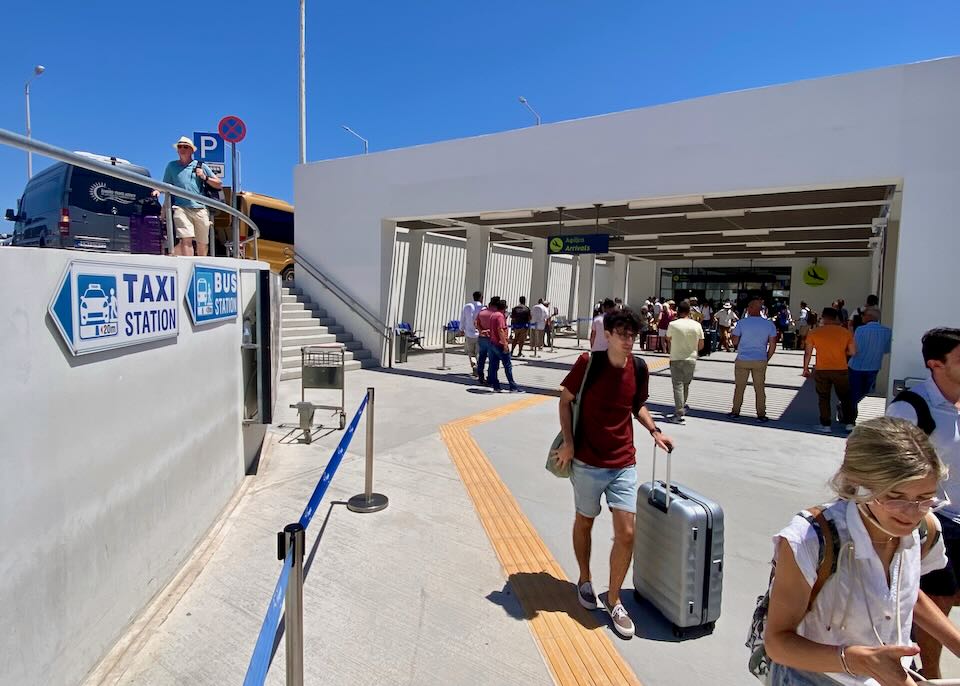
Arrivals at the international airport in Santorini. If you’re arriving from outside the Schengen Area, for example London, you’ll complete passport control and EES processing here. If you connect through Athens, Rome, Paris, or another Schengen airport, the checks take place there instead.
How Much Connection Time Do You Need in Athens?
Allow extra time if Athens is your first entry into the Schengen Area. You need enough time for passport control and EES processing, any required security check, and the walk to your departure gate.
A self-transfer takes longer. You may need to collect your luggage, exit into arrivals, check in again, drop your bags, clear security, and reach the next gate.
I would not book a tight self-transfer after an international arrival. This is especially true with a separately booked flight to a Greek island.
Do not book a ferry from Piraeus shortly after landing at Athens Airport. You need time for passport control, baggage collection, the trip across Athens, and finding the correct ferry gate. See my Greek Ferries Guide for practical advice on ferry connections.
Can You Use the Travel to Europe App?
The official Travel to Europe app lets eligible non-EU travelers pre-register some EES information before reaching participating border crossings. It does not replace passport control or any fingerprints required at the border.
The app currently works when entering Sweden and Portugal, but the features are different. Sweden supports advance passport data, facial image, and the entry questionnaire. Portugal supports the entry questionnaire.
Other countries may add the app later. Check shortly before your trip to see whether your border crossing supports it.
ETIAS Is Not Required Yet
ETIAS is not operating as of October 2, 2026. Applications are not open. The European Union says it will announce the specific start date several months before ETIAS begins.
Any website claiming that it can secure an approved ETIAS now is misleading you.
Once ETIAS begins, it will be an online travel authorization for visa-exempt travelers visiting Greece and other participating European countries. It will work much like the U.S. ESTA or U.K. ETA. It is not a visa and does not guarantee admission at the border.
Who Will Need ETIAS?
ETIAS will apply to many visa-exempt visitors, including travelers using passports from the United States, Canada, United Kingdom, Australia, New Zealand, Japan, and South Korea.
Travelers who need a Schengen visa will continue to use the visa process rather than ETIAS. Citizens of EU countries, Iceland, Liechtenstein, Norway, and Switzerland will not need ETIAS.
How Much Will ETIAS Cost?
The planned fee is €20. Applicants under 18 and over 70 will not pay the application fee, though they will still need an authorization if ETIAS applies to them.
ETIAS will normally be valid for up to 3 years or until the passport used for the application expires, whichever comes first. If you replace the passport, you will need a new ETIAS.
When applications open, use the official EU website. Third-party ETIAS sites already exist and may charge additional fees.
The 90/180-Day Schengen Rule

My wife and I at immigration at Athens airport.
Visa-exempt visitors can normally spend a maximum of 90 days in any rolling 180-day period in the Schengen Area.
Greece does not have a separate 90-day allowance. Days in Greece, France, Italy, Spain, Germany, the Netherlands, and every other Schengen country count toward the same total. Both your arrival and departure days count.
The common mistake is counting only the upcoming trip and forgetting earlier travel within the previous 180 days. Leaving Schengen for a weekend does not reset the clock.
Use the European Commission’s official short-stay calculator if you are close to the limit. EES has not changed how the 90/180 rule works.
Greece Passport Validity Rules
For a short tourist visit, your passport must:
- Have been issued within the previous 10 years on the date you enter
- Remain valid for at least 3 months after the date you plan to leave the Schengen Area
The 3-month requirement is based on when you leave the entire Schengen Area, not when you leave Greece. If you visit Greece and then Italy, for example, count from the day you leave Schengen after Italy.
Do You Need Six Months of Passport Validity?
No. The standard Schengen requirement for a short visit is at least 3 months beyond your planned departure from the Schengen Area, and the passport must have been issued within the previous 10 years.
Cruises, Ferries, and Greek Ports

Arriving at the International Airport in Mykonos.
EES applies at external sea borders as well as airports and land crossings. What matters is whether you are traveling between Schengen and a non-Schengen country.
- Turkey to Greece: This crosses an external Schengen border. Expect passport control and EES processing.
- Italy to Greece: Both countries are in Schengen, so this is normally an internal Schengen journey.
- Cruise visiting only Schengen ports: You will not normally complete a new EES entry at every stop.
- Cruise visiting Turkey or another non-Schengen country: Exit and entry checks apply when the itinerary crosses the external border.
Traveling With Two Passports
Use the same passport to enter and leave the Schengen Area. Once ETIAS begins, use the passport connected to your ETIAS authorization.
If you are also an EU citizen, use your EU passport or accepted national identity document when entering Greece rather than entering as a short-stay non-EU visitor.
Greece Entry Requirements for Children
Children need their own valid passport or accepted travel document. Under EES, children under 12 are not fingerprinted, but their facial image and passport information can still be recorded.
If a child is traveling with only one parent or with an adult who is not their parent, carry a signed consent letter and supporting documents, especially when surnames differ. Requirements can vary by country and airline.
Frequently Asked Questions
Do U.S. citizens need a visa for Greece in 2027?
No. U.S. citizens can visit Greece without a visa for tourism or business for up to 90 days in any 180-day period.
Where do I complete immigration when connecting to Greece?
At the first airport where you enter the Schengen Area. If you fly Toronto to Frankfurt to Athens, for example, passport control is in Frankfurt.
Does time in Italy or France count toward my 90 days in Greece?
Yes. Greece and the other Schengen countries share the same 90-days-in-180 allowance.
What Most Greece Travelers Actually Need to Do
For a typical vacation, check that your passport meets the Schengen validity rules and that you have enough time remaining under the 90/180-day limit. If you are entering Schengen on the way to a connecting flight, leave enough time for passport control and EES processing.
You do not need ETIAS yet.
Travelers with a previous Schengen overstay, denied entry, deportation, complicated residence status, or criminal history should get qualified immigration advice before traveling. Those situations are too important and too specific to sort out at passport control.

About Santorini Dave