Updated: November 6, 2026 • By Santorini Dave
My Favorite Hotels in Amsterdam
- 5-Star: Waldorf Astoria (Southern Canal Belt)
- 4-Star: Kimpton De Witt (City Center)
- 3-Star: Linden Hotel (Jordaan)
- Boutique: Pulitzer (Western Canal Belt)
- Train Station: Park Plaza Victoria • art’otel
- Cruise Port: Mövenpick (Near Passenger Terminal Amsterdam)
- Dam Square: Hotel TwentySeven (Overlooking Dam Square)
- For Couples: The Dylan (Western Canal Belt)
- For Families: Linden Hotel (Jordaan) • Mandarin Oriental Conservatorium (Luxury)
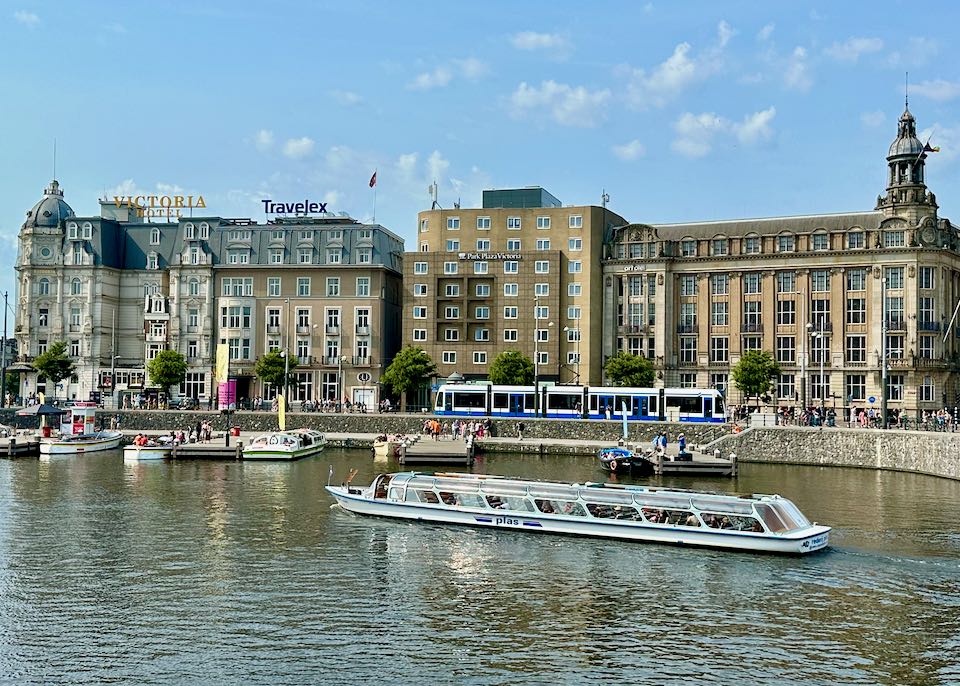
The Park Plaza Victoria and art’otel, directly opposite Amsterdam Centraal station. Frequent trains connect Centraal with Schiphol Airport.
The Western Canal Belt is my favorite area to stay in Amsterdam, especially for a first visit. Beautiful canals, excellent restaurants, and boutique hotels within walking distance of the historic center, without the busiest City Center crowds. The Pulitzer is my favorite hotel in Amsterdam.
For a short stay, pay more for a central location rather than a larger room farther out. You don’t need a car: walk around the center and use trams or the metro for longer trips.
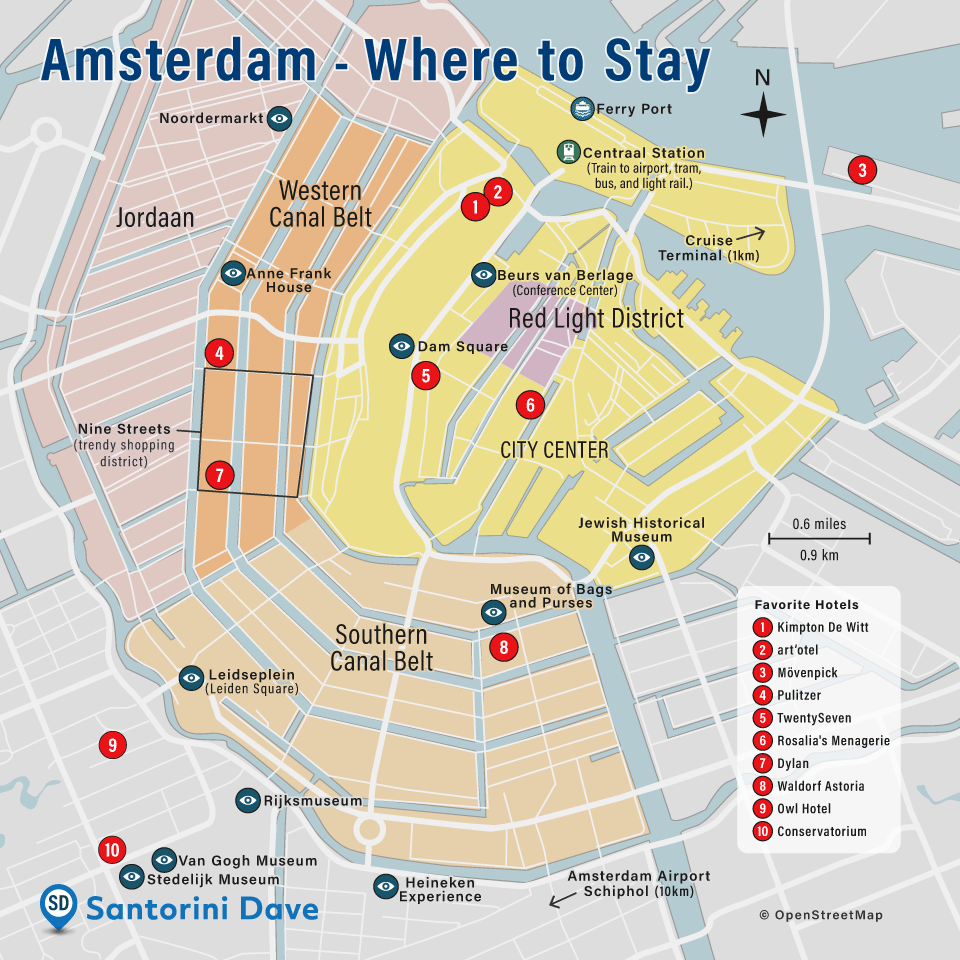
1. Kimpton De Witt • 2. art’otel • 3. Mövenpick • 4. Pulitzer • 5. TwentySeven • 6. Rosalia’s Menagerie • 7. The Dylan • 8. Waldorf Astoria • 9. Owl Hotel • 10. Mandarin Oriental Conservatorium
The Best Areas to Stay in Amsterdam
- Western Canal Belt: My first choice for first-time visitors and couples; beautiful canals and excellent boutique hotels.
- City Center: Best for Amsterdam Centraal, shopping, and convenience. Choose carefully: nightlife streets can be noisy.
- Southern Canal Belt: Luxury hotels and nightlife. Stay away from Leidseplein and Rembrandtplein for quieter nights.
- Jordaan: Traditional pubs, neighborhood restaurants, and smaller hotels on attractive residential streets.
- Oud-Zuid (Museum Quarter): Best for major art museums, Vondelpark, and families wanting quieter surroundings.
- De Pijp: Best for casual dining, cafés, and neighborhood bars, with good metro connections.
- De Plantage and Amsterdam-Oost: De Plantage for families and the zoo; farther east for parks and better-value accommodation.
- Amsterdam Noord: Unusual hotels, contemporary art, and waterfront restaurants. Stay near a ferry or metro station.
- Amsterdam-West: Foodhallen, Westerpark, and neighborhood restaurants.
- Eastern Docklands and IJburg: Modern waterfront hotels; expect to use public transport for sightseeing.
My son and I on a boat tour of Amsterdam’s canals.
Amsterdam Hotel Booking Tips
- Avoid noisy nightlife areas. Hotels near Leidseplein, Rembrandtplein, and the Red Light District can be loud late at night, especially on weekends. For a quieter stay, I prefer the Western Canal Belt, Jordaan, or Museum Quarter.
- Check for elevators and steep stairs. Many smaller hotels occupy historic canal houses with narrow staircases and no elevator. Upper-floor rooms can be difficult with heavy luggage.
- Book a canal-view room if you want the view. Even hotels directly on a canal will have rooms facing courtyards or neighboring buildings.
- Book early for spring and summer. Hotel prices and demand are high during tulip season (mid-March to mid-May), King’s Day (April 27), Easter, and the summer months (June to August).
- Book the big museums before you arrive. Anne Frank House tickets are sold only through the museum’s own website, with new tickets released on Tuesdays at 10am Amsterdam time for visits six weeks later. Neighborhood walking tours do not include admission to the house. Reserve timed tickets for the Van Gogh Museum and Rijksmuseum too.
The Best Hotels in Amsterdam
- Best Luxury Hotels:
Andaz Prinsengracht • De L’Europe • InterContinental Amstel • Sofitel Legend The Grand • Waldorf Astoria- Best Boutique Hotels:
The Dylan • Hotel Estheréa • Rosalia’s Menagerie • Pulitzer • The Toren • Hotel TwentySeven- Best Cheap/Midrange Hotels:
CityHub Amsterdam • Hotel De Hallen • Nadia • Owl Hotel • The Social Hub Amsterdam City • Hotel Corner House- Best Hotels for Families:
Mandarin Oriental Conservatorium for luxury and connecting family rooms • Linden Hotel for a smaller hotel in Jordaan, with a compact 23 m² family room containing four single beds.Our family room at the Linden Hotel in Jordaan.
Best Amsterdam Neighborhoods by Travel Style
- Best for First-Time Visitors and Sightseeing: Western Canal Belt
My first choice for canals, boutique hotels, and walking to the historic sights, including the Anne Frank House. Choose the City Center for easy access to Amsterdam Centraal, or the Museum Quarter if the Rijksmuseum, Van Gogh Museum, and Stedelijk Museum are your priorities.- Best for Families: Museum Quarter and De Plantage
Choose the Museum Quarter for Vondelpark, art museums, and nearby Blue Boat canal cruises. De Plantage is particularly good with younger children, with Artis Zoo, Micropia, and quieter surroundings.- Best for Nightlife: Southern Canal Belt and De Pijp
Stay near Leidseplein for live music at Paradiso and Melkweg, or Rembrandtplein for clubs such as Escape. Reguliersdwarsstraat is good for LGBTQ+ bars; De Pijp for neighborhood bars and cocktails. For craft beer, head across the IJ to Walhalla Brewery & Taproom in Noord. Light sleeper? Book a few blocks away from the nightlife squares.- Best for Food: De Pijp
My favorite for casual dining: Bakers & Roasters and Little Collins for brunch, Leeman Döner for an inexpensive meal, and Massimo Gelato for ice cream. In the Western Canal Belt, try Café De Klepel for dinner and wine or Chocolaterie Pompadour for chocolates and pastries.- Best for Couples: Western Canal Belt
The Pulitzer, The Dylan, and The Toren are excellent choices for a romantic stay. Book a canal-view room specifically if the view matters. The Southern Canal Belt around the Waldorf Astoria is also great.- Best for Neighborhood Atmosphere: Jordaan and De Pijp
Choose Jordaan for canals, traditional pubs, small galleries, and the Noordermarkt. Choose De Pijp for livelier streets, casual restaurants, and the Albert Cuyp Market.- Best for Shopping: Nine Streets
The Nine Streets (De Negen Straatjes) are my favorite for independent boutiques and vintage shops. Head to P.C. Hooftstraat for luxury brands, Kalverstraat and Leidsestraat for mainstream shopping, Haarlemmerstraat and Haarlemmerdijk for independent shops, and Nieuwe Spiegelstraat for antiques.The lounge at The Dylan, one of my favorite boutique hotels in the Western Canal Belt.
Safety in Amsterdam
Amsterdam is generally safe for visitors, including at night. The main concerns are pickpocketing in crowded tourist areas, intoxicated crowds around the Red Light District and nightlife squares, and bicycle traffic. Leidseplein and Rembrandtplein can get particularly rowdy on weekends. Watch for cyclists before stepping into a bike lane. They move quickly and won’t necessarily stop for pedestrians.
For a quieter hotel location, I prefer the Western Canal Belt, Museum Quarter, Jordaan, or De Plantage over the streets immediately around the Red Light District and major nightlife squares.


The Pulitzer is my favorite hotel in Amsterdam, with a beautiful location on Prinsengracht and Keizersgracht in the Western Canal Belt.
The 10 Best Neighborhoods in Amsterdam for Tourists
1. City Center
Best for convenience, nightlife, shopping, and access to Amsterdam Centraal station.
The City Center is Amsterdam’s historic core, immediately south of Centraal station. Its narrow streets contain cafés, traditional pubs, shops, and major attractions, including the Royal Palace on Dam Square, Oude Kerk, Nieuwe Kerk, and the medieval Begijnhof courtyard.
East of Dam Square is De Wallen, Amsterdam’s Red Light District. The area is busy with visitors, bars, and nightlife, especially after dark. Nearby Nieuwmarkt has a large square, the historic De Waag building, and Amsterdam’s small Chinatown along Zeedijk.
Farther east, the historic Jewish Quarter contains the Rembrandt House, Jewish Museum, and Portuguese Synagogue.
The City Center has Amsterdam’s widest selection of hotels, from luxury properties to hostels. Prices are high, and cheap hotels can be disappointing. I would pay more for a good central hotel rather than book a poorly reviewed budget property near the Red Light District.
For easy airport connections, stay near Amsterdam Centraal. For a quieter central location, look toward the western edge of the City Center or along the canals.
- Best Hotels in City Center
art’otel • De L’Europe • Hotel The Craftsmen • Kimpton De Witt • Sofitel Legend The Grand • Hotel TwentySeven • W Amsterdam- Best Cheap/Midrange Hotels
Hotel Corner House • Motel One Waterlooplein- Best Hostels
ClinkMama • Flying Pig Downtown • THIS HO(S)TEL • Bulldog Hotel


The Sofitel Legend The Grand is one of Amsterdam’s best luxury hotels, with a central location near Dam Square.
2. Western Canal Belt (Grachtengordel-West)
My favorite neighborhood in Amsterdam, especially for first-time visitors and couples.
The Western Canal Belt lies between the City Center and Jordaan. Its historic canals, including Prinsengracht, Keizersgracht, Herengracht, and Singel, are lined with gabled townhouses, independent shops, restaurants, and some of Amsterdam’s best boutique hotels. The seventeenth-century canal ring is a UNESCO World Heritage Site.
The northern part of the neighborhood contains the Anne Frank House and Westerkerk, where Rembrandt was buried. His exact grave location is unknown. Nearby Westermarkt has the Anne Frank statue and Homomonument, a memorial to people persecuted for their sexuality.
Farther south, De Negen Straatjes (Nine Streets) is one of Amsterdam’s best areas for independent boutiques, vintage shopping, cafés, and restaurants. Other attractions include the Museum of the Canals and Embassy of the Free Mind, a museum and library associated with the Bibliotheca Philosophica Hermetica.
The Western Canal Belt is expensive, but the location is worth it. Most major sights are within walking distance, and the quieter canal streets are particularly appealing in the evening. The northern end is convenient for Amsterdam Centraal; hotels farther south are better reached by tram or taxi if you have luggage.
My favorite hotels here are the Pulitzer, The Dylan, and The Toren. Book a specific canal-view room if that’s important to you.
- Best Hotels in the Western Canal Belt
Andaz Prinsengracht • The Dylan • The Hoxton • Pulitzer • The Toren • Hotel Estheréa- Best Cheap/Midrange Hotel
Nadia


The courtyard at The Dylan in the Western Canal Belt.
3. Southern Canal Belt (Grachtengordel-Zuid)
Best for luxury hotels, restaurants, shopping, and nightlife.
The Southern Canal Belt continues south and east from the Nine Streets, with grand canal houses, museums, restaurants, and two of Amsterdam’s main nightlife squares: Leidseplein and Rembrandtplein.
The area has several worthwhile museums, including Foam photography museum, KattenKabinet, Museum Van Loon, and Willet-Holthuysen House. The Bloemenmarkt along Singel is Amsterdam’s famous floating flower market, though today it’s largely aimed at tourists.
Leidsestraat connects the Canal Belt with the City Center and Museum Quarter. Utrechtsestraat, south of Rembrandtplein, is particularly good for independent shops, cafés, and restaurants.
This is an excellent area to stay, but the exact street matters. Hotels near Leidseplein and Rembrandtplein can be noisy late at night. A few blocks away, the canal streets are much quieter. The Waldorf Astoria is one of Amsterdam’s finest luxury hotels, while Banks Mansion is a good choice for its central location and included drinks and refreshments.
- Best Hotels in the Southern Canal Belt
Banks Mansion • The Blue Stairs • Hotel 717 • Waldorf Astoria- Best Cheap/Midrange Hotels
The Albus • Hotel The Bird- Best Hostel
Hans Brinker Hostel


Banks Mansion includes drinks and refreshments in its room rates, including a complimentary lobby bar and wine and cheese service.
4. Jordaan
Best for neighborhood restaurants, traditional pubs, quiet streets, and smaller hotels.
Jordaan lies immediately west of the Western Canal Belt. Once a working-class neighborhood, it’s now one of Amsterdam’s most desirable residential areas, with narrow streets, canals, galleries, independent shops, and excellent restaurants.
The neighborhood has several small museums, including the Houseboat Museum, Cheese Museum, and Tulip Museum. Café Winkel 43 is famous for its apple pie, and Noordermarkt hosts a popular Saturday market and a Monday market with a different mix of stalls.
Jordaan is one of my favorite areas for walking and eating out. It’s quieter than the City Center but still close to the Anne Frank House and the Nine Streets. There are fewer hotels here than in the Canal Belt, and good properties book quickly.
The Linden Hotel is an excellent choice for families and travelers looking for a smaller hotel. Mr Jordaan is another favorite, with a good location near the canals.
- Best Hotels in Jordaan
Linden Hotel • Mr Jordaan- Best Cheap/Midrange Hotels
B&B La Festa • B&B WestViolet • The Eelhouse


Krisotel is near Leidseplein, south of Jordaan, and offers rooms for one to four guests.
5. Oud-Zuid (Museum Quarter)
Best for museums, families, luxury hotels, and quieter surroundings.
The Museum Quarter is part of the larger Oud-Zuid district and contains three of Amsterdam’s most important museums: the Rijksmuseum, Van Gogh Museum, and Stedelijk Museum. The nearby Moco Museum focuses on modern and contemporary art, while the Concertgebouw is one of Europe’s leading concert halls.
Oud-Zuid has wide, tree-lined streets, elegant houses, and some of Amsterdam’s best luxury shopping along P.C. Hooftstraat. Vondelpark is a major attraction for families, with playgrounds, paths, lawns, and cafés.
This is a particularly good neighborhood for travelers who want a quieter hotel without being far from the center. The Museum Quarter has excellent restaurants and tram connections, though Amsterdam Centraal and the Red Light District are too far for most visitors to walk comfortably.
The Mandarin Oriental Conservatorium is the standout luxury hotel. Hotel Fita, De Ware Jacob, and Owl Hotel are good alternatives at lower prices.
- Best Hotels in Oud-Zuid
Mandarin Oriental Conservatorium • De Ware Jacob Boutique Hotel • Hilton Amsterdam • Owl Hotel • Bed and Breakfast Amsterdam (on Sloterkade, near the western end of Vondelpark; outside the Museum Quarter)- Best Cheap/Midrange Hotels
Apollofirst Boutique Hotel • Hotel Fita • The Muse Amsterdam- Best Hostels
Flying Pig Uptown • Stayokay Vondelpark


De Ware Jacob Boutique Hotel is on a quiet residential street in Oud-Zuid, about a 10-minute walk from Vondelpark.
6. De Pijp
Best for restaurants, bars, cafés, and a lively neighborhood atmosphere.
De Pijp lies south of the Southern Canal Belt, between the Amstel River and the Museum Quarter. Once a working-class neighborhood, it’s now one of Amsterdam’s best areas for restaurants, independent shops, coffee bars, and nightlife.
The main attraction is the Albert Cuyp Market, Amsterdam’s largest street market, open Monday through Saturday. The neighborhood also has traditional brown cafés, international restaurants, and the Heineken Experience.
De Pijp is a good choice for travelers who prefer neighborhood restaurants and bars over the busiest tourist sights. The North/South metro line makes it easy to reach Amsterdam Centraal, and the Museum Quarter is within walking distance of northern De Pijp.
Hotel Okura is the best-known luxury hotel in the area, with excellent restaurants and city views. Sir Albert is a smaller, stylish option in a former diamond factory. Pestana Amsterdam Riverside has a quieter location near the Amstel.
- Best Hotels in De Pijp
Hotel Okura • Pestana Amsterdam Riverside • Sir Albert Hotel- Best Cheap/Midrange Hotels
Bicycle Hotel • Colours in de Pijp


Sir Albert Hotel occupies a former diamond factory in De Pijp, near the Albert Cuyp Market and Museum Quarter.
7. De Plantage and Amsterdam-Oost
Best for families, parks, quieter streets, and good-value accommodation.
De Plantage is a green residential neighborhood east of the historic center. Its main attractions are Artis Zoo, ARTIS-Groote Museum, which explores the relationship between people and the natural world, and Micropia, a museum dedicated to microbes.
Other attractions include the Hortus Botanicus, a botanical garden founded in the seventeenth century, the Dutch Resistance Museum, the National Holocaust Names Monument, and the National Holocaust Museum. The former Hermitage Amsterdam is now the H’ART Museum, with changing exhibitions.
Farther east, Amsterdam-Oost is a large residential district centered on Oosterpark, home to the National Slavery Monument. The Wereldmuseum Amsterdam, formerly the Tropenmuseum, explores world cultures and colonial history. Other highlights include Brouwerij ‘t IJ beside the De Gooyer windmill and the restaurants and shops along Javastraat.
De Plantage is particularly good for families who want a quiet hotel near the zoo and museums. Amsterdam-Oost offers better value than the Canal Belt, but some hotels are farther from the main sights. Check tram and metro connections before booking.
The InterContinental Amstel is nearby on the Amstel River, just outside De Plantage, and is one of Amsterdam’s finest historic luxury hotels.
- Best Hotels in De Plantage and Amsterdam-Oost
citizenM Amstel • InterContinental Amstel • Zoku • Breitner House- Best Cheap/Midrange Hotels
Hotel Adolesce • The Social Hub Amsterdam City- Best Hostels
Bee Hostel • Generator Amsterdam • Stayokay Amsterdam Oost


The InterContinental Amstel overlooks the Amstel River, near De Plantage and the eastern edge of the Canal Belt.
8. Amsterdam Noord
Best for unusual hotels, waterfront restaurants, breweries, and contemporary art.
Amsterdam Noord lies across the IJ from Amsterdam Centraal. Once dominated by shipyards and industry, it now has converted warehouses, galleries, restaurants, breweries, and some unique places to stay.
The main attraction is NDSM Wharf, a former shipyard reached by ferry from Amsterdam Centraal. It’s home to the STRAAT Museum, restaurants, bars, and the IJ-Hallen flea market, held on scheduled weekends.
Closer to Centraal, the Eye Filmmuseum is one of Amsterdam’s most distinctive modern buildings. Next door, the A’DAM Lookout has panoramic views and an outdoor swing high above the waterfront. This is Holland offers a simulated flight over the Netherlands.
Free ferries connect Amsterdam Centraal with Noord. The Buiksloterweg ferry runs frequently and operates through the night. The NDSM ferry takes longer and has a different schedule. Hotels farther into Noord may be better connected by metro than ferry.
For a first visit, I prefer staying south of the IJ. Noord is more appealing for repeat visitors or travelers who want a different side of Amsterdam. Sir Adam and ClinkNOORD are particularly convenient for the ferry. Tribe Amsterdam City is farther north but close to the metro.
- Best Hotels in Amsterdam Noord
Crane Hotel Faralda • Holiday Inn Express North Riverside • Sir Adam Hotel • Tribe Amsterdam City- Best Cheap/Midrange Hotel
BUNK Hotel- Best Hostel
ClinkNOORD


Sir Adam Hotel occupies part of the A’DAM Tower, next to the Eye Filmmuseum. The building also houses the separate A’DAM Lookout attraction and its outdoor swing.
9. Amsterdam-West
Best for Foodhallen, Westerpark, neighborhood restaurants, and good-value hotels.
Amsterdam-West is a large district west of Jordaan. The most interesting areas for visitors are around Westerpark and De Hallen.
Westerpark combines lawns, walking paths, restaurants, and the Westergas cultural complex, which hosts exhibitions and events. Highlights include Fabrique des Lumières, an immersive art venue, and nearby Museum Het Schip, dedicated to Amsterdam School architecture.
Farther south, Foodhallen is one of Amsterdam’s best food halls, occupying a converted tram depot that also contains shops, a cinema, and Hotel De Hallen. Nearby Ten Katemarkt is good for street food and produce.
Amsterdam-West has some excellent-value hotels, but it’s a large area. I prefer staying near Westerpark or De Hallen rather than farther west, where getting to the main attractions takes longer. Of the hotels below, MET Hotel and The Social Hub Amsterdam West are farther out in Nieuw-West, near Postjesweg and Jan van Galenstraat metro stations respectively. Consider them when the savings justify using public transport for sightseeing.
- Best Hotels in Amsterdam-West
Conscious Hotel Westerpark • Hotel De Hallen • Met Hotel Amsterdam- Best Cheap/Midrange Hotels
CityHub Amsterdam • The Social Hub Amsterdam West • WestCord Art Hotel- Best Hostel
Dutchies Hostel


Conscious Hotel Westerpark occupies a historic building in Westerpark, close to restaurants, walking paths, and the Westergas cultural complex.
10. Eastern Islands, Docklands, and IJburg
Best for modern waterfront hotels, maritime attractions, and travelers who don’t mind staying outside the historic center.
East of Amsterdam Centraal are the historic Eastern Islands of Kattenburg, Wittenburg, and Oostenburg, followed by the redeveloped Eastern Docklands and the newer residential islands of IJburg.
The historic waterfront contains the National Maritime Museum, housed in a seventeenth-century naval storehouse, and the NEMO Science Museum, one of Amsterdam’s best attractions for children. Nearby are the ARCAM Architecture Centre and Muziekgebouw concert hall.
The Eastern Docklands have converted warehouses, modern apartment buildings, bridges, and waterfront restaurants. Farther east, IJburg is primarily residential, with modern architecture, marinas, and waterfront recreation. Strand IJburg is a seasonal beach undergoing redevelopment, so check access before planning a visit.
These areas are quieter than the City Center but have fewer restaurants and attractions within walking distance. Public transport is important. Tram 26 connects IJburg with Amsterdam Centraal, while the Eastern Docklands have their own tram and bus connections.
Hotel Jakarta is my favorite hotel in this area, with an excellent waterfront location and indoor pool. Mövenpick is particularly convenient for cruises departing from Passenger Terminal Amsterdam, though travelers should confirm their ship’s actual departure terminal.
- Best Hotels in the Eastern Islands and Docklands
Hotel Jakarta • Hampton Amsterdam Centre East • Mövenpick City Centre • Pension Homeland • vondice hotel- Best Cheap/Midrange Hotels in IJburg and the Eastern Docklands
Camping Zeeburg • La Corte Sconta B&B • Four Elements Hotel • Holiday Inn – the niu, Fender • Amadi Panorama Hotel


The NEMO Science Museum is one of the best science museums we’ve visited and an excellent attraction for families.
More Amsterdam Neighborhoods
Amsterdam-Zuidoost: Most visitors come here for football matches and concerts at the Johan Cruijff ArenA, home of Ajax. Stadium tours are available on non-match days. Jaz in the City is my favorite hotel near the arena. For sightseeing, I prefer staying closer to central Amsterdam.
Unique Amsterdam Hotels: Bridge Houses
Amsterdam has several former bridge keeper’s houses converted into small hotel suites by SWEETS Hotel. Each occupies a different bridge, with views over canals, streets, or the waterfront. They’re among the most unique places to stay in Amsterdam.
Most accommodate two adults, though one larger property can sleep four. Guests must be at least 21. Check-in is handled digitally, and there is no conventional hotel reception. Expect some stairs, limited space, and bridge noise.
My Favorite Bridge Houses
- Westerdoksbrug – Near Amsterdam Centraal. A convenient choice for train connections, with a tower-like design and waterfront views.
- Hortusbrug – De Plantage. An architectural landmark beside the Hortus Botanicus botanical garden. Access involves stairs.
- Scharrebiersluis – Historic Center. A small bridge house dating from the early twentieth century, beside a traditional Dutch café.
- Kinkerbrug – Amsterdam-West. Good for exploring the Kinkerbuurt, Foodhallen, and neighborhood restaurants.
- Kortjewantsbrug – Eastern Islands. A distinctive round tower with panoramic views over the waterways and historic maritime district.

A canal boat tour is one of the best ways to see Amsterdam, especially the historic Canal Belt.
Amsterdam Transportation Tips
Getting from Schiphol Airport to Amsterdam
Choose your airport route around your hotel. From Schiphol Airport, trains leave from beneath the terminal and reach Amsterdam Centraal in about 15 to 20 minutes. This is the simplest option for hotels near the station and the northern City Center. For the Museum Quarter or Leidseplein, the direct Amsterdam Airport Express bus 397 is more convenient. Amsterdam Zuid is useful for onward metro connections.
Taxis are more expensive but convenient for families with luggage. Use the official taxi rank outside Schiphol Plaza, where taxis run on the meter, or arrange a transfer with a confirmed price. Don’t accept unsolicited taxi offers inside the terminal. (Yes, I’ve done this and it worked out fine, but there’s no good reason to do it.) For Uber or Bolt, follow the signs to the designated app pick-up point.
There’s little reason to stay at Schiphol unless you have an early flight or overnight connection. The best airport hotels within walking distance of the terminal are citizenM Schiphol Airport, Hilton Amsterdam Airport, and Sheraton Amsterdam Airport.
Getting Around Amsterdam
Walking is best for exploring the City Center and Canal Belt.
For longer distances, Amsterdam has excellent trams, metro lines, buses, and ferries operated by GVB. Pay with a contactless credit card, debit card, or phone using OVpay. Tap in and out with the same card or device; a physical card and that card on your phone count as different payment methods. Each traveler using OVpay needs their own card or device. GVB day tickets can be good value for several tram, metro, or bus trips, but they cover only GVB services, not NS trains or the Connexxion airport bus 397.
Free ferries behind Amsterdam Centraal connect to Amsterdam Noord. The 3-minute Buiksloterweg ferry is the easiest way to reach the Eye Filmmuseum and A’DAM Lookout.
Cycling in Amsterdam
Amsterdam is flat and has an extensive network of bike lanes. Renting a bicycle costs around €15 to €20 per day, with MacBike and Bike City (my favorite shop).
Walking is easiest for short distances and hopping between central attractions. Cycling is great for longer trips, exploring neighborhoods outside the center, and getting into the countryside. Central Amsterdam can be intimidating for inexperienced cyclists, but riding gets easier and more enjoyable away from the busiest streets.
One of my favorite bike rides starts behind Amsterdam Centraal station. Take the free 3-minute ferry to Buiksloterweg in Amsterdam Noord (bikes are allowed). From there, ride east to Nieuwendammerdijk, a quiet street lined with historic houses, then continue along the waterfront to the village of Durgerdam. It’s about 8 to 9 km each way, with traditional Dutch houses, countryside views, and few tourists. For a longer ride, continue through the Waterland countryside to Edam, about 25 km from central Amsterdam. I’ve done this ride and stayed overnight at Hotel & Restaurant De Fortuna, a charming hotel in Edam’s historic center with a canal-side restaurant. It’s sort of idyllic actually.

About Santorini Dave