London › First Time Visitors
Updated: October 18, 2026 • By Santorini Dave
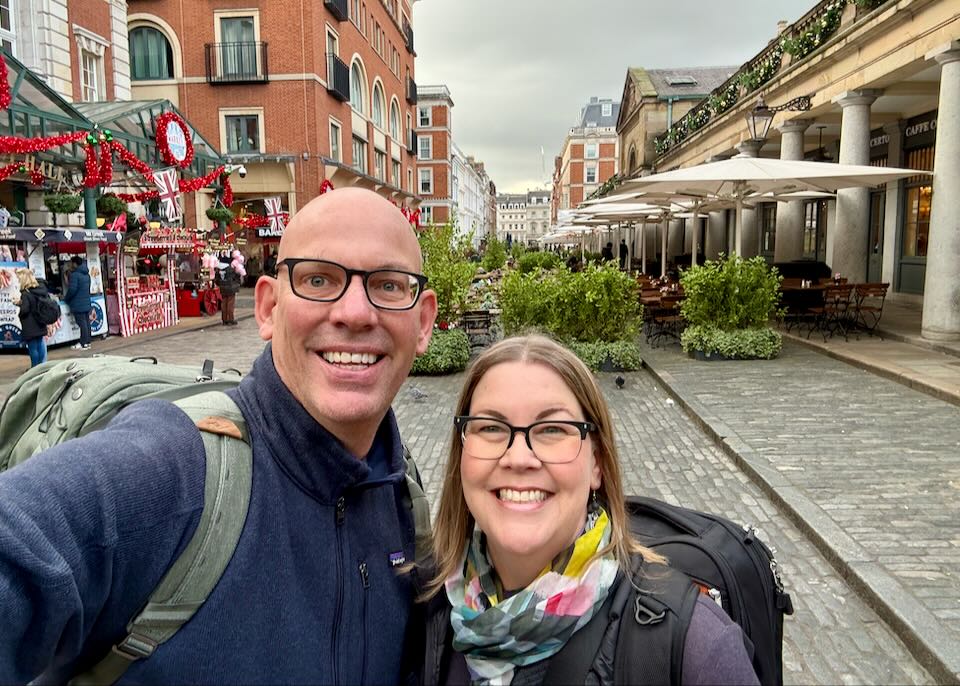
My wife and I in Covent Garden, London.
Where to Stay in London for First-Time Visitors
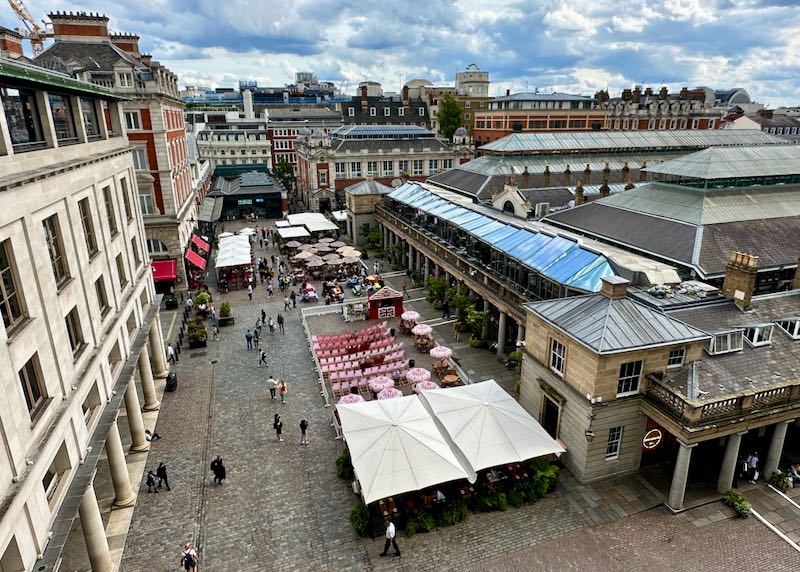
Covent Garden is my favorite area to stay in London for a first visit. It’s central, walkable, and close to West End theaters, Soho restaurants, Trafalgar Square, the National Gallery, and the Thames. You can see a lot of London without using the Tube.
Covent Garden is busy, touristy, and expensive, but the convenience is hard to beat. If your budget allows, this is where I would stay.
For a quieter central location, consider Bloomsbury. Soho is better for nightlife, South Bank for families and river walks, and South Kensington for museums. See my full guide to where to stay in London for more options.
My Favorite Hotels in Covent Garden
- Best Luxury: The Savoy
- Best Boutique: Covent Garden Hotel
- Best Modern Luxury: One Aldwych
- Best for Couples: NoMad London
- Best Midrange: Strand Palace
- Best Budget: The Z Hotel Covent Garden
Why Stay in Covent Garden?
Covent Garden puts you in the middle of the West End. Most theaters are within a 5 to 15-minute walk, Soho and Chinatown are close for dinner, and Trafalgar Square, the National Gallery, Somerset House, and the Thames are all nearby. The British Museum is about a 15-minute walk north.
The covered market and piazza are fun to explore, with shops, restaurants, and street performers. But the location is the real reason to stay here.
The main drawbacks are expensive hotels, small rooms, and crowds around the market, especially on weekends. Some restaurants near the piazza are overpriced and mediocre. For better food, walk toward Soho or explore the smaller streets around Covent Garden. Don’t worry about finding a hotel right beside the market. The Strand, Aldwych, and the streets toward Trafalgar Square are also excellent locations.
Best Hotels in Covent Garden for First-Time Visitors
- The Savoy: Best classic luxury. One of London’s great hotels, on the Strand near the Thames. Grand, expensive, and genuinely special. Excellent for couples and splurge trips, with Covent Garden, theaters, and river walks close by.
- Covent Garden Hotel: Best boutique luxury. Individually designed rooms, excellent service, and a warm, clubby atmosphere. One of my favorite London hotels for couples who want luxury without the formality of The Savoy.
- One Aldwych: Best modern luxury. Beautiful hotel at the eastern edge of Covent Garden, with an indoor pool and excellent service. A particularly good choice for families wanting luxury and a central location.
- NoMad London: Best for couples. Stylish hotel in the former Bow Street Magistrates’ Court, with dramatic interiors and excellent restaurants and bars. Fantastic location for Covent Garden and West End theaters.
- ME London: Best contemporary hotel. Sleek rooms and a popular rooftop bar on the Strand. Good for couples who want modern design, nightlife, and easy access to Covent Garden and the Thames.
- St. Martin’s Lane Hotel: Best for nightlife and theaters. Modern design hotel close to Leicester Square, Soho, Chinatown, and Trafalgar Square. Excellent location, though the surrounding streets can be busy late at night.
- The Henrietta Hotel: Best small boutique hotel. Stylish, intimate hotel close to Covent Garden Market. Rooms are not especially large, but the location is excellent for restaurants, shopping, and theaters.
- Strand Palace: Best midrange. Large, reliable hotel on the Strand. Rooms can be compact, but the location is outstanding for sightseeing and theaters. One of the better choices if you want to stay central without paying luxury prices.
- Fielding Hotel: Best simple hotel. Small, no-frills hotel near the Royal Opera House. Rooms vary in size and amenities, but the location is hard to beat. Good for travelers who spend most of their time sightseeing.
- Citadines Trafalgar Square: Best apartment-style stay. Studios and apartments with kitchen facilities, useful for families and longer visits. Near Trafalgar Square and Charing Cross, within easy walking distance of Covent Garden and the Thames.
- The Waldorf Hilton: Best traditional hotel. Large historic hotel on Aldwych, close to Covent Garden, Somerset House, and the West End. More traditional than the boutique hotels nearby, but a good choice when rates are competitive.
- The Z Hotel Covent Garden: Best budget location. Small, modern rooms in the heart of Covent Garden. Some rooms have no windows. Best for solo travelers or couples who travel light and care more about location than space.
Best Things to Do Near Covent Garden
- Covent Garden Market: Historic covered market with shops, restaurants, and street performers. Worth seeing, but you don’t need more than an hour or two.
- West End Theaters: One of the best reasons to stay here. Many major theaters are within a 5 to 15-minute walk.
- Royal Opera House: Major venue for opera and ballet, right in Covent Garden.
- London Transport Museum: Excellent museum, especially for families with younger children.
- Trafalgar Square & National Gallery: About a 10-minute walk. The National Gallery has free general admission and is one of London’s best museums.
- National Portrait Gallery: Excellent collection just off Trafalgar Square, with free general admission.
- Somerset House: Historic arts complex on the Strand with exhibitions, restaurants, and seasonal events.
- Soho & Chinatown: Great for restaurants, bars, and nightlife. An easy walk west of Covent Garden.
- British Museum: About a 15-minute walk north in Bloomsbury. Free general admission.
- Waterloo Bridge: One of my favorite places for views along the Thames, especially toward sunset.
My Top Tips for London First-Timers

Riding the Elizabeth Line.
1. Use Contactless Payment for Transport
For most visitors, contactless credit cards, debit cards, Apple Pay, or Google Pay are the easiest ways to pay for the Tube, buses, Elizabeth Line, London Overground, and DLR. You don’t need an Oyster card.
Each adult needs a separate card or device. Use the same payment method throughout your journeys so the fare caps work correctly. Your phone and physical card count as different payment methods, even if linked to the same bank account.
Tap in and out on the Tube, Elizabeth Line, Overground, and DLR. On buses, tap only when boarding. Children may qualify for free or discounted travel, so check the age rules before paying adult fares.
2. Walk Whenever It Makes Sense
The Tube map is not to scale. Some central London stations are so close that walking is faster than taking the train. Leicester Square to Covent Garden is the classic example.
Walking is also the best way to discover London’s pubs, shops, squares, and smaller streets. If you stay in Covent Garden, Soho, or Bloomsbury, many major attractions are within walking distance.
3. Group Sightseeing by Neighborhood
London is huge. Don’t waste time crossing the city repeatedly.
Spend one morning or afternoon around Westminster: Westminster Abbey, Big Ben, Churchill War Rooms, St. James’s Park, and Buckingham Palace.
Group the Tower of London, Tower Bridge, and St. Paul’s Cathedral into another day, with Borough Market nearby for lunch. Allow a separate morning or afternoon for the museums in South Kensington.
You don’t need to see everything. Two or three major attractions in a day is plenty.
4. Book Popular Attractions in Advance
Book the Tower of London, Westminster Abbey, London Eye, Warner Bros. Studio Tour London, and popular West End shows ahead of time, especially during summer and school holidays.
The Sky Garden is free, but standard free tickets need advance booking and are released about three weeks ahead. Popular times fill quickly.
5. Take Advantage of Free Museums
The British Museum, National Gallery, Tate Modern, V&A, Natural History Museum, and Science Museum all have free general admission. Some offer free timed-entry reservations, which are worth arranging during busy periods.
Special exhibitions cost extra. You can easily spend half a day in the British Museum or Natural History Museum, so don’t try to squeeze several large museums into one afternoon.
6. Know How Pubs and Tipping Work
In traditional pubs, order drinks at the bar. For food, you may need to find a table, note its number, and order at the bar. Some pubs offer table service.
Tipping is not expected when ordering drinks at the bar. Restaurants commonly add a discretionary service charge of 12.5% or more. If it’s already included, there’s no need to tip extra. If there’s no service charge, around 10% for good table service is reasonable.
7. Use Buses for Short Trips
The Tube is faster, but buses are better for seeing the city. Sit upstairs near the front when possible. They’re especially enjoyable for short journeys through central London.
Use a journey planner rather than choosing a bus just because it passes a famous sight. Central London traffic can be slow, and walking is often faster for short distances.
8. Don’t Rent a Car
You don’t need a car in London. Traffic is slow, parking is expensive, and driving involves congestion charges, emissions rules, and complicated streets.
Use public transport, walk, or take a taxi when needed. If you’re visiting the countryside afterward, rent a car when you leave London.
London First-Time Visitor FAQs

My wife and I outside Paddington Station.
How many days do you need in London?
Four or five full days is ideal for a first visit. Three days is enough for the major highlights, but you’ll need to be selective. With a week, you can explore more neighborhoods, visit museums without rushing, and take a day trip to Windsor, Oxford, or Hampton Court.
Is London expensive?
Hotels are the biggest expense, especially in Covent Garden, Soho, and Mayfair. But London has excellent free museums, parks, markets, and walking routes. Public transport is reasonably priced compared with taxis, and you can eat well without spending a fortune. I would spend more on a central hotel and save money elsewhere. A convenient location makes a bigger difference to a first London trip than an oversized room or expensive hotel amenities.
Do you need cash in London?
Rarely. Contactless payments are accepted almost everywhere, including public transport, restaurants, pubs, shops, and museums. I carry a small amount of cash as backup, but it’s easy to spend an entire visit without using any.
What is the best way to get around London?
Walk and use the Tube. For most sightseeing, the Tube is the fastest way to cover longer distances, while walking is quicker for short trips around the West End. Use the Elizabeth Line for Heathrow and journeys across central London, particularly east to west. Buses are slower but useful for short trips when you want to see the city above ground. You rarely need a taxi, but black cabs and Uber are convenient late at night or with luggage. Use contactless payment for public transport, with a separate card or device for each adult.
Is London safe for first-time visitors?
Yes. Central London is generally safe for tourists, including in the evening. The main things to watch for are pickpockets and phone theft, particularly around busy stations, shopping streets, and tourist attractions.
Where should you stay if arriving by train?
For Eurostar, King’s Cross and St. Pancras are convenient. Paddington is excellent for the Heathrow Express and Elizabeth Line. Victoria is useful for Gatwick Express and Southern trains. But don’t choose a station hotel automatically. If you’re staying four or five nights, I’d choose Covent Garden or another central sightseeing neighborhood and take the Tube or a taxi to the station when needed.

About Santorini Dave