London › Best Neighborhoods
Updated: June 14, 2026 • By Santorini Dave
My Favorite Hotels in London
- 5-Star: The Connaught • The Savoy
- 4-Star: Ham Yard Hotel
- Boutique: Batty Langley’s
- Budget: Motel One • Z Soho
- For Families: Park Plaza Westminster
- For Couples: The Soho
- Kings Cross: St. Pancras Renaissance
- Victoria Station: DoubleTree Victoria
- Paddington: Hilton
- Airports: Sofitel Heathrow • Sofitel Gatwick
London Maps – My Tips
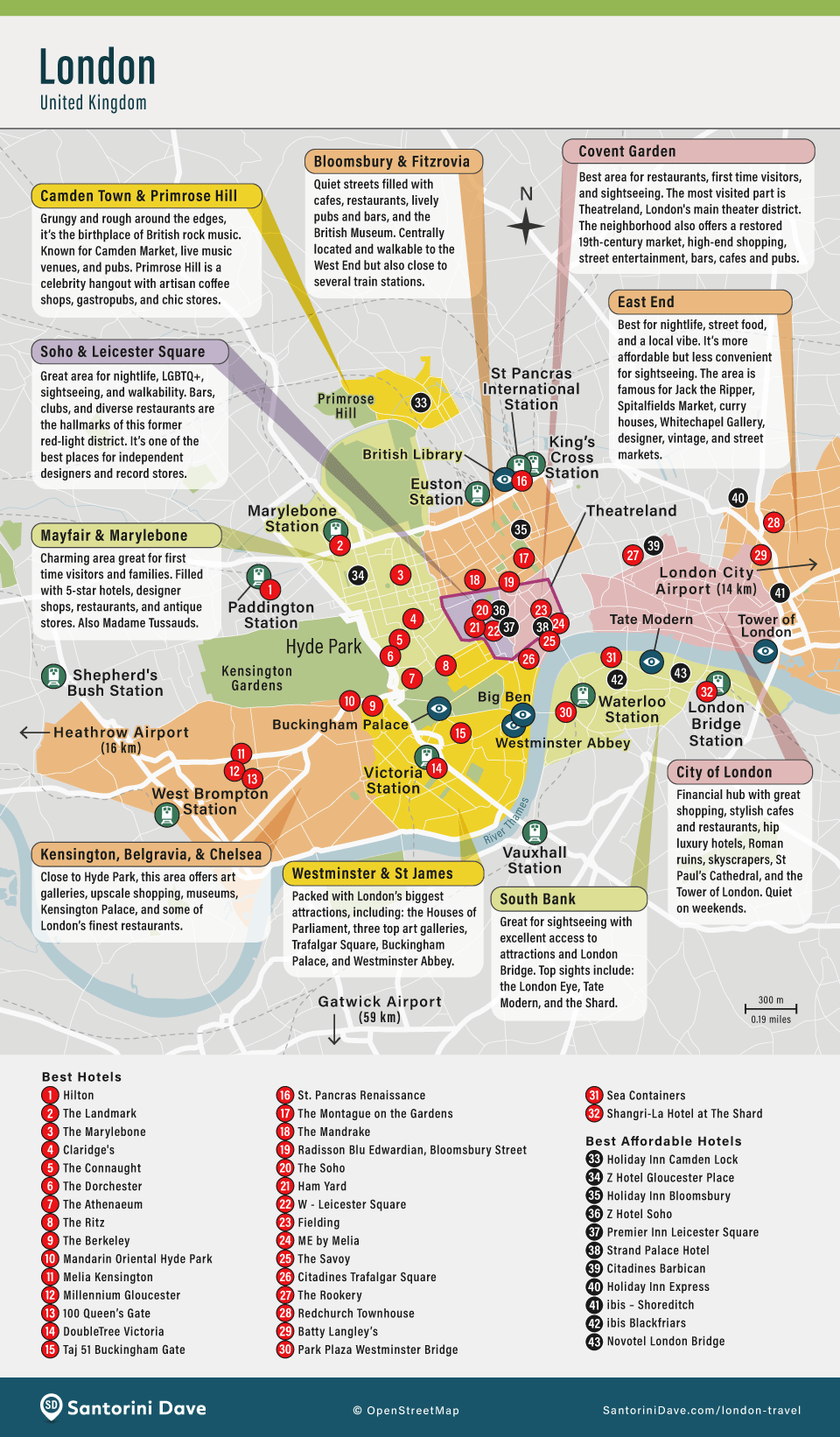
- This map highlights the best central neighborhoods in London. I’ve hand-picked the top luxury and affordable hotels in each area to help you decide where to base yourself.
- First-Timers: Stay in Covent Garden or Soho. You are in the middle of the theater district, dining, and major sights like Trafalgar Square.
- Luxury Stays: Look at Mayfair (near Hyde Park) or Westminster (near Buckingham Palace) for the most exclusive 5-star experiences.
- For Families: South Bank (near the London Eye) and Marylebone are safe, walkable, and central without being chaotic.
- On a Budget: The East End (Shoreditch) and Camden offer great value and a cool local vibe, though they are slightly further from the classic tourist sights.
- West End vs. The City: Be careful not to confuse them. The West End (Covent Garden, Soho, Mayfair) is the tourist and entertainment hub. The City (near St. Paul’s) is the financial district and can be very quiet and empty on weekends.
- Getting Around: The Tube (underground) is the fastest way to travel. You do not need an Oyster card; simply tap your contactless credit card or phone (Google Pay or Apple Pay) on the readers at the entrance and exit gates.
- Booking Hotels: London hotels fill up fast. Book 3 to 4 months in advance for the best rates and availability.
Map of London Neighborhoods

London Neighborhood Guide
1. Covent Garden & The Strand
Covent Garden is the easiest answer for most first-time visitors. You can walk to the West End theaters, Soho, Trafalgar Square, the National Gallery, the Thames, and half the restaurants you’ve bookmarked. It is busy, touristy, and expensive, but the convenience is hard to beat. I tell people to stay here if they want London to feel easy from the moment they arrive.
2. Soho & Leicester Square
Soho is best for restaurants, bars, theaters, Chinatown, and nightlife. It is central, fun, and very walkable, but it can be loud late into the night, especially around Leicester Square and Piccadilly Circus. Stay here if you want to be out in the evening and do not mind crowds. For a quieter stay with the same central location, look just north toward Fitzrovia or east toward Covent Garden.
3. Kensington, Belgravia & Chelsea
This is polished, residential west London, with elegant streets, excellent hotels, and easy access to the V&A, Natural History Museum, Science Museum, Hyde Park, Harrods, and the King’s Road. South Kensington is the most practical base, especially for families and museum-heavy trips. Belgravia and Chelsea are quieter and more upscale, but less convenient for quick Tube connections. Beautiful area, but not my first choice if you want late-night energy or easy walking access to the West End.
4. Westminster & St. James
Westminster is best for classic London sightseeing: Big Ben, Westminster Abbey, Buckingham Palace, Churchill War Rooms, St. James’s Park, and the Houses of Parliament. It is calm and stately at night, which some travelers love and others find a little dull. Stay here if you want major sights close by and a quieter hotel base. For restaurants and nightlife, you will usually head to Covent Garden, Soho, or Mayfair.
5. Mayfair & Marylebone
Mayfair is London’s classic luxury hotel district, with designer shopping, private clubs, polished restaurants, and some of the city’s most expensive rooms. Marylebone is more interesting and more livable, with a proper high street, good restaurants, independent shops, and easy access to Regent’s Park, Oxford Street, and Baker Street. If budget allows, Mayfair is elegant and central. If you want charm without feeling trapped in a luxury bubble, I prefer Marylebone.
6. Camden Town & Primrose Hill
Camden is lively, messy, fun, and rough around the edges, with markets, pubs, live music history, canal walks, and a younger crowd. It is not the prettiest base and can feel hectic around the market, but it has character. Primrose Hill, just to the west, is much calmer and prettier, with village streets, cafés, and one of the best skyline views in London. Stay here if you have been to London before or want a less polished, more local-feeling base.
7. The East End, Shoreditch & Spitalfields
Shoreditch and Spitalfields are best for street food, markets, bars, street art, design hotels, and a more contemporary London feel. You are close to Brick Lane, Spitalfields Market, Columbia Road Flower Market, and some excellent restaurants. The tradeoff is that you are not as close to the classic sights, and parts of Shoreditch can feel scruffy or loud at night. It works well for younger travelers, repeat visitors, and anyone more interested in food and nightlife than royal London.
8. South Bank
South Bank is one of London’s best areas for sightseeing on foot. The riverside walk connects the London Eye, National Theatre, Tate Modern, Shakespeare’s Globe, Borough Market, and London Bridge, with great views across to Westminster and St. Paul’s. It is especially good for families because walking along the river is easy and entertaining. The downside is that some hotels feel a little businesslike, and the area can be busy during school holidays and sunny weekends.
Best Hotels on the Map
Best Luxury Hotels (Red Markers)
- Hilton (Paddington)
- The Landmark (Marylebone)
- The Marylebone (Marylebone)
- Claridge’s (Mayfair)
- The Connaught (Mayfair)
- The Dorchester (Mayfair)
- The Athenaeum (Mayfair)
- The Ritz (St. James)
- The Berkeley (Knightsbridge)
- Mandarin Oriental Hyde Park (Knightsbridge)
- Melia Kensington (Kensington)
- Millennium Gloucester (Kensington)
- 100 Queen’s Gate (Kensington)
- DoubleTree Victoria (Victoria Station)
- Taj 51 Buckingham Gate (Westminster)
- St. Pancras Renaissance (King’s Cross)
- The Montague on the Gardens (Bloomsbury)
- The Mandrake (Fitzrovia)
- Radisson Blu Edwardian, Bloomsbury Street (Bloomsbury)
- The Soho (Soho)
- Ham Yard (Soho)
- W – Leicester Square (Leicester Square)
- Fielding (Covent Garden)
- ME by Melia (The Strand)
- The Savoy (The Strand)
- Citadines Trafalgar Square (The Strand)
- The Rookery (Clerkenwell)
- Redchurch Townhouse (Shoreditch)
- Batty Langley’s (Shoreditch)
- Park Plaza Westminster Bridge (South Bank)
- Sea Containers (South Bank)
- Shangri-La Hotel at The Shard (London Bridge)
Best Affordable Hotels (Black Markers)
- Holiday Inn Camden Lock (Camden)
- Z Hotel Gloucester Place (Marylebone)
- Holiday Inn Bloomsbury (Bloomsbury)
- Z Hotel Soho (Soho)
- Premier Inn Leicester Square (Leicester Square)
- Strand Palace Hotel (The Strand)
- Citadines Barbican (The City)
- Holiday Inn Express (East End)
- ibis – Shoreditch (Shoreditch)
- ibis Blackfriars (South Bank)
- Novotel London Bridge (South Bank)
Best Hotels by Neighborhood
• Best Hotel in Kensington: Mandarin Oriental
• Best Hotel in Westminster: Taj 51
• Best Hotel in St James: The Ritz
• Best Hotel in South Bank: Shangri-La at the Shard
• Best Hotel in The City: Four Seasons at Ten Trinity Square
• Best Hotel in Mayfair: The Connaught
• Best Hotel in Marylebone: The Marylebone
• Best Hotel in Soho: Ham Yard
• Best Hotel in Bloomsbury: Montague on the Gardens
• Best Hotel in Covent Garden: The Savoy
• Best Hotel in the East End: Batty Langley’s

My wife and I at a pub in East London.
What is the best area to stay for tourists?
For most first-time visitors to London, Covent Garden is the easiest and best answer. You can walk to Soho, the West End theaters, Trafalgar Square, the National Gallery, Leicester Square, the Thames, and lots of restaurants. Soho is better if you want nightlife and late dinners. South Bank is better for families and river walks. Marylebone is better if you want something central but calmer. I would not overthink it: for a first trip, stay as central as your budget allows.
Where should I stay in London on a budget?
The best-value central-ish areas are usually Bloomsbury, King’s Cross, Paddington, Victoria, Southwark, and parts of Shoreditch. Camden can be good value too, but I would choose it more for the vibe than the convenience. Be careful with cheap hotels that describe themselves as “London” but are far from the center. A room in Zone 3 or 4 can look like a bargain, then cost you 45 minutes each way and make the trip feel harder than it should.
Is it better to stay in West London or East London?
For a first visit, West London and the West End are usually better. They put you closer to the classic sights, museums, parks, shopping, and theaters. East London, especially Shoreditch and Spitalfields, is better for restaurants, bars, markets, street art, and a more modern London feel. I like the East End, but I usually recommend it for repeat visitors, younger travelers, or anyone who cares more about food and nightlife than Buckingham Palace and Westminster Abbey.
How many days should I spend in London?
For a first trip, 4 or 5 full days is the sweet spot. That gives you time for Westminster Abbey, the Tower of London, a museum or two, a West End show, a walk along the Thames, and a few unplanned meals and neighborhoods. With only 2 or 3 days, stay very central and do not waste time chasing too many sights. With a week, add Greenwich, Hampstead, Richmond, or a day trip to Windsor, Oxford, Cambridge, Bath, or Hampton Court.
What is the best way to get around London?
Use the Tube, Elizabeth Line, buses, and your feet. You do not need a paper ticket, and most visitors do not need an Oyster card. Tap in and out with the same contactless credit card, debit card, Apple Pay, or Google Pay. Buses are slower but great for short hops and sightseeing from the top deck. Black cabs are useful late at night or with luggage, but they are expensive. Uber and Bolt work, though traffic can make short trips surprisingly slow.
Do I need an Oyster card in London?
Usually, no. Contactless payment is the easiest way to use London transport, and daily capping means you will not keep paying endlessly once you hit the day’s cap. The important rule is to use the same card or phone for every journey. Do not tap in with your phone and tap out with the physical card, even if they are linked to the same account. Oyster can still make sense for some children, railcard discounts, or travelers without a reliable contactless card, but most visitors can skip it.
Where is the actual center of London?
Technically, Charing Cross, just off Trafalgar Square, is the point from which distances to London are measured. For visitors, the useful center is the West End, especially Covent Garden, Soho, Leicester Square, Mayfair, and the area around Trafalgar Square. If your hotel is within a 20-minute walk of Covent Garden, you are in a very convenient location.
What is the difference between the West End, Theatreland, and Central London?
The West End is London’s main visitor zone for theaters, restaurants, shopping, nightlife, and many major sights. It includes areas like Covent Garden, Soho, Leicester Square, Mayfair, Marylebone, and parts of Fitzrovia. Theatreland is the smaller theater district around Shaftesbury Avenue, Leicester Square, and Covent Garden. Central London is broader and less precise. A hotel can say “Central London” and still be less convenient than it sounds, so always check the exact neighborhood and nearest Tube station.
What is the difference between “The City” and Central London?
The City, also called the Square Mile, is London’s historic financial district around St. Paul’s Cathedral, Bank, Monument, and Liverpool Street. It is excellent for business travel, St. Paul’s, the Tower of London, Borough Market, and East End access. But it can be quiet on weekends and evenings compared with the West End. For a first-time leisure trip, I would usually choose Covent Garden, Soho, South Bank, Marylebone, or Westminster over The City.
Is it safe to stay south of the River Thames?
Yes, as long as you are choosing the right area. South Bank, Bankside, Borough, and the area around London Bridge are popular, central, and very good for visitors. South Bank is especially easy for families because the riverside walk is wide, scenic, and mostly pedestrian-friendly. Do not dismiss a hotel just because it is south of the river. Some of London’s best sightseeing locations are there.
Which London neighborhood is best for families?
South Bank and Marylebone are my top picks. South Bank is great with kids because you have the London Eye, river walks, playgrounds, the National Theatre, Tate Modern, Borough Market, and easy walks across the bridges. Marylebone is calmer, with Regent’s Park, London Zoo, good restaurants, and a village feel. South Kensington is also excellent for families focused on the Natural History Museum, Science Museum, V&A, and Hyde Park.
Where should couples stay in London?
For a polished romantic stay, choose Mayfair or Marylebone. Mayfair has the grand hotels, famous restaurants, and luxury shopping. Marylebone feels more charming and less showy, with mews streets, boutiques, cafés, and easy walks to Regent’s Park. For something more scenic and modern, South Bank works well, especially if you want evening walks along the Thames. For nightlife and restaurants, stay in or near Soho, but choose your hotel carefully to avoid late-night noise.
Where is the best area for solo travelers?
Covent Garden, South Kensington, Marylebone, and South Bank are all excellent for solo travelers. They are central, busy, well-connected, and easy to navigate at night. Soho is great if you want nightlife, but some streets are loud and crowded late. Shoreditch is good for a more social, younger feel, but I would stay near Liverpool Street, Shoreditch High Street, or Old Street for better transport.
Where is the best area for LGBTQ+ travelers?
Soho is the historic and most convenient base for LGBTQ+ travelers, especially around Old Compton Street. It puts you close to gay bars, clubs, restaurants, theaters, Chinatown, and the West End. Vauxhall and Dalston have important nightlife scenes too, but they are less convenient for first-time sightseeing. For most visitors, stay in Soho or nearby Covent Garden and travel out for specific nights if you want to explore beyond the center.
Where should food lovers stay in London?
For food, I like Soho, Marylebone, Shoreditch, Clerkenwell, and Borough. Soho has the best concentration of restaurants in the center. Borough is ideal for Borough Market, Bermondsey Street, and London Bridge. Shoreditch and Spitalfields are great for markets, casual dining, and bars. Clerkenwell is underrated and excellent for serious restaurants, though it is quieter at night than Soho.
Which London neighborhood is best for shopping?
Mayfair is best for luxury shopping, especially Bond Street and Mount Street. Marylebone is better for boutiques, bookstores, cafés, and a more relaxed high street. Soho and Covent Garden are best if you want to be near Oxford Street, Regent Street, Carnaby Street, Seven Dials, and the Covent Garden shops. Oxford Street is famous, but it is also crowded and not especially pleasant. I prefer Regent Street, Marylebone High Street, and the smaller streets around Covent Garden.
Where should I stay for museums?
Stay in South Kensington for the Natural History Museum, Science Museum, and V&A. This is the best museum base for families. Stay in Bloomsbury for the British Museum, bookstores, garden squares, and easy access to Covent Garden. Stay near South Bank or Bankside for Tate Modern, Shakespeare’s Globe, and the riverside walk. London’s museums are spread out, so do not choose your hotel based on one museum unless it is a major focus of the trip.
Where should I stay for West End shows?
Stay in Covent Garden, Soho, Leicester Square, or Bloomsbury. After an evening show, being able to walk back to your hotel is a real advantage. Leicester Square is the most central but can be noisy and touristy. Covent Garden gives you the best mix of theater access, restaurants, and charm. Bloomsbury is usually better value and still walkable to many theaters.
Where should I stay for the easiest airport transfer?
For Heathrow, stay near Paddington for the Heathrow Express, or near an Elizabeth Line station such as Bond Street, Tottenham Court Road, Farringdon, or Liverpool Street. For Gatwick, Victoria is easiest for the Gatwick Express and Southern trains, while London Bridge, Blackfriars, Farringdon, and King’s Cross work well for Thameslink. For Eurostar, stay near King’s Cross St Pancras or Bloomsbury. Do not choose an airport-transfer area if it makes the rest of your sightseeing inconvenient.
Should I stay near a Tube station?
Yes. This is one of the simplest ways to avoid a bad London hotel choice. I want my hotel within a 5-minute walk of a Tube or Elizabeth Line station. Even better is a station served by multiple lines, such as Tottenham Court Road, Green Park, Bond Street, South Kensington, Liverpool Street, Westminster, or King’s Cross St Pancras. A hotel that is “only 15 minutes from the Tube” can get old very quickly after a full day of sightseeing.
What areas of London should first-time visitors avoid staying in?
I would not stay near an airport unless you have a very early flight or a late arrival. I would also be cautious with cheap hotels far out on the Tube, especially if the nearest station is not close. Areas like Wembley, Stratford, Canary Wharf, Hammersmith, and Greenwich can work for specific reasons, but they are not ideal default bases for a first London trip. They often save money on the room but cost you time every day.
When should I book London hotels?
For spring, summer, Christmas season, school holidays, and weekends with big events, book 3 to 6 months ahead if you care about location and value. For luxury hotels, family rooms, and apartments, earlier is better. London has a huge hotel supply, so you can usually find something late, but the best-located good-value rooms disappear first. If you are traveling during Wimbledon, major concerts, bank holidays, or New Year’s, do not wait.
Where to Stay for Easy Airport & Train Access

Farringdon Station has direct trains to both Heathrow (Elizabeth Line) and Gatwick (Thameslink), making it an ideal place to stay if you’re flying in and out of different airports.
- Heathrow Airport: Stay near Paddington Station for the easiest Heathrow transfer. The Heathrow Express is the fastest option, taking about 15 minutes to Terminals 2 and 3, with a few extra minutes for Terminal 5. The Elizabeth Line is usually the better value and is more useful for many visitors, with direct trains from Heathrow to Paddington, Bond Street, Tottenham Court Road, Farringdon, Liverpool Street, and Canary Wharf. The Piccadilly Line is slower but cheaper and works well if you are staying around South Kensington, Knightsbridge, Piccadilly Circus, or Covent Garden. Paddington is practical rather than charming, but it works very well for early flights, late arrivals, and families with luggage.
- Gatwick Airport: Stay near Victoria Station if you want the simplest Gatwick transfer. The Gatwick Express and Southern trains run between Gatwick and Victoria in about 30 to 35 minutes, and Victoria is also convenient for Buckingham Palace, Westminster, and easy bus and Tube connections. That said, do not book Victoria automatically. If your hotel is near London Bridge, Blackfriars, Farringdon, or King’s Cross St Pancras, Thameslink can be just as easy or easier than Victoria.
- Eurostar to Paris, Brussels, or Amsterdam: Stay near St Pancras International if you have an early Eurostar departure or late arrival. This is London’s international rail terminal, and the adjoining King’s Cross area is far better than it used to be, with excellent restaurants, cafés, shops, and canalside walks around Coal Drops Yard and Granary Square. For sightseeing, I prefer Bloomsbury, Covent Garden, or South Bank, but for Eurostar logistics this area is hard to beat.

About Santorini Dave