Greece › Ferries › Santorini to Milos Ferry
Updated: July 24, 2026 • By Santorini Dave
Questions? dave@santorinidave.com
See Also
Ferries travel from Santorini to Milos throughout the year, with up to 3 departures a day in summer and much less frequent service in winter. The fastest high-speed ferries take about 2 hours, while slower conventional ferries take up to 5 hours and cost much less. I prefer the conventional ferry when its schedule is convenient. It is larger, steadier, cheaper, and has outdoor deck space. Take the high-speed ferry when saving several hours matters more than price or comfort.
Helpful Links
- How I buy ferry tickets: Ferryhopper.com
- Pre-booked Santorini transfer: Welcome Pickups
Santorini to Milos Ferry: Quick Guide
- Frequency: Up to 3 ferries a day in summer. Winter service drops to roughly 1 or 2 sailings a week.
- Travel time: About 2 hours on the fastest high-speed ferry and as long as 5 hours on a conventional ferry.
- Best ferry for most travelers: The conventional ferry when its schedule works. It is cheaper, steadier, and more comfortable.
- Best ferry for saving time: SeaJets operates the fastest sailings on many summer dates.
- Departure port: All ferries leave from Athinios Port. Do not go to the Old Port below Fira.
- Arrival port: Ferries arrive at Adamas, Milos’s main port town.
- When to book: Book as soon as your dates are fixed for July and August, especially when traveling with a vehicle.
- Port transfer: Pre-book a taxi or transfer in summer. Santorini has few taxis, and traffic on the road to Athinios can be severe.
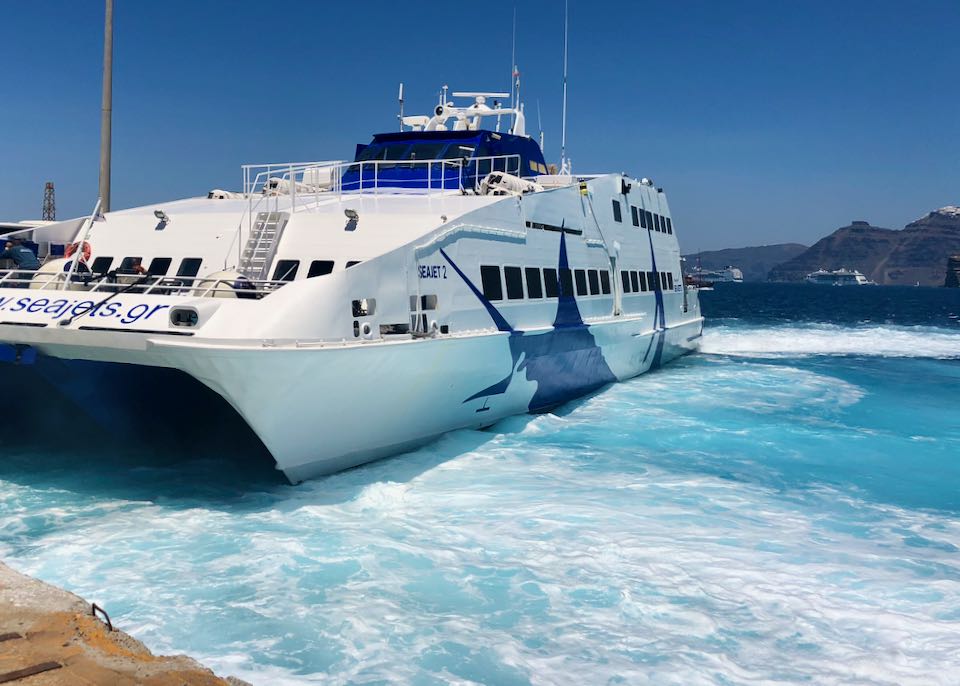
SeaJets operates the fastest Santorini-to-Milos sailings on many summer dates. The high-speed ferries save several hours but cost considerably more than conventional ferries.
Santorini to Milos Ferry Times and Frequency
In summer, there are 2 to 3 departures a day. Winter service drops to roughly 1 or 2 sailings a week, making advance planning important outside the tourist season. Departure times change by date and are commonly scheduled in the morning or afternoon.
- Fastest crossing: About 2 hours.
- Conventional ferry: Up to about 5 hours, depending on the vessel and intermediate stops.
- Summer: Up to 2 ferries a day.
- Winter: Roughly 1 or 2 ferries a week.
Some ferries travel directly to Milos, while others stop at Folegandros, Sikinos, or additional islands. Compare the complete route rather than choosing solely by departure time.
Which Ferry Should You Take?
Conventional Ferry: Best for Comfort and Value
Choose the conventional ferry when its timetable fits your plans. It is larger, steadier, and much cheaper than the fastest high-speed ferry. It also has outdoor decks, more room to move around, and easier access to sea views. The drawback is the journey time. A conventional sailing can take close to 5 hours, especially when it stops at other islands before reaching Milos. This is my preferred choice for families, travelers prone to seasickness, and anyone who enjoys the ferry journey rather than treating it solely as transportation.
High-Speed Ferry: Best for Saving Time
The fastest high-speed ferries reach Milos in about 2 hours. Choose one when it saves a useful portion of the day or provides a much better departure time. The tradeoffs are the higher fare, enclosed seating, less freedom to move around, and a rougher ride in strong winds. High-speed ferries are also more susceptible to weather-related schedule changes than large conventional ships.
How Much Do Santorini to Milos Ferry Tickets Cost?
Conventional-ferry fares start around €35, while the fastest high-speed ferries cost roughly €110 or more. Prices vary by sailing, operator, vessel, and seat category.
- Conventional ferry: The best value and the cheapest way to travel between the islands.
- High-speed ferry: Costs considerably more but saves up to several hours.
- VIP and Business Class seating: Costs more than the standard passenger fare but has more space and a more relaxed atmosphere.
- Vehicles: Vehicle space is limited and requires a separate ticket.
- Children: Discounts depend on the ferry company and the child’s age. Enter each passenger’s correct age when booking.
Book based on the total journey and schedule, not simply the lowest fare. A cheap ferry that arrives late at night or takes 3 hours longer might not be the best choice for your itinerary.
Buying Tickets, E-Tickets, and When to Book
I use Ferryhopper to compare schedules, journey times, stops, vessels, and prices.
- July and August: Book as soon as your dates are fixed, especially when you need vehicle space or want a specific high-speed departure.
- May, June, September, and October: Several weeks ahead is normally enough, but book earlier when only one sailing fits your plans.
- Winter: Seats rarely sell out, but the sparse schedule makes advance planning essential.
- Mobile tickets: Mobile boarding passes are available on the main ferries serving this route.
- Online check-in: Follow the instructions in your confirmation email. Some companies issue the boarding pass immediately, while others require online check-in shortly before departure.
- Identification: Bring the passport or identification used when booking.
Download the boarding pass or save a screenshot before leaving your hotel. Mobile reception can be unreliable at the crowded port.
Example Santorini to Milos Ferry Schedule
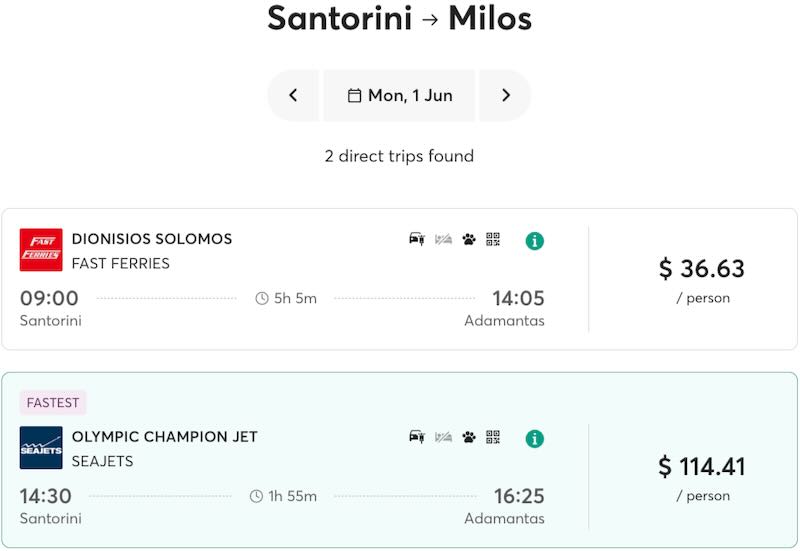
Example Santorini-to-Milos ferry schedule and prices on Ferryhopper.com. Use this only as an example because departures, vessels, and fares vary by date.
Getting to Athinios Ferry Port
All passenger ferries leave from Athinios Port at the bottom of the caldera cliffs. Do not go to the Old Port below Fira, which serves cruise passengers and excursion boats. Athinios is reached by a steep switchback road. Traffic becomes severely congested when several ferries arrive or depart close together, particularly from June through September.
By Bus
Port buses leave from the main bus station in Fira in coordination with ferry departures. Check the current schedule shortly before travel because bus times change with the ferry timetable. The bus is cheap and works well for solo travelers with manageable luggage. The drawbacks are crowding and the need to reach Fira first. Travelers staying in Oia, Imerovigli, Kamari, or Perissa must take a bus or taxi to Fira before transferring to the port bus.
By Taxi or Private Transfer
A pre-booked taxi or private transfer is the easiest option from most Santorini hotels. It removes the uncertainty of finding one of Santorini’s limited taxis, though no driver can bypass congestion on the single road down to Athinios.
Ask your hotel or transfer company to recommend a pickup time based on:
- your hotel location;
- the ferry departure time;
- summer traffic;
- the number of ferries scheduled around the same time;
- and whether you are traveling with children or substantial luggage.
From Oia or Imerovigli, leaving 2 to 2½ hours before a summer ferry is not excessive when the port is busy. Uber on Santorini dispatches licensed taxis or transfer vehicles when available, but supply is limited. Do not rely on requesting one shortly before departure.
By Rental Car
Rental cars can be dropped at Athinios when arranged in advance with the rental company. Confirm the meeting place and return procedure because parking and stopping space near the ferry ramps is limited. When taking a vehicle onto the ferry, follow the operator’s check-in instructions and arrive earlier than foot passengers.
When to Arrive
Aim to reach Athinios 45 to 60 minutes before departure. The port is small, crowded, exposed to sun and wind, and uncomfortable when several ships are loading at once. The important step is leaving your hotel early enough to account for traffic. Arriving at Athinios several hours early provides little benefit.
What Athinios Port Is Like
Athinios has ticket offices, cafés, small shops, toilets, and limited indoor waiting space. It becomes chaotic when passengers from an arriving ferry mix with those waiting to depart. Keep children close, watch the port signs, and listen for boarding announcements. Ferries load quickly, and the ramps are shared by passengers, luggage, cars, buses, and trucks. Do not stand directly beside the water waiting for the ship when strong wind or vehicle traffic makes the area uncomfortable. Remain near the cafés or designated waiting areas until boarding begins.
Arriving at Adamas Port in Milos
Ferries arrive in Adamas, Milos’s main port town and one of the easiest ferry arrivals in the Cyclades. Hotels, restaurants, cafés, rental offices, buses, and taxis are close to the dock.
Walking to an Adamas Hotel
Many Adamas hotels are within a 5 to 15-minute walk of the ferry. The waterfront is flat, but hotels on the hills behind town require a longer uphill walk. Check the exact route before assuming a hotel is convenient with luggage. A short distance on the map can include a steep road or stairs.
Buses
The main bus stop is beside the port, with summer service to Plaka, Pollonia, Sarakiniko, and other popular areas. Check the current timetable before arrival. Evening and shoulder-season buses are less frequent, and the schedule does not necessarily coordinate with every ferry.
Taxis and Hotel Transfers
There is a taxi stand near the ferry dock, but Milos has a limited number of taxis. Lines form quickly when a busy ferry arrives.
Ask your hotel to arrange a pickup when:
- staying outside Adamas;
- arriving in the evening;
- traveling with young children or substantial luggage;
- or staying at a remote hotel or villa.
A pre-booked transfer is especially useful for Pollonia and hotels away from the main bus routes.
Rental Cars
A rental car is useful for exploring Milos’s dispersed beaches, villages, and western coastline. Reserve well ahead for July and August and arrange pickup at or near the port. Do not expect to arrive in peak summer and find a suitable vehicle without a reservation. A car is unnecessary for a short stay based entirely in Adamas, but most visitors will see far more of Milos with one.
Luggage, Food, and Seasickness
Luggage
Large bags are stored in luggage racks near the ferry entrance. Keep passports, medication, electronics, money, and valuables with you. Luggage allowances are generous, and normal holiday suitcases are not weighed. Label each bag because luggage areas become crowded when the ferry serves several islands.
Food and Drink
Ferries have cafés or snack bars, and larger conventional ships offer the widest selection. You can also bring your own food and water. Do not expect elaborate meals on every high-speed ferry. Eat before boarding when traveling around lunch or dinner time.
Seasickness
Choose a conventional ferry when prone to seasickness. Larger vessels provide a steadier ride than high-speed catamarans, especially during strong summer winds.
On a high-speed ferry:
- sit near the middle of the vessel;
- look toward the horizon rather than at a phone or book;
- avoid a heavy meal immediately before departure;
- and take motion-sickness medication in advance according to the package instructions or your doctor’s advice.
Delays, Wind, and Ferry Strikes
Ferries reaching Santorini after earlier island stops are more prone to delay, particularly later in the day. A ferry can be on time, 20 minutes late, or delayed much longer. Do not schedule a tightly timed hotel transfer, boat tour, dinner reservation, or flight immediately after the expected arrival in Milos. Use the MarineTrafficSantorini to Milos Ferry Route
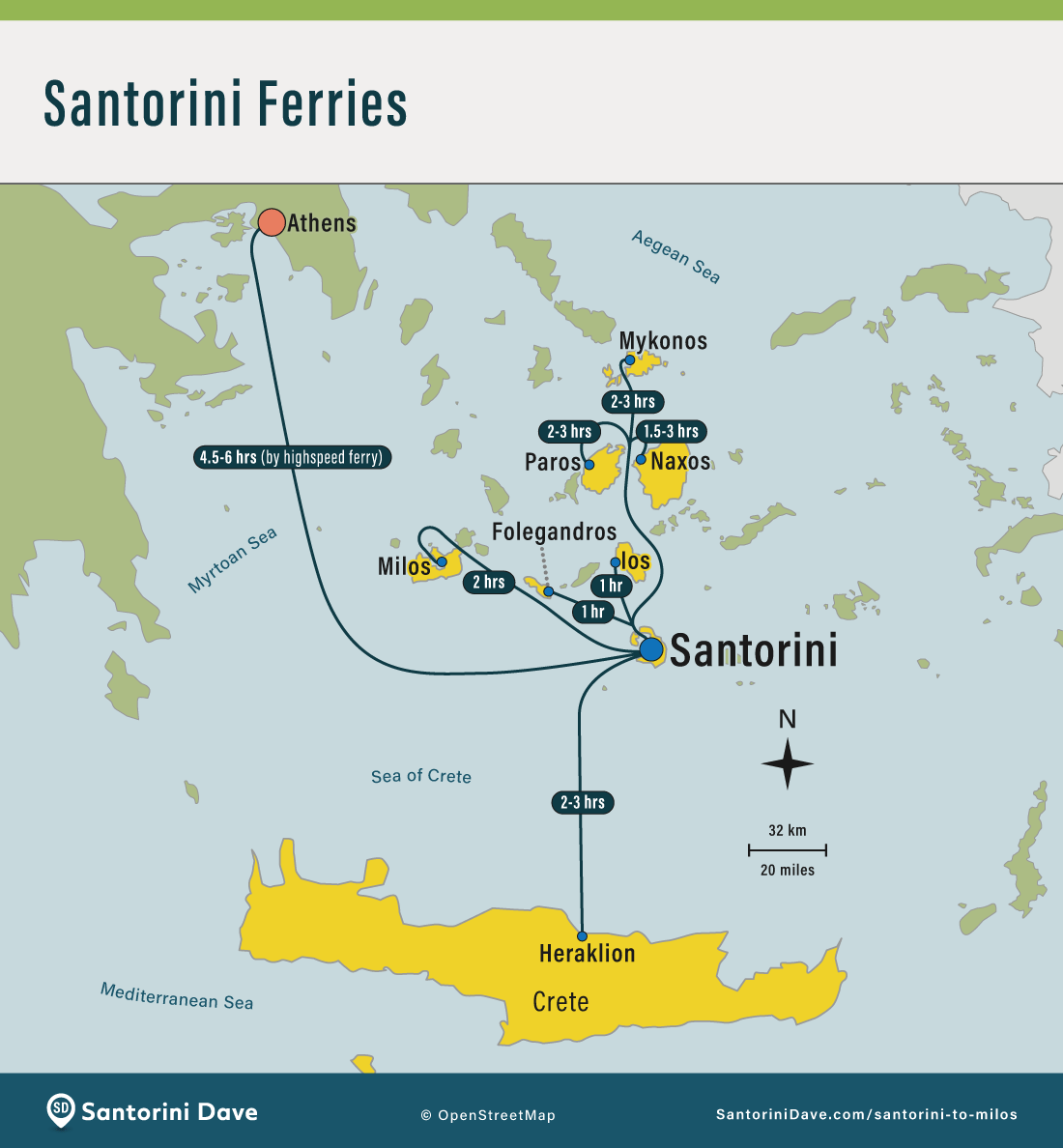
Fast ferries travel more directly, while conventional sailings can stop at Folegandros, Sikinos, or other islands before reaching Milos. Check the complete route because two ferries leaving at similar times can have very different journey lengths.

About Santorini Dave