Greece › Greek Ferry Guide
Updated: August 30, 2026 • By Santorini Dave
Questions? dave@santorinidave.com
Popular Routes
- Athens to Santorini Ferry
- Athens to Naxos Ferry
- Athens to Paros Ferry
- Athens to Mykonos Ferry
- Rafina to Mykonos Ferry
- Mykonos to Santorini Ferry
- Crete to Santorini Ferry
Ferry Ports
Helpful Links
- How I buy ferry tickets: FerryHopper.com
- Pre-booked taxi service: Welcome Pickups
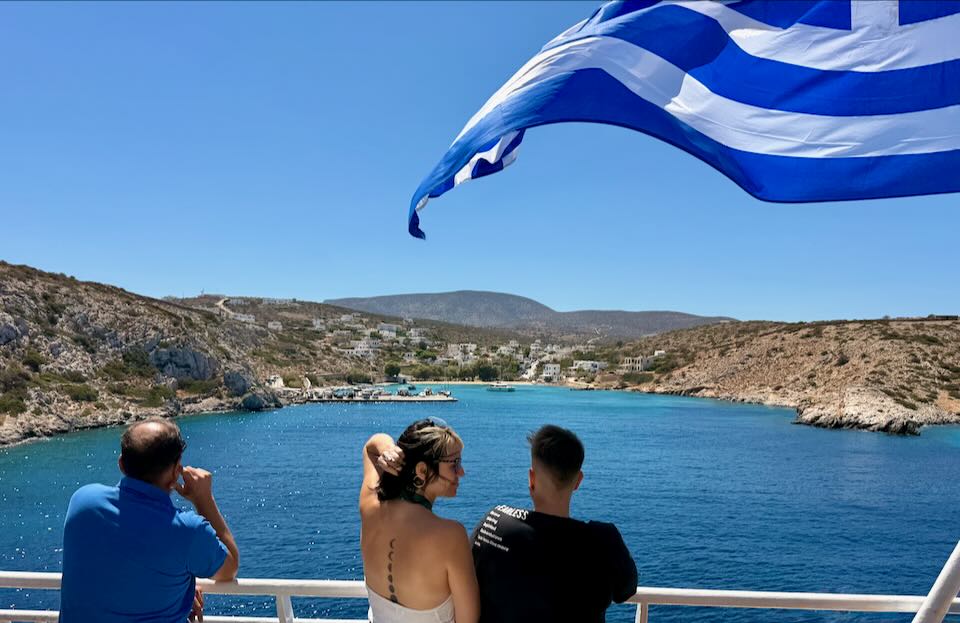
One of the great pleasures of traveling in Greece: standing on a ferry deck as a new island comes into view.
If You Only Read 6 Things
- Take the ferry for nearby islands and fly when the ferry trip is long or awkward: Ferries are the best way to travel between most neighboring Greek islands. For routes such as Athens to Rhodes or Kos, flying is much faster.
- My default choice is a Blue Star ferry with an Air Seat: Blue Star conventional ferries are slower, cheaper, and much more stable in rough seas, with open decks where you can walk around. SeaJets high-speed ferries are faster and more expensive, with no outdoor deck access while underway. I prefer Blue Star when the schedule works.
- Book online, but save your ticket before you get to the port: I use FerryHopper for my ferry tickets. Check in online and save the QR code to your phone or take a screenshot. Cell service at busy ports can be poor.
- Never make a tight ferry-to-flight connection: Ferries can be delayed or canceled by wind, strikes, and other disruptions. If you have an important international flight from Athens, I recommend returning to Athens the day before and spending the final night there.
- Arrive early and check your gate: Get to the port about 45 minutes before departure if you are walking on, and earlier if you have a vehicle. Piraeus is huge, and getting to the correct gate can take longer than expected.
- Leave large luggage downstairs but keep valuables with you: Large bags are normally left on racks near the vehicle deck or entrance. Bring your passport, phone, wallet, medication, chargers, and anything valuable upstairs in a small bag.
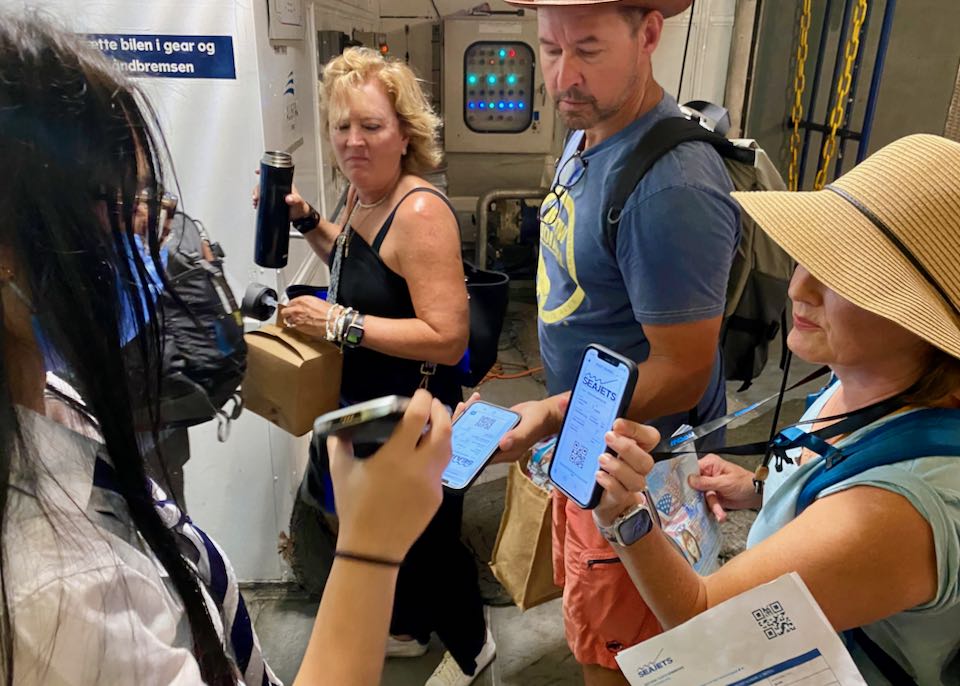
Greek ferries use e-tickets. When you book through FerryHopper, check in online and save the QR code to your phone before you get to the port.
Greek island hopping by ferry is easy once you understand the basic routes. Ferries connect Athens with the major islands and link neighboring islands particularly well during spring, summer, and early fall.
Ferry or Flight?
For most island hopping, take the ferry. Direct flights between Greek islands are uncommon, and flying often means connecting through Athens.
- Athens to Paros, Naxos, or Mykonos: I normally take the ferry, especially when starting from central Athens. Piraeus is easy to reach by Metro or taxi.
- Athens to Rhodes or Kos: I would fly unless you specifically want a long or overnight ferry trip.
- Athens to Santorini: Both work. Fly if time is tight. Take the ferry if you have the time and want to arrive by sea.
- Athens to Crete: Fly for speed or take an overnight ferry and book a cabin. Both are good options.
- Island to island: Ferries are almost always the better option when a direct route exists. Santorini, Naxos, Paros, Mykonos, Milos, and other Cycladic islands have great connections in summer.
- Winter: Ferry routes are much more limited. Major routes continue year-round, but many island-to-island services disappear or run only a few times each week.
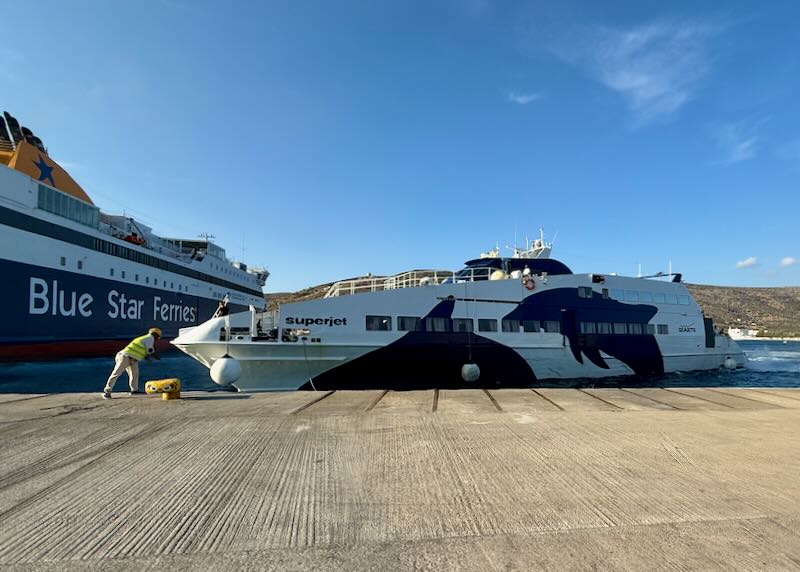
The size difference is obvious: SuperJet on the right, Blue Star on the left. Bigger conventional ferries are slower but much more stable in rough seas.
Blue Star vs SeaJets
For a three- to six-hour crossing in the Cyclades, I prefer a large conventional ferry when the schedule works.
- Blue Star: Large conventional ferries with indoor lounges and open decks. They are slower but much more stable in rough seas and are normally cheaper than high-speed ferries. My first choice for anyone prone to seasickness, families with young children, or travelers who enjoy being outside during the trip.
- SeaJets: Faster high-speed ferries that are useful when they save several hours or provide the best connection between islands. Seating is indoors and outdoor deck access is not available while underway. Smaller vessels can have a rough ride when the Meltemi is blowing.
I do not avoid SeaJets. I use them all the time. But if Blue Star and SeaJets leave at similar times and the extra travel time is reasonable, I usually take Blue Star.
Common Ferry Mistakes
- Booking too many islands: You lose half a day to travel and hotel check-ins every time you move.
- Assuming every island connects directly: Nearby islands often connect well, but routes between different island groups can be awkward or nonexistent. Rhodes to Santorini, for example, is not a simple island hop.
- Connecting a ferry to an important flight: Return to Athens the day before an international flight whenever possible.
- Bringing too much luggage: You may need to carry it up ramps, stairs, and over island cobblestones.
- Panicking during boarding: Greek ferry boarding looks disorganized and chaotic. Crew members will yell instructions. Just have your ticket ready and follow their directions.
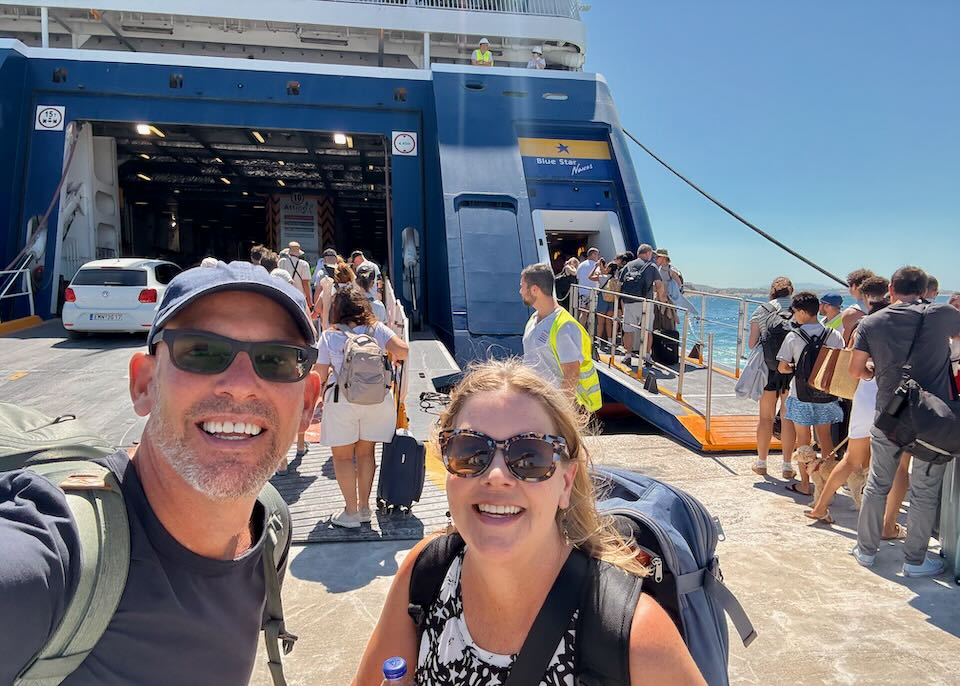
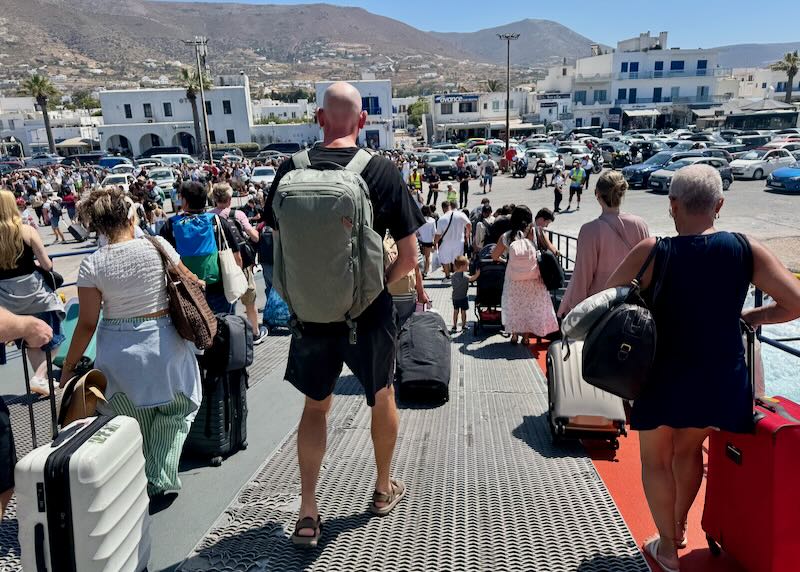
Boarding a Greek ferry: a little hectic the first time, totally normal by the second.
Ports, Boarding, and Luggage
Which Athens port should I use?
Athens has three ferry ports. Check your ticket and be sure you’re heading to the right port.
- Piraeus: The main Athens ferry port and the one most visitors use. Ferries leave from here for Santorini, Naxos, Paros, Crete, Hydra, and many other islands.
- Rafina: Closer to Athens Airport and particularly useful for Mykonos, Andros, and Tinos. Much smaller and easier to navigate than Piraeus.
- Lavrio: Southeast of Athens and useful for routes including Kea and Kythnos. Most first-time visitors will not use it.
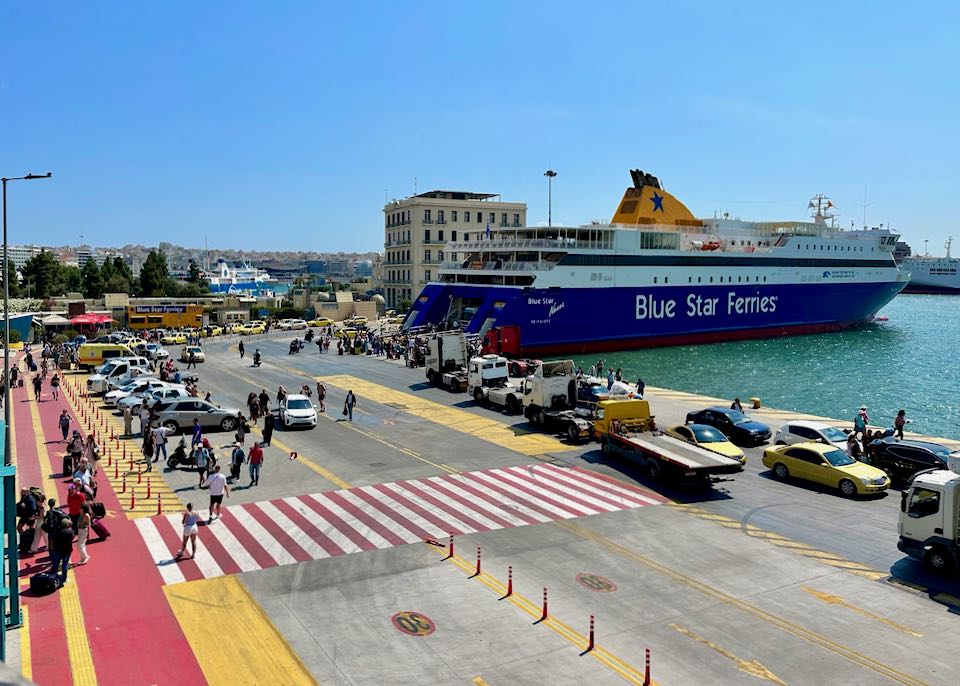
A ferry departing for Paros, Naxos, and Santorini from Piraeus near Athens.
What is boarding a Greek ferry like?
Boarding is fast and a little chaotic. Hundreds of passengers and vehicles can be moving at the same time, and there is rarely a neat single-file line. Have your phone ticket ready, keep your ID handy (just in case), and follow the crew’s instructions.
- Find your gate and ferry: Check the departure boards, especially at Piraeus. Match the ferry company, destination, and departure time to your ticket.
- Wait near the boarding area: Passengers gather quickly when boarding starts. It can look disorganized but moves surprisingly fast.
- Scan your ticket: Staff scan the QR code at the ramp or shortly before you board.
- Leave your large luggage: Crew members will show you where to put large bags, generally on racks near the vehicle deck or entrance. Keep valuables and medication with you.
- Go to the passenger decks: Large conventional ferries have indoor lounges, cafés, and outdoor decks. High-speed ferries have assigned indoor seating.
- Get ready before your stop: When your island is next, gather your small bag and head toward the exit when instructed. Stops can be very short.
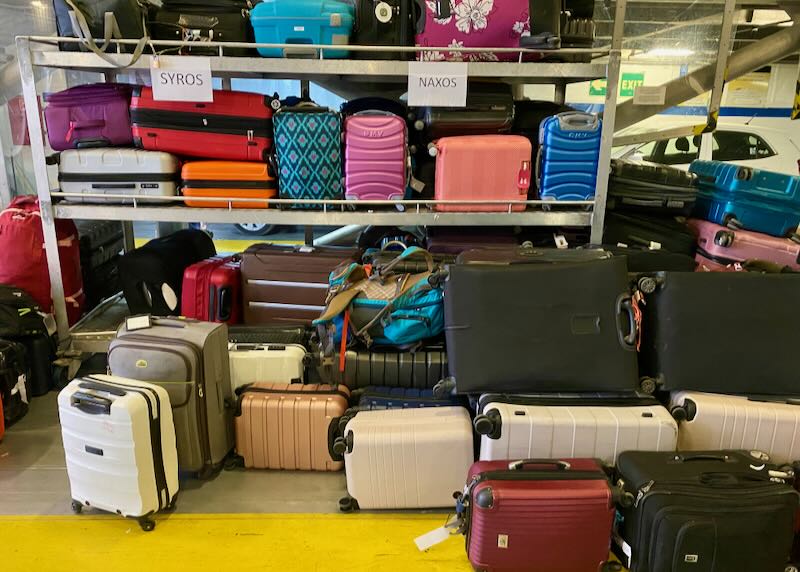
Large bags are left in designated luggage areas, often grouped by destination. Keep medicine, passports, and anything valuable with you.
Luggage on Greek Ferries
Ferry luggage is much less restrictive than airline luggage, but you still have to handle your own bags. A backpack or small suitcase is much easier than a huge four-wheel spinner, especially on ferry ramps and island cobblestones.
Large suitcases are normally left near the vehicle deck or entrance as you board. Bring valuables, medication, passports, and anything fragile upstairs with you.
What to keep in your day bag
- Phone and ferry ticket
- Passport or photo ID and wallet
- Medication and seasickness tablets
- A sweater or light jacket because indoor lounges can be cold
- Sunglasses and hat if your ferry has an outdoor deck
- Power bank because outlets get claimed quickly
I love using a backpack when I ferry hop around Greece. Hands free makes boarding and getting off much easier.
Life Onboard
Can I walk around?
On large conventional ferries such as Blue Star, yes. Walk through the lounges, get a coffee, and go outside on the open decks. That is one of the reasons I prefer them.
High-speed ferries have indoor passenger areas but no outdoor deck access while underway. You will spend most of the trip inside.
Food, Water, and Bathrooms
You can bring your own food and water onboard. Large conventional ferries have cafés and snack bars, and some have additional restaurants or fast-food counters. High-speed ferries also sell drinks and snacks, though the selection is smaller.
Bathrooms are similar to what you would expect on an airplane or train. On a large ferry there are several throughout the passenger decks.
The cafe on a SeaJets ferry. The sugar donuts are delicious.
Wi-Fi and Charging
Wi-Fi is available on many ferries but is not reliable enough for important work. Service can disappear when the ferry is far from land. Power outlets are scattered around the lounges and get claimed quickly, so I always bring a power bank.
Mobility and Accessibility
Large conventional ferries are usually the easiest choice for travelers with limited mobility. Many have elevators or escalators between the vehicle and passenger decks, but accessibility varies by ship. If stairs are a concern, check the specific vessel before booking and contact the ferry company for assistance.
Vehicles and Rental Cars
For most island-hopping trips, rent a different car on each island instead of taking an Athens rental car on the ferry. Many rental companies require advance written permission to take a car on a ferry, and insurance or roadside-assistance coverage can change once the vehicle leaves the mainland.
If you do take a car, reserve the vehicle space with your ferry ticket and arrive earlier than a foot passenger. Loading is efficient but not especially relaxing, with crew members directing cars into very tight spaces.
Schedules, Delays, and Tickets
Can I trust the published schedule?
Yes, but do not build a tight connection around it. A ferry leaving its first port has the best chance of departing on schedule. Ferries making several island stops can pick up delays during the day from weather, port traffic, loading, and other disruptions.
I use MarineTraffic.com to see where the ship actually is when I am waiting for a ferry that is coming from another island.
What if my route does not show up online?
Greek ferry schedules are released gradually. Major routes appear first; some summer routes between smaller islands are not published until much closer to the travel season.
If you are looking months in advance and nothing appears, check again later. If your travel date is approaching and there is still no direct ferry, look at nearby dates or routes through a hub such as Piraeus, Naxos, Paros, or Syros.
Strikes, Weather, and Busy Travel Days
Ferry strikes do happen, and May 1 is a particularly risky travel date. If I can avoid ferry travel that day, I do.
Strong winds can also cancel or delay sailings, particularly smaller high-speed vessels. Check your email and messages from the ferry company or booking service before leaving for the port.
Greek Easter and the days around August 15 are among the busiest domestic travel periods of the year. Book early if you are traveling then.

Frequently Asked Questions
When do Greek ferry schedules for 2027 come out?
Schedules are released gradually, not all at once. Major routes are often available well in advance, while seasonal island-to-island routes can appear much later. If a ferry that works well for your June through September trip is already available, I would book it rather than wait for every company to publish its schedule.
Do ferry tickets sell out?
Yes. High-speed ferries, cabins, and vehicle spaces are the first to sell out during July and August and around major holidays. Large conventional ferries have much more capacity, but popular sailings can still fill.
For peak summer travel, I prefer booking once the itinerary is set rather than waiting until I am in Greece.
How much do ferry tickets cost?
Prices depend heavily on the route and ferry type. High-speed ferries can cost considerably more than conventional ferries. On Athens to Santorini, for example, conventional ferry tickets are much cheaper than the fastest high-speed options.
Ferry prices do not normally move up and down like airline fares. Booking early is mainly about getting the sailing, seat, cabin, or vehicle space you want.
What happens if my ferry is canceled?
Weather and strikes are the most common causes of major disruption. If your sailing is canceled, the ferry company or booking service will provide instructions for changing the ticket or obtaining the refund available under the fare and passenger-rights rules.
Do not rush to the port without checking first. The next useful ferry might leave hours later or the following day.
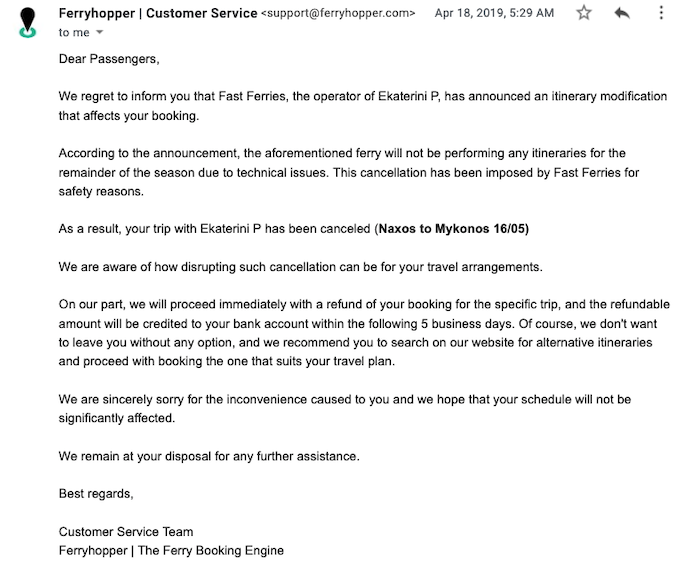
Email I received when our ferry was cancelled.
How do seats work? Economy vs Air Seat
- Economy / Deck on conventional ferries: No assigned seat. You use available indoor lounge seating, café seating, or outdoor deck chairs. Fine for a short trip, less appealing on a crowded summer crossing.
- Air Seat / Airplane Type on conventional ferries: A reserved numbered seat in an indoor air-conditioned lounge. This is what I normally book. It usually costs only a little more than Economy and means you always have a seat waiting for you.
- High-speed ferries: Passenger tickets have assigned indoor seating. Check the seat and lounge or class printed on your ticket.
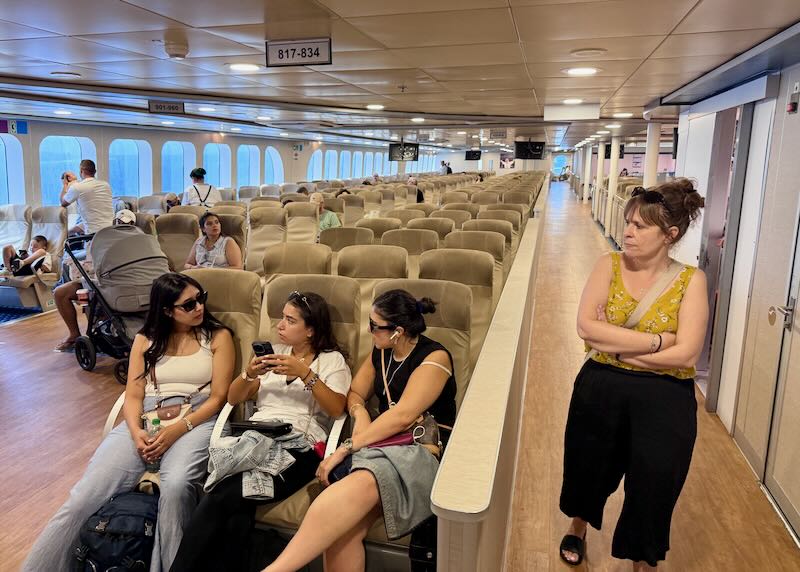
Reserved airplane-style seating on a SeaJets ferry.
Can I sleep on the ferry?
Yes. On daytime conventional ferries, people nap in Air Seats and lounges. For an overnight trip to Crete, Rhodes, or another distant island, I strongly recommend booking a cabin.
Should I book a cabin?
For an overnight ferry, yes. A cabin gives you beds, privacy, and a private bathroom and makes a huge difference the next morning.
A cabin can also be worth it on a long daytime crossing if you have young children, want to sleep, or simply want somewhere quiet away from the passenger lounges.
Can I bring my pet?
Yes. Most Greek ferry companies accept pets, but the rules vary by operator and vessel. Depending on the ship and ticket, pets may travel in a carrier, designated pet area, kennel, or pet-friendly cabin. Check the rules for your exact ferry when booking.
Are there return ticket discounts?
Some ferry companies offer discounts on selected return journeys or other promotional fares. Do not assume a round-trip ticket will automatically be cheaper. Compare the two sailings when booking.
What is the best ferry route for scenery?
Arriving in Santorini by ferry is one of the greatest views in the world. You sail below the cliffs and into the caldera before reaching Athinios Port.
For the best arrival, take a conventional ferry with an open deck and go outside before the ferry enters the caldera. High-speed ferries do not allow passengers onto outdoor decks while underway.
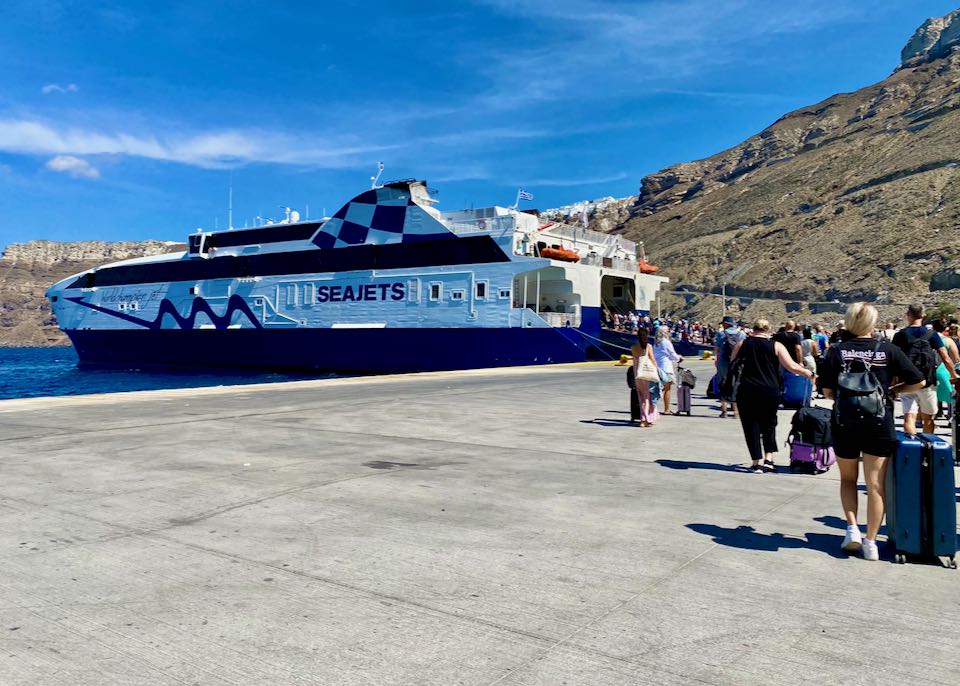
Passengers at Santorini ferry port boarding the Santorini to Mykonos ferry. SeaJets WorldChampion Jet is one of the large high-speed ferries used in the Cyclades.
Getting to and From the Ferry Port
How do I get from central Athens to Piraeus Port?
The Metro is the easiest way.
- From Monastiraki: Take Line 1 or Line 3 directly to Piraeus.
- From Syntagma: Take Line 3 directly to Piraeus.
- Fare: The standard 90-minute Athens transit fare is €1.20. You can tap a contactless bank card, Apple Pay, or Google Pay at the gates instead of buying a separate ticket.
Piraeus is a large port. The Metro station is convenient for several gates but not all of them, so check your ferry’s gate before you leave Athens.
How do I get from Athens Airport to Piraeus Port?
- Metro: Line 3 runs directly from Athens Airport to Piraeus. The airport fare is €9 and trains run roughly every 30 minutes.
- X96 Bus: The airport express bus runs 24 hours a day between the airport and Piraeus. The fare is €5.50. It is useful late at night when the Metro is not running, though traffic can make the trip slow.
Contactless bank-card and phone payment is available for both airport Metro and airport express-bus fares.
How do I get from the island ferry port to my hotel?
Have a plan before you arrive, especially on Santorini and Mykonos. Several hundred passengers can walk off a ferry at once and taxis are limited.
- Pre-arranged transfer: My preference on Santorini, Mykonos, and when traveling with lots of luggage. I use Welcome Pickups when available.
- Walking: Very easy in places such as Naxos Town or Parikia if your hotel is close to the port. Check the exact route first. A “10-minute walk” can feel very different with luggage, stairs, cobblestones, steep roads, or midday heat (just ask my wife).
- Taxi: Fine when one is available, but I would not count on walking off the ferry and immediately finding one at Santorini or Mykonos in peak season.
- Bus: Cheap and useful if the route matches where you are staying. On Santorini, port buses run to Fira, where you change for most other destinations. This works best with light luggage.
- Hotel transfer: Many hotels arrange port pickup for a fee. This is especially useful for villas and caldera hotels where the final entrance can be difficult to find.
- Rental car: Reserve ahead in summer and confirm exactly where the car will be delivered or where the shuttle meets you. Do not expect every rental office to be directly beside the ferry ramp.
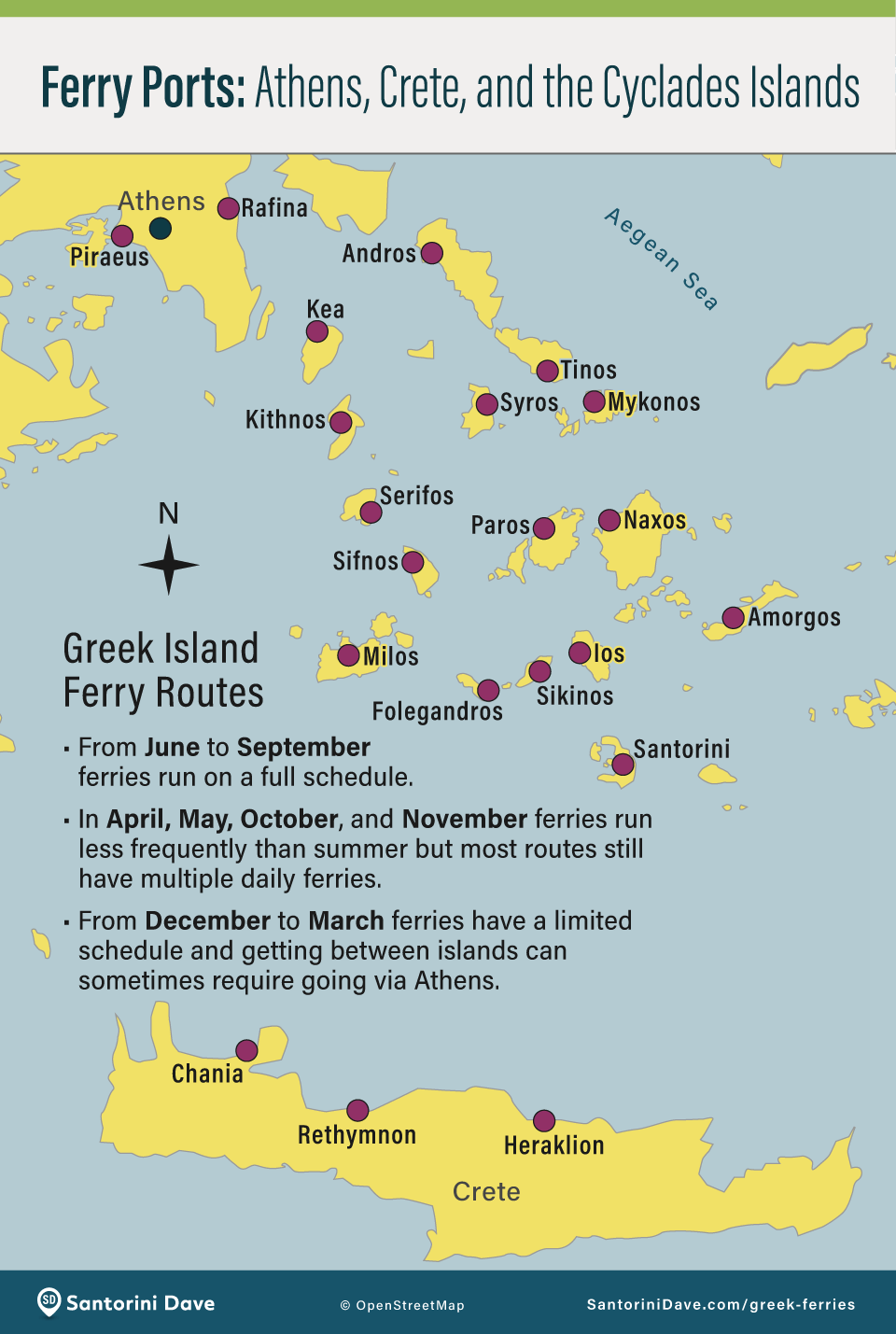
Direct connections between every island are not the norm. Ferries connect Athens with the major islands and provide good links between many neighboring islands.
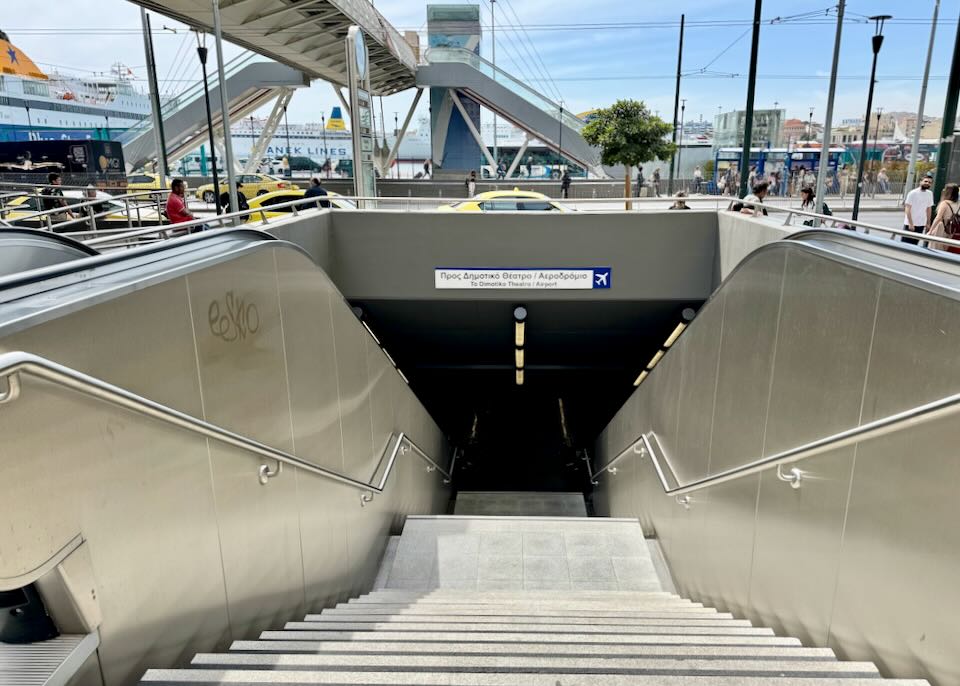
Metro Line 3 runs directly between Athens International Airport and Piraeus ferry port. The Metro station is directly across from the E6 entrance.
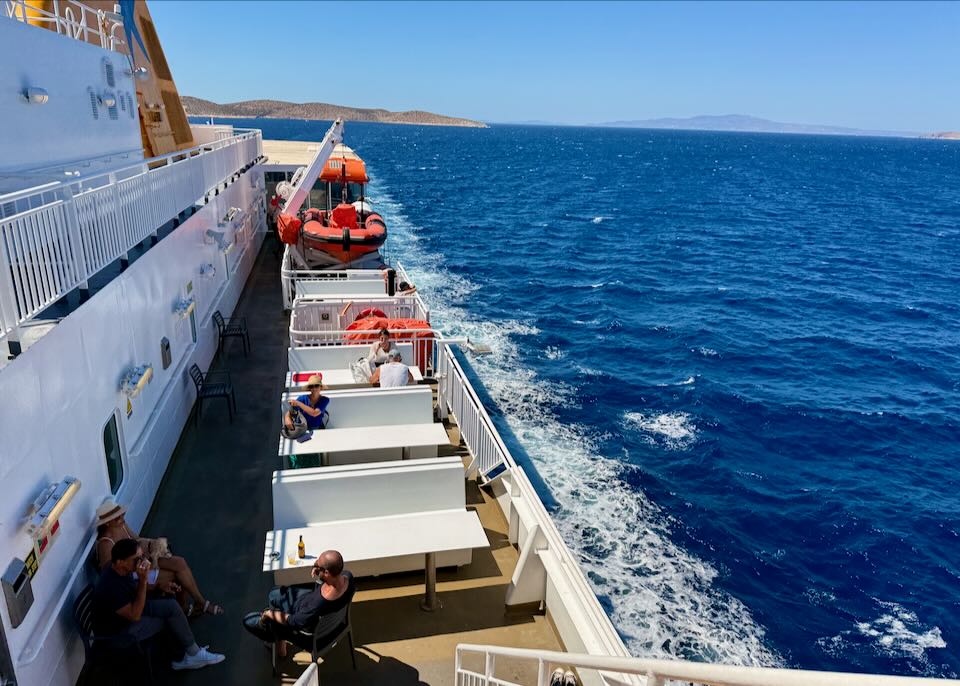
On the open deck of a Blue Star ferry in the Cyclades, one of the great simple pleasures of traveling in Greece.
 Santorini Dave was started in 2011 when I posted a short guide to visiting Santorini with kids. Now, my site publishes regularly updated guides to
Hi Dave – We (a family of four with a tween/teen) fly into Athens at the end of July and are spending two nights there before heading to the Cyclades. We have six nights before we catch a 7pm flight from Mykonos to Budapest on RyanAir. I thought we’d start with three nights on Milos (do we need four?) and then have one other stop before heading to Mykonos. A couple of questions:
With that 7pm flight, would you think we could arrive the same day in Mykonos, or should we plan on arriving the night before?
Which other island would you pair with Milos, considering we go on to Mykonos? I was thinking either 3/3 or 4/2 with Folegandros, but maybe we should be closer to Mykonos? Thank you!
Ashley
Here is my honest take on your plan, considering the ferry connections and the reality of travel in late July (peak wind season).
1. The “Same Day” Flight Question
Can you arrive in Mykonos the same day as a 7pm flight? Technically, yes. Practically? It makes me nervous.
Why:
• The Wind: Late July is prime time for the Meltemi winds. The ferry connections between the Western Cyclades (Milos/Folegandros) and Mykonos are almost exclusively serviced by small, high-speed catamarans (like the SuperJet or Seajet 2). These are the first boats to get cancelled or significantly delayed when the winds pick up.
• The Route: There is no “straight line” large car ferry from Milos to Mykonos. You are relying on those smaller boats that zigzag through the islands. If the sea is rough, that 3 to 5-hour ride can be a stomach-churning ordeal, and arriving at the airport green and exhausted isn’t fun.
• My Thinking: If you are coming from Milos or Folegandros, I would not risk a same-day arrival for a flight, even a 7pm one. The risk of a cancellation leaving you stranded is just high enough to cause anxiety.
However, if you are coming from an island right next door to Mykonos (like Naxos or Paros), I would be much more comfortable with a same-day arrival because the ferries are larger, frequent, and the trip is only 40 minutes.
2. How to pair Milos (and timing)
You have 6 nights. That is a tight window for two islands plus a travel day, but it’s doable.
• Milos duration: Three nights is the absolute minimum for Milos. It is a big island and the best beaches are spread out. You need a rental car to see it properly Plus you have to do a boat tour. If you do 3 nights, you really only have 2 full days.
Which island to pair it with?
Option A: Milos (3 nights) + Naxos (3 nights) – My Top Pick for Families
• This is the best balance of logistics and “teen friendliness.”
• Why: Naxos has great beaches, a cool main town, and is very active for teens. The ferry from Milos to Naxos is easy, and the ferry from Naxos to Mykonos is very short (40 mins) and serviced by larger boats.
• The Flight Day: You could comfortably wake up in Naxos on your departure day, take a noon ferry to Mykonos, arrive by 1pm, grab lunch in Mykonos Town, wander for 2 hours, and head to the airport for your 7pm flight. This feels safe to me, but is not as safe as Option B.
Option B: Milos (4 nights) + Mykonos (2 nights)
• This removes all the stress.
• Why: You give Milos the time it deserves (4 nights allows you to do the Kleftiko boat tour without rushing). Then you head to Mykonos for the final 2 nights.
• The Vibe: Mykonos is expensive and crowded, yes, but for a family with a teen, it’s actually quite a spectacle. The town is incredibly photogenic, the shopping is fun, and seeing Delos (short boat trip from town) is great history. You are already there for your flight, so zero stress on the last day.
Option C: Milos (3) + Folegandros (3)
• The “aesthetic” choice, but a “logistical” headache.
• Why: I love Folegandros – it’s magical and chill. But for a teen? It might be a little too quiet after 2 days (no water sports, very small town).
• The Problem: Getting from Folegandros to Mykonos on flight day is risky (see my point above about small boats). You would spend your last day stressed about the wind. I would skip Folegandros this time unless you fly out of Santorini (which is much closer to Folegandros).
Summary Advice
If I were you, I would do Option A (Milos & Naxos).
• Days 1-3: Milos. Rent a car. Explore Sarakiniko and Tsigrado.
• Day 4: Ferry to Naxos (usually runs in the morning/afternoon).
• Days 4-6: Naxos. Stay at St. George Beach (in town) so the teen can walk around, or Plaka/Agios Prokopios for better sand.
• Day 7: Mid-day ferry from Naxos to Mykonos. Taxi to airport. Fly to Budapest.
Hope that helps you structure the week.
Hi Dave – couple questions for you. We are doing Athens, Santorini and Naxos for our honeymoon in August. We are traveling from Santorini to Naxos via Ferry and can’t decide on the right choice of ferry. We would prefer the Blue Star Ferries since they are more reliable, but the only choices are 6:25 AM or 3:30 PM. We are doing 3 nights in Santorini and not looking to leave at 6 AM. Would you recommend using SeaJet instead to leave around 12 PM? Worried about the delays later in the day at the 3:30 time.
Also – we are flying from Naxos at 7:25 AM landing in Athens at 8:15 AM. We have our flight back to the states at 1 PM from Athens. Do you think that’s enough time between flights? Been hearing that some people schedule to fly back to Athens the night before a flight. We’re doing 2 nights in Athens at the beginning of our trip and hoping to spend 4 in Naxos at the end.
Thanks!
Nikki
SeaJets at 12:00 PM is a better option if you want an on-time ferry. Blue Star at 3:30 PM is better if you want the caldera views from the ferry deck. If changing your itinerary is possible, I would move your two nights in Athens to the end of your trip. That will give you some buffer days in case flights or ferries are delayed or canceled. If not, the 7:25 flight will give you plenty of time unless it’s canceled or delayed. Hope that helps.
Hi! We have a car rental for Athens and Meteora, should we return the car before island hopping?
Yes, definitely return before getting on a ferry. You likely won’t need a rental car on the islands at all. If you do, just rent for a day or two as needed. There’s no need to pay for ferry transport for a vehicle you’ll barely need on the islands.
Your site is by far the best website for travel to Greece and Europe! Amazing content. Thanks.
We arrive by flight to Athens from London. Do you recommend going directly to the ferry port or spending a few days in Athens?
Tracy
Most ferries to the islands depart in the A.M. hours, so unless you have a very early flight, you’ll likely need to spend the night in Athens regardless. Athens has plenty to see and can easily fill 2 or 3 days with good sightseeing, great nightlife, and fantastic restaurants. I recommend at least one full day and two or three if the main attractions look appealing to you. Then get an early morning ferry and head to the islands.
We fly in and out of Athens in September (the 1st to the 20th). We want to visit Naxos, Paros, Milos, Folegandros, Mykonos, and Santorini. How best should we order these islands to minimize travel time and maximize ferry options?
This is a fantastic and ambitious itinerary. Fitting six islands into 20 days is fast-paced but absolutely doable if you plan your route efficiently. The key is to order the islands along the main ferry lines to prevent backtracking.
The most logical and efficient route for your island list is to travel in a general north-to-south direction through the central Cyclades, then hop to the western islands before returning to Athens.
The Best Island Hopping Route
• Athens ➝ Mykonos ➝ Paros ➝ Naxos ➝ Santorini ➝ Folegandros ➝ Milos ➝ Athens
Route Breakdown & Logic
• Athens to Mykonos: Start your trip by taking a ferry from Rafina port, not Piraeus. Rafina is much closer to the Athens airport (a 20-minute taxi ride vs. 60-90 minutes to Piraeus) and is the main hub for fast ferries to Mykonos. This will save you significant time on your arrival day.
• Mykonos to Paros: A quick and easy hop (30-50 minutes) on a frequent high-speed ferry.
• Paros to Naxos: These islands are neighbors. The ferry takes only 30-45 minutes and runs many times a day. You could visit one on a day trip from the other, but it’s better to switch hotels to properly experience both.
• Naxos to Santorini: A very common route on the main ferry line. The high-speed ferry takes about 1.5 to 2 hours. There are multiple sailings per day.
• Santorini to Folegandros: This is your pivot from the central to the western Cyclades. Ferries (usually SeaJets) run this route regularly. The trip takes about one hour. Santorini is the best-connected island for making this jump.
• Folegandros to Milos: A short, beautiful trip between two stunning islands in the western Cyclades. This leg takes about 1 to 1.5 hours.
• Milos to Athens: From Milos, you have frequent and direct ferries back to Piraeus port in Athens. Both fast catamarans (about 3-4 hours) and larger, more stable conventional ferries (5-7 hours) serve this route.
Suggested Time Allocation (19 nights)
With 20 days, you have 19 nights on the islands. This is a packed schedule, so be prepared for moving around. I recommend booking everything well in advance.
• Mykonos: 3 nights
• Paros: 3 nights
• Naxos: 4 nights (the best beaches in the Cyclades)
• Santorini: 4 nights (enough time for the caldera, wineries, and Akrotiri)
• Folegandros: 2 nights (it’s small, this is enough to experience the magical Chora)
• Milos: 3 nights (essential for exploring the unique beaches and taking a boat tour of Kleftiko)
Booking Ferries
• Use a site like Ferryhopper to check schedules and book all your tickets in one place. It’s reliable and shows all available companies for your route.
• Book your September ferries by June or July. While September is less crowded than August, popular routes can still sell out, especially on the faster catamarans.
Hi Santorini Dave! Thank you for the thorough breakdown. I’m planning my trip now to Greece in September, visiting Athens, Santorini and Milos. Looking on Ferryhopper, there is an option from Milos to Athens on Minoan Lines and is cheaper than the Seajets option while being on a similar timetable. Minoan seems to get some bad reviews on Tripadvisor though, so I’m wondering if you have any experience with them and if I should have any reservations on booking this. Thank you!
My advice is to book the Minoan Lines (probably the Festos Palace) without hesitation. The most critical difference is the vessel itself: the Festos Palace is a massive, stable cruise ferry, while Seajets uses much smaller, high-speed catamarans. For a long journey, the Minoan ship provides a more comfortable experience, with spacious lounges and open decks you can walk around, unlike the somewhat restrictive, airplane-style seating on many Seajets. The larger ferry is far more reliable and less likely to be canceled by the high winds that can occur in September. Given that it’s also the cheaper option, the Minoan Lines ferry is the better choice – though it does often depart Milos in the middle of the night, so do double-check sailing times.
Hi Dave,
I am planning my 5th visit to Greece with an entire month on the islands in June. No need to revisit the two Cycladic hotspots but do want to visit a couple quieter ones. Then, I want to move on to the Dodecanese, Rhodes, Symi and Patmos.
How do you ferry between the Cyclades and Dodecanese? The Ferry Hopper site doesn’t help if you don’t know which Cycladic island is your origin.
Thank you!
Chris
San Francisco, California
Syros will have the most ferries heading east. It’s the Cycladic island you’ll most likely find routes to Rhodes, Kos, Patmos, etc. I love Syros in its own right, and it is definitely worth a visit.
What are the baggage weight (and pieces per person limit) on Greek ferries? We’ll probably be booking SeaJets World Champion from Athens to Santorini in September. Thanks!
It varies by company and ferry so read the baggage allowance for your specific ferry. Small catamarans might allow substantially less than larger ferries like the World Champion Jet. I’ve never had my baggage limited as I board, but I always travel pretty light.
Trying to determine ferry schedules between Santorini and Mykonos, and between Mykonos and Piraeus and/or Rafina in November. It’s Blue Star and Super Express between Mykonos and Athens, and Sea Jet between Santorini and Mykonos. Do you know when they will post these November sailings?
Thanks. You have a nice site with great information.
There will definitely be ferries between Piraeus and Santorini (both ways) and between Piraeus and Mykonos (both ways) in November. It’s always uncertain when the last ferry runs between Mykonos and Santorini. Some years it’s November 1st, some years November 20th or even a little later. I would check in September when schedules should be out for those months.
I have a flight out of Santorini next summer at 10:55am and I’m taking the ferry from Ios to Santorini (08:15am-9:00am) on a Seajets vessel. I heard ferries are notoriously late. Am I in jeopardy of missing my flight?
That is cutting it very close. I personally would not book those plans. It could easily be 9:30 when you’re walking off the ferry (without the SeaJet really being “late”). Then find a taxi and get up to the airport would probably get you to the terminal at 10:00. Lines can be long if you need to check in or check bags, so to have any chance of making it you should be fully checked in (with boarding pass) and have only carry on bags.
Hi Dave! We are scheduled June 20 on a Seajet from Santorini to Heraklion slated to arrive at 6 pm. It makes me a little nervous that you mention the ferries get more delayed as the day goes on because when we arrive we will have to pick up our rental car and drive two hours to Chania. How long of a delay are we typically talking about? If it’s hours delayed typically at this time of day I am really reluctant, and thinking of switching to a flight. Greatly appreciate your advice!!
That ferry is typically on time or close to it.
Hi Dave,
What is a reasonable layover time to get off 1 ferry at a port (e.g. Milos) and get on another ferry?
FerryHopper is suggesting 40 min is too little time, but 50 minutes is reasonable?
Thank you!
At all island ports ferries are literally steps from each other and there isn’t really a check-in process, you just scan your ticket on your phone as you board. So in theory you only need a minute or two to walk off one ferry and walk on another. What you’re really concerned about is how late, on average, the first ferry will be such that you might miss the second ferry and that’s hard to generalize. I would be comfortable with a one-hour difference between two ferries. 30-minutes is cutting it close. But there’s no right answer. Hope that helps.
Dave,
Thanks for the valuable information. Do you know when next year’s ferry schedule will be released? When has it been released in the past?
Trying to book a trip in April.
I’ve never found any set pattern and it can change year to year. But my best guess for April ferry schedules is December or January.
Hi Dave – Would you recommend SeaJets Champion Jet 2 or Blue Star Delos from Naxos to Santorini on 30 October. We want the most reliable ferry as well as the least likely to cause seasickness. Thanks in advance!
The Blue Star ferry will be the most reliable and stable. I love the outdoor deck that you can walk about on for fresh air and great views as you sail through the caldera.
Hi Dave…Do you know if Santorini has any ferries going anywhere besides Athens in November? I can’t find any schedules online but I’m surprised there is absolutely nothing except Athens, don’t locals need to get around too?
Cheers!
Mario
Locals typically need to go to Athens and from there towns and villages on the mainland. But they generally don’t need to go to other islands hence the limited inter-island ferry schedule. That said the Blue Star from Santorini to Athens will usually stop in Naxos and Paros on the way – and less often Ios.
Hi Dave,
We are trying to go directly from mainland Greece (any port) directly to Ithaka on Sunday, June 6. I cannot seem to find any information on car ferry schedules for this, though I have read they run. Ideally, we would like to leave in the morning.
Have they just not published the ferry routes yet or are they not running this year? Any information you have would be very helpful. Thank you!
Amanda
Yes, ferries should run but they haven’t been published/updated for the summer quite yet. The itineraries announced for Kyllini to Ithaca are up to April 23rd. Since Levante Ferries is serving the line in winter, they should serve it also during summer. A new line was also added last year from Astakos to Ithaca, serving daily itineraries. The summer itineraries are not yet announced, but again they should post in the following weeks. I use Ferryhopper to find the most recent routes and timetables.
Hi Dave.
We would like to take a ferry from Crete to Santorini on the 3rd of September. There are only 2 ferries available (from Heraklion): The Naxos Jet & Champion Jet 2 (on Ferryhopper). We prefer the Blue Star (on your recommendation), but it is not available. Any suggestions?
Thanks.
The Blue Star does not run between Santorini and Crete. Those two ferries are your only options but I like and recommend both of them.
Hi Dave!! I have a 16 year old person traveling from Athens to Folegandros. She’s not traveling alone but couldn’t get her on her cousins’ reservation. Do you think this could be a problem as she is underage?
And also even if I purchased her ticket from another company with the same schedule as her cousins’ my guess is that it’s the same ferry, isn’t it? I imagined there is only one route a day from Athens to Folegandros?
They don’t check ID or age bording the ferry so there should not be a problem. (I’ve never had my ID checked as I boarded a ferry.) If it’s the departing at the same time it will almost certainly be the same ferry. But the ticket should give the name and company of the ship – which will tell you for sure.
Are the ferries nonsmoking? We have an asthmatic so very curious about this or at least the nonsmoking area? Also, is there a place to find a map of sorts to show the location of each section of the reserved air seating (AK 1-5)? I am having no luck on the BlueStar website. Thank you!
There’s no smoking inside on Greek ferries. Just outside on the deck. I don’t know of a Blue Star seating map.
We are trying to book a ferry midweek from Rhodes to Symi for first week in June and staying for two nights. All the ferry companies we have tried are not offering any availability. Are the timetables not out yet or is it too late?
I just looked on Ferryhopper and there was a daily ferry leaving Rhodes for Symi at 9am.