Updated: September 1, 2026
Greece › Money, Cash, and Credit Cards
By Santorini Dave • dave@santorinidave.com
See Also
- Where to Stay in Athens
- Where to Stay in Santorini
- Where to Stay in Mykonos
- Where to Stay in Naxos
- Where to Stay in Paros
- Where to Stay in Crete
- Where to Stay in Corfu
- Where to Stay in Rhodes
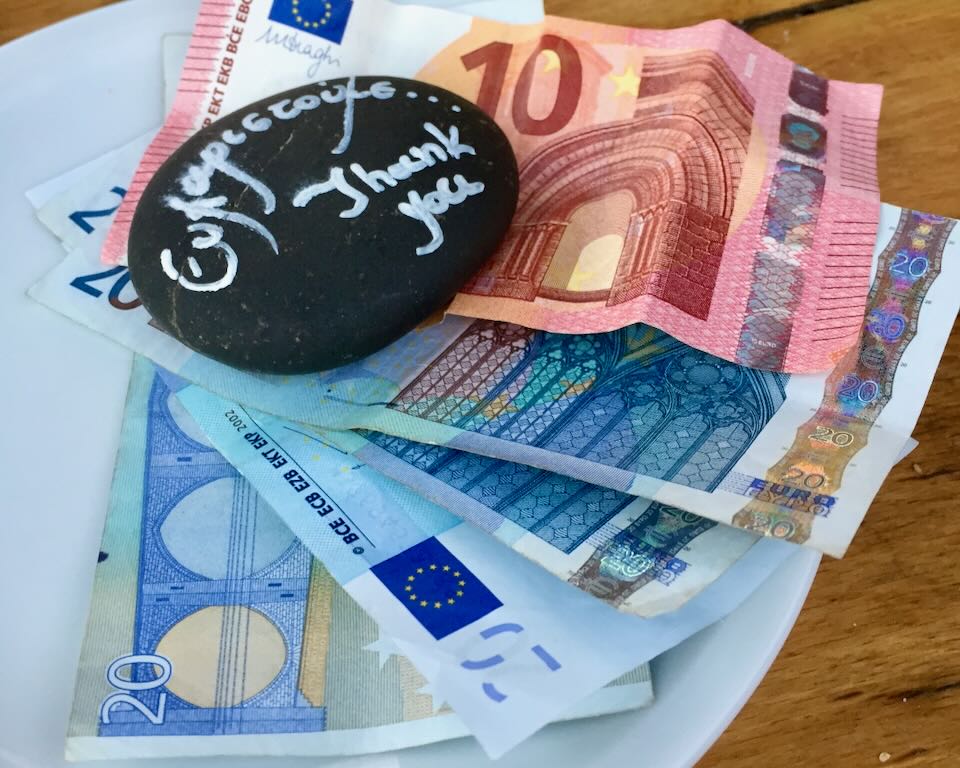
Paying with a mix of cash and cards is common in Greece. Cards are accepted almost everywhere, but carrying €100–200 in cash is still useful for small purchases, tips, buses, and the occasional cash-only business.
Use cards for most spending in Greece, but keep €100 to €200 per couple in cash. Visa, Mastercard, Apple Pay, and Google Pay are widely accepted in Athens, major resorts, and the popular Greek islands. Cash is still useful for tips, local buses, small purchases, remote beaches, village businesses, and the occasional card terminal that cannot connect.
Do not bring your entire vacation budget in euros. Withdraw cash from an ATM in Greece when you need it, preferably at a major Greek bank. At both ATMs and card terminals, always choose to be charged in euros, not dollars, pounds, Canadian dollars, Australian dollars, or another home currency.
My Recommended Payment Setup for Greece
- Primary card: A Visa or Mastercard credit card with no foreign transaction fee.
- Backup card: A second Visa or Mastercard from another bank, kept separately.
- ATM card: A debit card with low international withdrawal fees.
- Cash: About €100 to €200 per couple, mostly in €5, €10, and €20 notes.
- Mobile payment: Apple Pay or Google Pay, but not as your only way to pay.
Use the credit card for hotels, restaurants, tours, rental cars, ferry tickets, and shopping. Keep cash for smaller expenses, tips, and backup.
Do You Need Cash in Greece?
Yes, but much less than many travelers expect.
Greece is far more card-friendly than it was a decade ago. Even bakeries, kiosks, cafés, taxis, and small shops now commonly have card terminals. In Athens, Thessaloniki, Santorini, Mykonos, Crete, Rhodes, and Corfu, you can easily go most of the day without using cash.
I would not travel through Greece with no cash at all. Terminals sometimes lose their connection, remote beach canteens can be cash-only, and some island buses still work best with cash. Cash is also much easier for tips.
Keep cash for:
- Tips for hotel staff, drivers, guides, and boat crews
- Island buses and tickets sold onboard
- Small kiosks, bakeries, cafés, and market stalls
- Remote beach bars and seasonal canteens
- Small local boats and water taxis
- Parking, lockers, public toilets, and other small expenses
- Any time a card terminal is temporarily not working
How Much Cash Should You Carry?
For most trips, start with €100 to €200 per couple. Carry more if you are going somewhere remote or to a small island with limited ATM access.
You may want more cash when:
- Traveling to a small island with only one or two ATMs
- Staying in a remote village
- Driving through rural Crete or mainland Greece
- Visiting beaches far from the nearest town
- Using local buses, small boats, or transfers that prefer cash
You will probably need less in central Athens, Thessaloniki, or a large resort. Do not carry all your cash in one wallet. Keep what you need for the day with you and store the rest separately with your backup card.
Small Notes Are Best
The most useful denominations are €20, €10, and €5 notes, plus €1 and €2 coins.
A bus driver, bakery, kiosk, or small café might not have change for a €50 note. If an ATM gives you only €50 notes, break one at a supermarket, museum ticket office, larger restaurant, or hotel.
Do not try to pay for a €3 coffee with a €100 note.
Should You Get Euros Before Going to Greece?
You do not need to order your full cash budget before leaving home.
Arriving with €50 to €100 can be convenient, especially if you land late or are traveling directly to an island. After that, withdraw euros from an ATM in Greece as needed.
Avoid exchanging a large amount at an airport currency counter. The exchange rate is usually worse than what you will get using a good bank card.
If an exchange counter advertises “0% commission,” look at how many euros you actually receive. A bad exchange rate can cost more than a service fee.
Are Credit Cards Widely Accepted in Greece?
Yes. Visa and Mastercard work almost everywhere most visitors spend money. Other card brands such as American Express and Discover are less dependable and should not be relied on as your main form of payment.
Use a card at:
- Hotels and resorts
- Restaurants, tavernas, cafés, and bars
- Supermarkets and pharmacies
- Rental-car offices
- Tour companies and private transfers
- Ferry offices and ferry-booking websites
- Museums and major archaeological sites
- Gas stations
- Beach clubs
- Clothing, souvenir, and jewelry shops

Greek supermarkets, like this one in Oia, Santorini, almost always accept credit cards, Apple Pay, and Google Pay, even for inexpensive purchases like bottled water or snacks.
Visa and Mastercard are the safest choices. American Express is accepted by some luxury hotels, upscale restaurants, international rental companies, and larger stores, but I would never bring it as my only card.
Discover is even less reliable.
Carry a second card and some cash. Even where cards are accepted, terminals occasionally stop working.
Credit Card or Debit Card?
Use a credit card for purchases and a debit card for ATM withdrawals.
A credit card is better for hotels, rental cars, expensive purchases, and anything that could involve a security hold or disputed charge. Debit cards are best kept for withdrawing cash.
Avoid using a debit card for:
- Large hotel deposits
- Rental-car security holds
- Gas-station authorization holds
- Expensive purchases you may later need to dispute
Do not use a credit card at an ATM unless it is an emergency. The withdrawal can be treated as a cash advance, with fees and interest.
Always Pay in Euros
This is the most important money rule in Greece. When an ATM or card terminal asks whether you want to pay in euros or your home currency, always choose euros.
For example, an American traveler might see:
- Pay €120
- Pay $146 with a guaranteed exchange rate
Choose €120.
The dollar option uses dynamic currency conversion, commonly called DCC. The ATM or payment company converts the money at its own exchange rate, which is usually worse.
At an ATM, look for wording such as:
- Decline conversion
- Continue without conversion
- Use local currency
- Charge in EUR
- Let my bank convert
Decline the conversion and continue with the withdrawal in euros. The same rule applies at restaurants, hotels, stores, and rental-car offices.
Using ATMs in Greece
ATMs are easy to find in cities, airports, ferry ports, and popular island towns.
When possible, use an ATM operated by a major Greek bank:
- Alpha Bank
- Eurobank
- National Bank of Greece
- Piraeus Bank
I prefer an ATM attached to a bank branch, particularly for a larger withdrawal.
Before confirming a withdrawal, check:
- The ATM fee
- The amount you are withdrawing
- Whether the machine is offering currency conversion
- That the transaction is in euros
Your home bank can also charge an international ATM fee, so check its rules before departure.
How Much Should You Withdraw?
Withdraw enough for several days rather than paying another fixed fee tomorrow. For most travelers, €100 to €300 at a time is sensible. Use the “Other amount” option if the ATM suggests a much larger withdrawal than you want.
Do not withdraw €800 just to save one ATM fee.
ATM Withdrawal Limits
The amount you can withdraw can be limited by your own bank, the Greek ATM, or the amount of cash in the machine. Check your daily withdrawal limit before leaving home if you expect to need a significant amount of cash.
Should You Avoid Euronet ATMs?
Euronet and other independent ATMs are common in tourist areas, especially around ports, pedestrian streets, souvenir shops, bars, and major attractions.
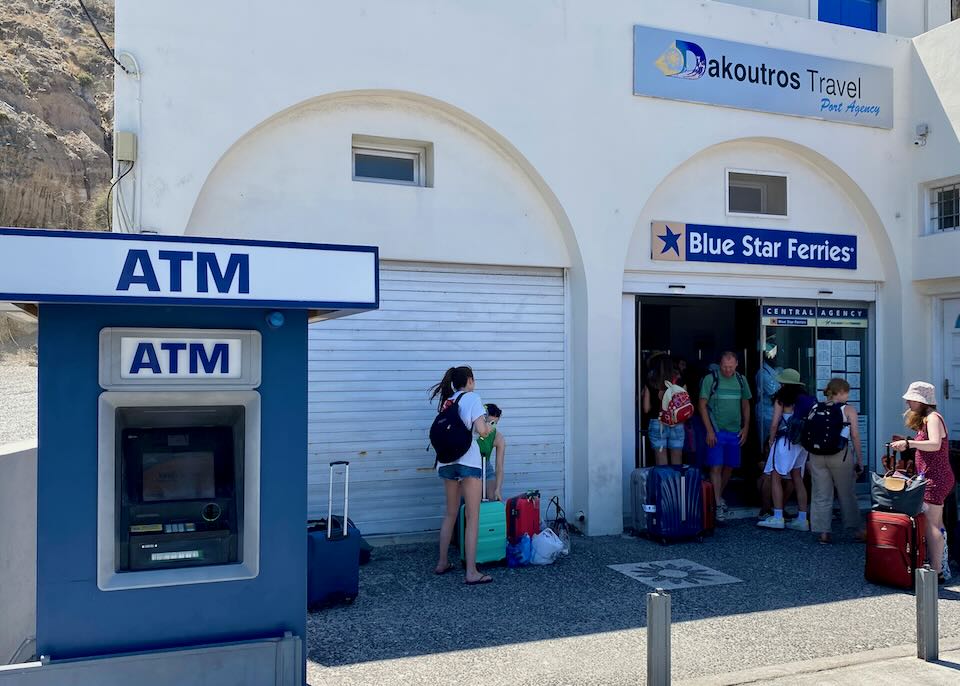
Independent ATMs at ferry ports, like this one in Santorini, are convenient but can charge withdrawal fees and push their own currency conversion. I use a Greek bank ATM when one is nearby.
They are legitimate ATMs, but not my first choice. They tend to push dynamic currency conversion and suggest larger withdrawal amounts. If you use one, check the fee, choose your own amount, decline currency conversion, and withdraw in euros.
Apple Pay, Google Pay, and Contactless Cards
Tapping a card or phone is routine in Athens and the main tourist destinations. Apple Pay and Google Pay work at contactless terminals when your linked card is supported.
Still, bring the physical card. Hotel deposits, rental-car desks, and some unattended machines can require it, and a phone can run out of battery, overheat, break, or get lost.
Keep a second card somewhere separate.
Do You Need a PIN?
Not for most purchases, but you should know your PIN.
You may need it at:
- Unattended gas pumps
- Parking machines
- Automated ticket machines
- Self-service kiosks
Many American credit cards are chip-and-signature rather than true chip-and-PIN cards. They work well at staffed Greek businesses but can fail at unattended machines.
If one card is rejected, try a second Visa or Mastercard, a debit card, contactless payment, cash, or a staffed counter.
Paying at Restaurants and Tavernas
Restaurants and tavernas throughout Greece accept cards, including small family-run businesses in popular destinations. Visa and Mastercard should work almost everywhere. I would only bother confirming before ordering at a very remote taverna if I had no cash.
Ask for the bill, say you want to pay by card, and check that the terminal shows the correct total in euros. Portable terminals are common and payment is normally completed at the table or register.
Can You Tip by Card?
Sometimes, but cash is easier.
Greek card terminals do not consistently show the large tipping screen common in North America. Some restaurants can add a tip before processing the payment, but ask first. I usually tip in cash.
Do Taxis in Greece Accept Cards?
Yes. Greek taxis are required to accept card payments, and terminals are standard in Athens and other major destinations. I still keep enough cash for the fare in case a terminal is not working.
Before getting into a street taxi:
- Confirm that the meter will be used when appropriate
- Ask whether the card terminal is working if you do not have cash
- Keep cash available as backup
For cashless payment, Uber and other taxi apps are easier because the card is stored and the trip is documented.
Using a Card on Athens Public Transportation
Athens public transportation is easy to use with a contactless bank card. You can tap a Visa or Mastercard directly on validators for:
- Metro
- Tram
- Buses
- Trolley buses
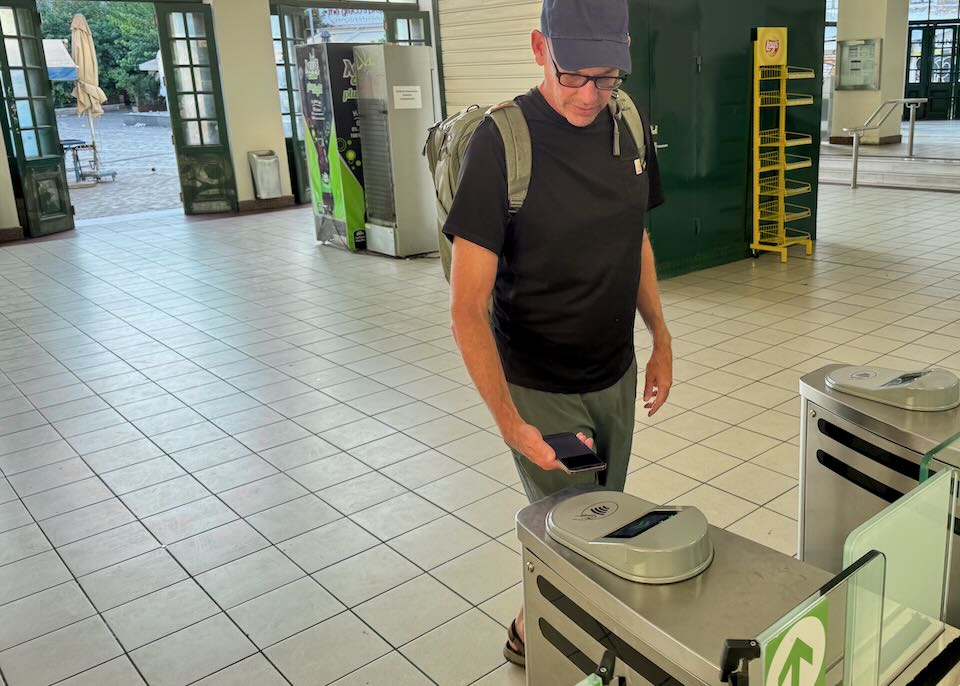
You can tap a contactless credit card, phone, or smartwatch, as I’m doing here with my iPhone, at Athens Metro gates. For an ordinary full-fare trip, there is no need to buy a paper ticket first.
Apple Pay, Google Pay, and supported smartwatches also work. For an ordinary full-fare journey, you do not need to buy an ATH.ENA Ticket.
Use the same physical card, phone, or watch throughout the day. They count as separate payment methods even when linked to the same card account, and switching between them can prevent the daily fare cap from being calculated correctly.
Airport Metro and Airport Express bus trips can also be paid contactlessly but have separate airport fares.
My Athens Transportation Guide explains the Metro, airport routes, taxis, buses, and ticket options in greater detail.
Island Buses Are Different
Do not assume every island bus accepts a contactless bank card onboard. Depending on the island, tickets can be sold at the bus station, a ticket booth, a nearby shop, or onboard.
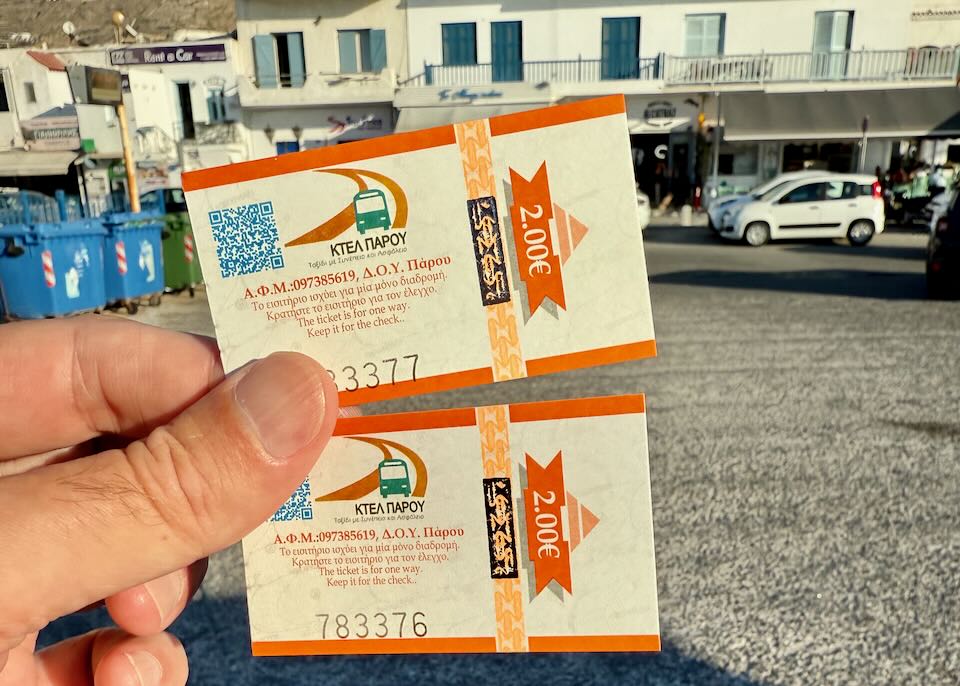
Our bus tickets in Paros. Island buses are one of the few places where cash is still handy. Keeping a few euro coins and small notes makes things easier.
Carry coins and small notes for island buses even if cards are accepted at the main station.
Paying at Hotels
Hotels accept cards for room payments, deposits, and additional charges. A hotel may also place a temporary authorization hold on your credit card at check-in.
Before approving the payment, confirm:
- Whether the room was prepaid
- Whether the card is being charged or only authorized
- Which local taxes and fees remain unpaid
- That the total is in euros
The climate crisis resilience fee is commonly collected separately at check-in or check-out. Many hotels accept cards for it, though some smaller properties ask for cash. Get a receipt.
For villas and independent apartments, verify any unexpected request to send money to a different bank account or payment link through the booking platform or a contact method you already know is legitimate.
Paying for Greek Ferries
Ferry tickets bought online, through a travel agency, or at a port office can be paid by credit or debit card. Visa and Mastercard are accepted by the major ferry companies and booking websites.
Cards are also widely accepted at cafés, bars, restaurants, and shops on the larger ferries, but I still carry some cash onboard and at the port.
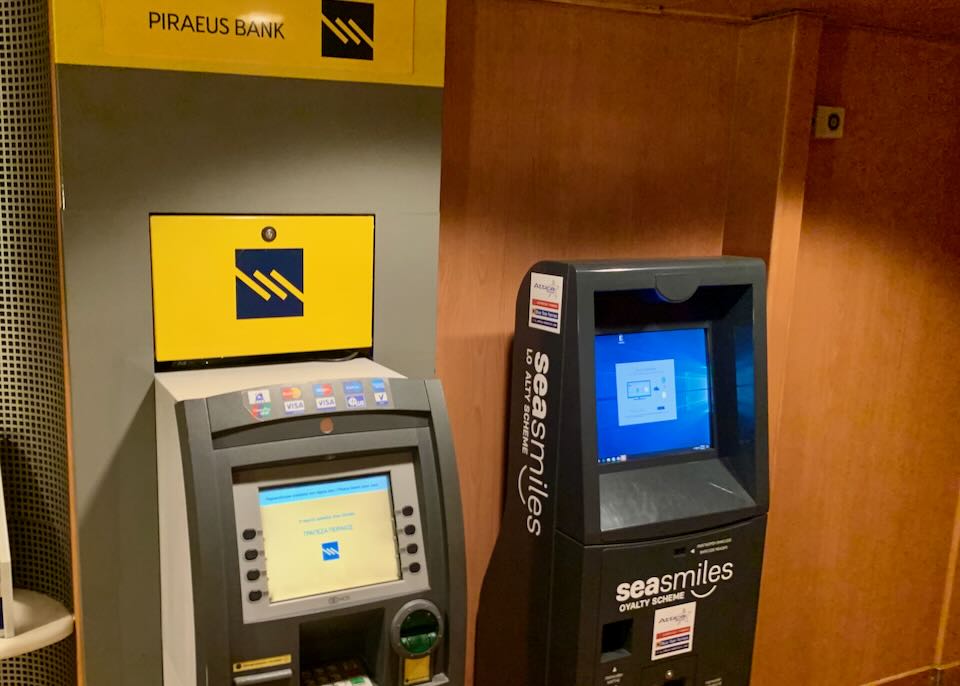
Some larger Greek ferries have ATMs onboard, but I would treat them only as a backup. Withdraw cash before boarding if you think you will need it.
Cash can be handy for small port kiosks, a taxi after arrival, baggage assistance, and local boats or water taxis.
My Greek Ferries Guide covers schedules, tickets, ports, boarding, luggage, delays, and choosing the right ferry.
Using Cards for Car Rentals
Car rentals are one place where the exact card rules matter.
Many rental companies require:
- A physical credit card
- The card to be in the main driver’s name
- Enough available credit for the security deposit
- The physical card rather than only Apple Pay or Google Pay
Some companies accept debit cards for the deposit and others do not. Prepaid and virtual cards are less dependable. Read the payment rules before booking and check the required deposit amount.
My Greece Car Rental Guide explains deposits, insurance, driving rules, rental locations, and which destinations actually require a car.
Gas Stations
Most staffed gas stations accept Visa and Mastercard, and an employee will normally pump the fuel for you.
In remote areas, keep some cash and do not wait until the tank is nearly empty. Unattended pumps can require a PIN or place a temporary authorization hold on your card, another good reason to use a credit card rather than a debit card.
Markets, Kiosks, Bakeries, and Beaches
Cards are common even for very small purchases in Greece. It is normal to tap for a coffee, pastry, bottled water, or inexpensive supermarket purchase.
Cash is most useful at farmers’ markets, roadside produce stands, remote beach canteens, seasonal parking areas, village festivals, and small local boat services.
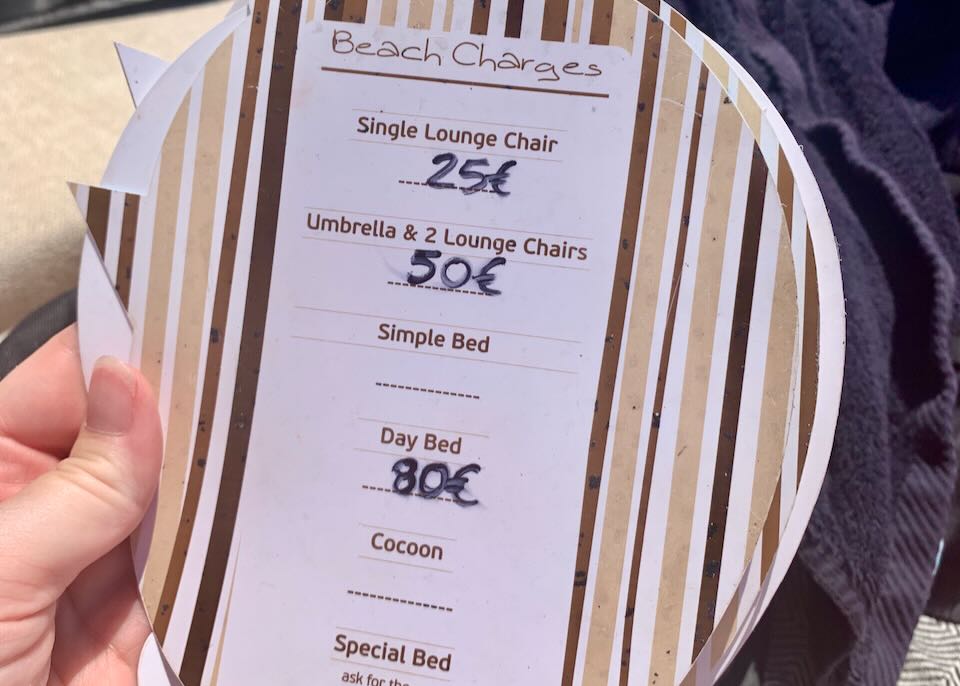
Many organized beaches charge for umbrellas and sunbeds. Larger beach clubs accept cards, but carrying a little cash is still handy at smaller and more remote beaches.
Established beach clubs in Santorini, Mykonos, Crete, Rhodes, Paros, and other popular destinations accept cards. If you are spending the day at a remote beach, withdraw cash in town first.
Foreign Transaction Fees
Your card issuer may add a foreign transaction fee to purchases in Greece, commonly around 1% to 3%. Many travel cards charge nothing.
Before departure, check your cards for foreign transaction fees, international ATM fees, cash-advance fees, and daily withdrawal limits.
Use a no-foreign-transaction-fee credit card if you have one. And still choose euros at the terminal. Paying in your home currency does not avoid an international transaction and usually gives you a worse exchange rate.
My Greece Money Checklist
- Bring at least two cards: Preferably Visa or Mastercard cards from different banks.
- Use a credit card for purchases: Especially hotels, rental cars, and larger charges.
- Use a debit card at ATMs: Avoid credit-card cash advances.
- Keep €100 to €200 in cash: Carry more only when your itinerary makes it useful.
- Carry small notes: €5, €10, and €20 notes are easiest to use.
- Always choose euros: Decline ATM and card-terminal conversion into your home currency.
- Prefer Greek bank ATMs: Check any fee before confirming the withdrawal.
- Bring the physical card: Do not depend entirely on Apple Pay or Google Pay.
- Keep your backup separate: Do not put both cards and all your cash in one wallet.
Frequently Asked Questions
Can I use a U.S., Canadian, British, or Australian credit card in Greece?
Yes. International Visa and Mastercard cards are widely accepted. Use a card without a foreign transaction fee if possible and pay in euros.
Is Visa or Mastercard better in Greece?
Both work well. American Express is less dependable, and Discover should not be your only card.
Should I get euros before my trip?
It can be convenient to arrive with €50 to €100, but there is no need to obtain your full cash budget before leaving home.
Should I accept the ATM exchange rate?
No. Decline conversion and withdraw in euros.
Can I use Apple Pay in Greece?
Yes. Apple Pay and Google Pay work at most contactless terminals. Carry a physical card as backup.
Do taxis in Greece accept cards?
Yes. Taxis are required to accept card payments. I still keep enough cash for the fare in case the terminal is not working.
Can I tap a bank card on Athens public transport?
Yes. Contactless Visa and Mastercard, Apple Pay, and Google Pay work directly on Athens Metro, tram, bus, and trolley validators. Use the same card or device throughout the day.
Can I pay for Greek ferries by card?
Yes. Major ferry websites, travel agencies, and port ticket offices accept cards.

About Santorini Dave