Greece › Is Greece Safe?
Updated: September 1, 2026 • By Santorini Dave
Questions? dave@santorinidave.com
My Guides
- Where to Stay in Athens
- Where to Stay in Santorini
- Where to Stay in Mykonos
- Where to Stay in Naxos
- Where to Stay in Paros
- Where to Stay in Crete
- Where to Stay in Corfu
- Where to Stay in Rhodes
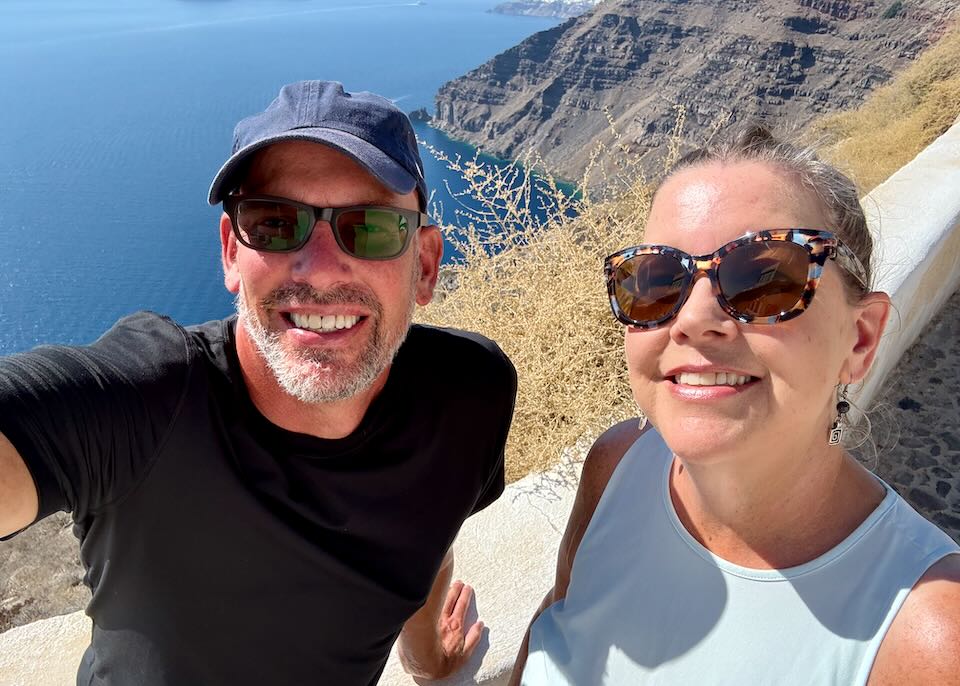
My wife and me overlooking the Santorini caldera. Greece is safe for normal tourism. The problems most likely to affect a trip are heat, swimming, road accidents, ferry delays, wildfires, and petty theft in crowded areas.
Yes, Greece is safe to visit. The U.S. State Department rates Greece Level 1: Exercise Normal Precautions, its lowest advisory level.
The biggest risks for tourists are not violent crime or war. They are stolen phones on the Athens Metro, extreme summer heat, swimming after drinking, scooter and ATV accidents, wildfires, rough seas, and ferry or flight connections booked too tightly.
Athens requires normal big-city awareness. The popular islands are safe and relaxed, but their hazards are different: narrow roads, strong sun, cliffs, boats, swimming, alcohol, and limited medical care on smaller islands.
Greece Safety Update: September 2026
- Greece remains safe for normal tourism. There is no nationwide travel warning or shutdown.
- Official U.S. advisory: Level 1: Exercise Normal Precautions.
- Wildfires: Greece had several serious wildfires in August, including fires and evacuations on Crete. Fire season is not over, especially during hot, dry, windy weather. Check the official fire-risk map and 112 alerts for your destination.
- Heat: Extreme temperatures can lead to midday closures or restricted hours at exposed archaeological sites, including the Acropolis.
- Protests: Demonstrations are possible in central Athens, including protests connected to Greek politics and the conflict in Israel and Gaza. Avoid active demonstrations, particularly around Syntagma and Parliament.
- Strikes: Ferry, rail, Metro, taxi, and air-travel strikes can be announced with limited notice. Check again before important travel days.
- Middle East conflict: There is no official advice against visiting Greece because of the conflict. Demonstrations, additional security, and occasional flight changes are the more realistic effects for travelers.
- EU border checks: The Entry/Exit System is operating at external Schengen borders. First-time biometric registration can add time at passport control. ETIAS is not yet operating.
- Emergency number: 112.
Is Greece Safe for Tourists?
Yes. The better question is not “Is Greece dangerous?” It is “What is most likely to cause a problem on my trip?”
The problems I hear about most are:
- A phone or wallet stolen on the Athens Metro
- Heat exhaustion during midday sightseeing
- A missed flight after a delayed ferry
- A scooter or ATV accident on an island
- Swimming after drinking or ignoring wind and sea conditions
- Luggage stolen from a rental car
- A strike, wildfire alert, or local closure disrupting one travel day
Use a secure bag, respect the heat and sea, avoid casual ATV rentals, and leave a buffer before important flights.
Is Athens Safe?
Yes, Athens is safe for tourists, but it needs more awareness than the islands.
Plaka, Syntagma, Monastiraki, Koukaki, Kolonaki, Psiri, and the streets around the Acropolis Museum are busy with visitors throughout the day and evening, and are the best places to stay in Athens for first-time visitors. The main concern in Athens is petty theft, not violent crime.
Be most alert:
- On crowded Metro trains and platforms
- On the Metro line between Athens Airport and the center
- At Syntagma, Monastiraki, and Omonia stations
- On escalators and while entering or leaving train cars
- At ticket machines, where distractions are easy to create
- Around Piraeus, bus stops, and ferry boarding areas
The airport Metro is an obvious target because travelers are carrying passports, phones, luggage, and wallets while trying to figure out where they’re going. Before getting on the train, put your passport, wallet, and phone somewhere secure. Don’t wait until you’re standing on a crowded platform with your luggage.
Athens traffic is a more immediate physical danger than crime. Look carefully before crossing, even when the pedestrian signal is in your favor. Scooters can appear between cars, and drivers do not always yield as predictably as visitors expect. Omonia and some nearby streets feel rougher than Plaka or Syntagma, especially late at night. First-time visitors who want an easy and comfortable base will be happier closer to Syntagma, Plaka, Monastiraki, Koukaki, or Kolonaki.
Are the Greek Islands Safe?
Yes, Santorini, Mykonos, and all the Greek islands are safe for ordinary tourism. Most feel calmer than Athens, and serious crime involving visitors is uncommon.
On Santorini, watch for steep stairs, unfenced drops, narrow roads, traffic, and hotel terraces or pools built against the caldera cliffs. Families should look carefully at hotel layouts before booking. A beautiful cave hotel can have dozens of steps and drops that would never be permitted at a large family resort.
Mykonos and Ios have more alcohol and nightlife-related problems: lost phones, poor judgment, dark roads, unsafe rides home, and swimming after drinking.
Crete, Rhodes, Corfu, and other large islands can require longer drives. Mountain roads are narrow and winding, and distances are greater than they appear on a map. On smaller islands, a serious injury or illness can require transfer to a larger island or Athens.
Many island roads lack sidewalks and streetlights. A hotel described as a short walk from town can be unpleasant or unsafe after dark if the route follows a busy road. Check the actual walking route before booking, not just the distance.
The Main Safety Risks in Greece
Pickpocketing and Theft
Petty theft is the main crime problem for tourists, particularly in Athens. Be especially careful on Metro trains and escalators, station platforms, airport routes, ferry ports, sightseeing streets, and anywhere you’re handling luggage. Be suspicious if someone creates a distraction near a train door, ticket machine, café table, or crowded sidewalk.
Keep a clear photo of your passport stored on your phone. It will not replace the passport, but it makes dealing with an embassy much easier if the original disappears. On days you aren’t changing hotels, leave your physical passport behind in your room, ideally in the safe. Carry only the cash you need for the day and keep a backup credit card stored separately. For a complete breakdown, read my advice on cash vs credit cards in Greece.
Do not leave suitcases, backpacks, laptops, passports, cameras, or shopping bags visible in a parked rental car. Personally, I would never leave my passport in a car, even in the trunk.
Heat and Sun
Athens, the mainland, and exposed archaeological sites can be brutally hot in July and August. The Acropolis and other outdoor attractions can close or restrict access during extreme temperatures, sometimes with little notice.
Visit the Acropolis first thing in the morning or later in the afternoon. Do not plan a long archaeological site, a walking tour, and several exposed neighborhoods back-to-back in the middle of the day. Carry water, sunscreen, and a hat, and take a midday break somewhere cool. Wind on the islands can make the temperature feel comfortable while your skin is burning.
Young children, older visitors, pregnant travelers, and anyone who struggles with heat or mobility need a less ambitious schedule. In July and August, I would plan fewer afternoon activities than I would in April, May, September, or October.
Wildfires
Wildfires are a serious risk during hot, dry, windy weather. The main fire season runs from April through October, with the greatest concern during summer. The risk is local, so a fire on one part of Crete, Rhodes, Corfu, or another large island does not mean the entire island is affected.
Check the official Daily Fire Risk Map before hiking, driving through dry rural areas, or spending a day at a remote beach.
Greece uses the 112 emergency-alert system. If you receive an evacuation message, follow it immediately.
- Keep your phone charged and emergency alerts enabled.
- Download offline maps before driving in remote areas.
- Do not enter closed forests, roads, gorges, or trails.
- Do not light barbecues or discard cigarettes in dry areas.
- Leave immediately when authorities order an evacuation.
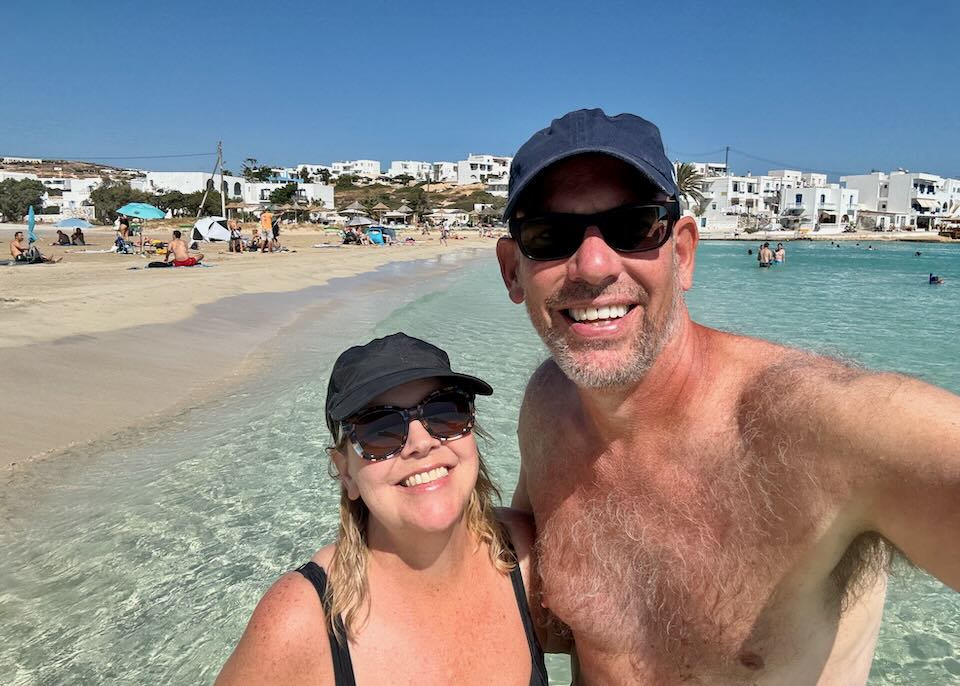
My wife and I swimming in Greece.
Swimming and Drowning
Beautiful weather does not always mean easy swimming. Offshore winds, currents, sudden drop-offs, slippery rocks, boat traffic, and beaches without lifeguards can create real danger.
My most important rules:
- Do not swim after drinking.
- Do not swim alone at a remote beach.
- Do not dive into unfamiliar water.
- Respect red flags, local warnings, and boat-crew instructions.
- Watch young children continuously around pools, beaches, and ferry decks.
- Wear a life jacket when you are not a confident swimmer.
Offshore wind can push inflatable floats, paddleboards, kayaks, and weak swimmers away from land, particularly in the Cyclades. Many Greek beaches have no lifeguard. If the water looks rough, locals are staying out, or a boat captain cancels a swimming stop, stay out of the water.
Driving, Scooters, and ATVs
Island roads can be steep, narrow, poorly lit, and shared by buses, rental cars, scooters, pedestrians, delivery vehicles, and ATVs.
A car can greatly improve a trip on Crete, Naxos, Paros, Rhodes, Corfu, or the Peloponnese. I am not anti-car in Greece.
I am anti-ATV rental by travelers who would never ride one at home.
Do not rent a scooter or ATV unless you are experienced, sober, and comfortable with the specific vehicle. Wear a real helmet. Check that your travel insurance covers the vehicle. Many policies exclude scooters, mopeds, or quad bikes when the rider lacks the correct licence or helmet. Do not assume a slow ATV is safe simply because it looks easier than a motorcycle. ATVs can be unstable and offer little protection in a collision. On Santorini and Mykonos, buses, taxis, hotel transfers, and private drivers are often better choices, especially after dark.
When driving:
- Do not drink.
- Use headlights on dark island roads.
- Expect sharp bends and vehicles crossing the center line.
- Do not follow online maps blindly onto unpaved tracks.
- Allow more time than the distance suggests.
Ferries, Wind, and Travel Disruption
Greek ferries are safe and used daily by residents and visitors. Wind, rough seas, port congestion, mechanical problems, and strikes can delay or cancel sailings. High-speed ferries are more vulnerable to rough conditions and can be uncomfortable for passengers prone to seasickness.
Never book the final ferry to Athens on the same day as a long-haul international flight. Spend the last night in Athens or near the airport. A ferry scheduled to arrive at noon does not give you a safe margin for a 4pm flight.
For a smooth trip:
- Check the ferry status the day before and again on the morning of travel.
- Arrive at the port with plenty of time to find the correct gate.
- Keep passports, medication, and valuables in your hand luggage.
- Choose a larger conventional ferry if seasickness or rough weather worries you.
See my Greek Ferries Guide for schedules, tickets, ports, luggage, and choosing between high-speed and conventional ferries.
Protests and Strikes
Demonstrations are common in Athens. Syntagma Square, Parliament, Panepistimiou Avenue, university districts, and the streets around some embassies are common locations. Do not stop to watch an active demonstration. Even a peaceful gathering can block roads and Metro stations or turn confrontational.
Strikes are more likely to disrupt a trip. Ferry crews, taxi drivers, Metro workers, rail employees, public-sector workers, and air traffic controllers can take industrial action, sometimes with short notice. Leave some flexibility around important travel days.
Earthquakes
Greece is in an active seismic zone, though most visitors never experience a significant earthquake. During strong shaking, protect your head and neck and stay away from glass, exterior walls, shelves, and heavy objects that could fall. Do not run onto stairs while the building is shaking or use an elevator immediately afterward.
Is Greece Safe Because of the Middle East Conflict?
Yes, for ordinary tourism. There is no official advice against visiting Greece because of the Middle East conflict. Travelers are more likely to encounter demonstrations, increased security, or occasional flight changes than anything directly connected to the fighting.
Alcohol, Nightlife, and Personal Safety

Travel blogger, heal thyself. These are consecutive photos in my camera roll: one minute, a beer in Athens; the next, a quick visit to a travel clinic after missing a step at a restaurant. All was fine, but it was a useful reminder to slow down and watch your footing.
Most nightlife problems involve lost phones, too much alcohol, dangerous rides home, falls, drink spiking, or swimming after drinking. Keep your drink with you, stay with your group, and know how you are getting back to the hotel. Use an official taxi, a taxi-hailing app such as Free Now or Uber where available, or a prearranged transfer when the route involves a dark road.
Do not drive, ride a scooter or ATV, swim, operate a boat, or walk a cliffside path after drinking. Go easy on alcohol on beach, boat, and travel days.
Is Greece Safe for Solo Women, Families, and Older Travelers?
Solo Female Travelers
Greece is a good destination for solo women. Watch your drink, use reliable transport late at night, and avoid isolated walks back to remote hotels. The awkward moment on many islands is not walking through town. It is returning to a remote beach hotel along a dark road with no sidewalk. Check the route before booking.
Families With Children
Greece is safe and welcoming for families, but parents need to look closely at pools, balconies, ferry decks, beaches, and traffic. Santorini caldera hotels can have steep steps and large drops with limited barriers. Many are wonderful for older children but poor choices for toddlers. Villa pools rarely have fences, beaches often lack lifeguards, and cars and scooters can pass close to pedestrians on narrow island lanes.
Older Travelers and Visitors With Medical Conditions
Heat, steep streets, uneven paving, ferry boarding, hotel stairs, and limited medical access are the main concerns. Athens, Thessaloniki, Heraklion, Rhodes Town, and Corfu Town have far better medical facilities than a small Cycladic island. If access to urgent or specialist care is important, choose your island and hotel carefully. Look for elevators, road access, and limited stairs. “Five minutes from the center” can still mean a steep uphill climb over polished stone.
LGBTQ+ Travelers
Greece is generally welcoming to LGBTQ+ travelers, especially in Athens, Thessaloniki, Mykonos, Santorini, Crete, and other major destinations. Mykonos is one of Europe’s best-known LGBTQ-friendly islands, and Athens has the country’s largest LGBTQ scene. Smaller villages and rural areas can be more conservative.
Jewish Travelers
Greece has important Jewish heritage sites in Athens, Thessaloniki, Rhodes, Corfu, and other destinations. During periods of heightened international tension, expect additional security around some synagogues, Jewish museums, embassies, and community buildings. Avoid political demonstrations and check opening hours, identification requirements, and security procedures before visiting Jewish sites.
Travelers of Color
Racially motivated incidents can occur in Greece, as they can elsewhere in Europe, but they are not a common problem reported by tourists. If you experience harassment, move to a busy public place and report a serious incident to police, hotel staff, or another local authority.
Medical Care, Insurance, and Emergencies
Medical care is best in Athens and Thessaloniki. Large islands such as Crete, Rhodes, Corfu, and Kos have hospitals and more specialist care than small islands. A tiny island may have only a clinic or health center, and serious cases can require transfer to a larger island or Athens.
Travel medical insurance is strongly recommended, particularly for island trips. Check that your policy covers emergency treatment, medical evacuation, trip interruption, and any scooters, ATVs, boats, hiking, diving, or other activities you plan to do.
Bring prescription medication in its original packaging and pack more than the exact amount needed. Some medicines available legally at home may be controlled in Greece, so travelers carrying unusual, injectable, narcotic, or psychotropic medication should check the rules before arriving.
The emergency number throughout Greece is 112. It connects callers with police, fire, ambulance, and other emergency services. The 112 system also sends location-based alerts for wildfires, extreme weather, and evacuations.
Entry Procedures and Border Delays
The EU Entry/Exit System is fully operating at external Schengen borders. It records passport details, facial images, fingerprints when required, and entry and exit dates for most non-EU visitors traveling for short stays. First-time registration can take longer than a normal passport check.
If you land in Athens from outside Schengen and continue on a separately ticketed island flight or ferry, leave a generous buffer. When you connect through Paris, Frankfurt, Amsterdam, Rome, Madrid, or another Schengen airport, you normally complete passport control there rather than in Athens.
ETIAS is not yet operating as of September 1, 2026. Applications are not yet open.
See my Greece Entry Requirements page for EES, ETIAS, passport validity, visa rules, and connection advice.
My Greece Safety Checklist
- Protect your passport: Do not treat your passport like you would a credit card. “If I lose it, I’ll just get another one.” Nope. If you lose it, expect a major disruption to your travel plans.
- Use a secure bag: Especially on the Athens Metro and at ports.
- Avoid the midday heat: Do major outdoor sights early or late in July and August.
- Check wildfire conditions: Especially before hikes, rural drives, and remote beach days.
- Do not swim after drinking.
- Avoid casual ATV rentals.
- Do not cut ferry-to-flight connections close.
- Check for strikes before important travel days.
- Know the walking route to your hotel: Not just the distance on a map.
What I Actually Worry About in Greece
- A tight ferry-to-flight connection
- A wallet in a back pocket on the Athens Metro
- Swimming after drinking
- An inexperienced traveler renting an ATV on Santorini
- Passports left visible in a rental car
- Walking along an unlit island road after dinner
- My wife shopping too much and then putting half of her purchases in my bag because I packed sensibly and she knows I have extra space
What I Do Not Worry Much About
- Being targeted simply for being an American tourist
- Violent crime in tourist areas
- Taking a Greek ferry in normal weather
- Traveling with children
- Headlines about conflicts outside of Greece
Frequently Asked Questions
Is Greece safe right now?
Yes. The U.S. State Department rates Greece Level 1: Exercise Normal Precautions. Check local wildfire, strike, and transportation conditions before important travel days.
Is Greece safe for American tourists?
Yes. Americans do not face any unusual safety problem in Greece. Pickpocketing, heat, swimming, road accidents, and travel disruption are much more realistic concerns.
Is Athens safe?
Yes. Watch your belongings on the Metro, stay away from active demonstrations, and pay attention to traffic.
Is Athens safe at night?
Plaka, Monastiraki, Psiri, Syntagma, Koukaki, and Kolonaki stay busy well into the evening. Use more caution on quiet side streets and around Omonia late at night. The actual walk from a restaurant to your hotel matters more than the neighborhood name alone.
Are the Greek islands safe?
Yes. On the islands I worry more about swimming, scooters and ATVs, narrow roads, cliffs, alcohol, and medical access than crime.
Is Greece safe for solo female travelers?
Yes. Use reliable transport late at night, watch your drink, and check the walking route before booking a remote hotel.
Is Greece safe for families?
Yes. Pay particular attention to unfenced pools, balconies, cliffside terraces, traffic, ferry decks, and beach conditions.
Is Greece safe because of the Middle East conflict?
Yes, for ordinary tourism. There is no official warning against visiting Greece because of the conflict.
Are wildfires a danger in Greece?
Yes, locally. Risk is highest during hot, dry, windy weather from spring through early fall. Check the official Fire Risk Map and follow 112 alerts immediately.
Is swimming safe in Greece?
Yes, when conditions are good. Do not swim after drinking, dive into unfamiliar water, ignore warning flags, or leave children unsupervised near pools or the sea.
Is it safe to drive in Greece?
Yes. Island and mountain roads can be narrow, steep, dark, and winding. Avoid scooters and ATVs unless you are experienced, properly licensed, and insured.
Are Greek ferries safe?
Yes. Delays, cancellations, rough seas, and missed connections are much more likely to cause problems than a serious onboard accident.
Do strikes make Greece unsafe?
No. They cause travel disruption. Check transportation updates before important travel days.
What is the emergency number in Greece?
Dial 112 for police, fire, ambulance, or another urgent emergency. The 112 system also sends wildfire, evacuation, and severe-weather alerts.
Do I need travel insurance for Greece?
I recommend it, especially for smaller islands where a serious medical problem can require evacuation. Check the policy carefully if you plan to rent a scooter or ATV.
Bottom Line
Greece is safe to visit. The things I worry about most are pickpockets on the Athens Metro, road and ATV accidents, swimming after drinking, summer heat and wildfires, and leaving too little time between a ferry and an international flight.

About Santorini Dave