Greece › Best Greek Islands
Updated: October 3, 2026 • By Santorini Dave
Questions? dave@santorinidave.com
Santorini is the best Greek island for a first visit, Naxos is the island I recommend most often, and Crete is the best choice if you want to spend a week on one island. Mykonos is best for nightlife and beach clubs, Paros for couples, Milos for scenery and boat tours, and Rhodes for beaches and history.
For a first trip, my favorite combination is Athens, Naxos or Paros, and Santorini. With one week, choose one island rather than rushing through three. With 10 to 14 days, two or three islands is plenty.
See my Greece itinerary and how many days in Greece guides before booking too many stops.
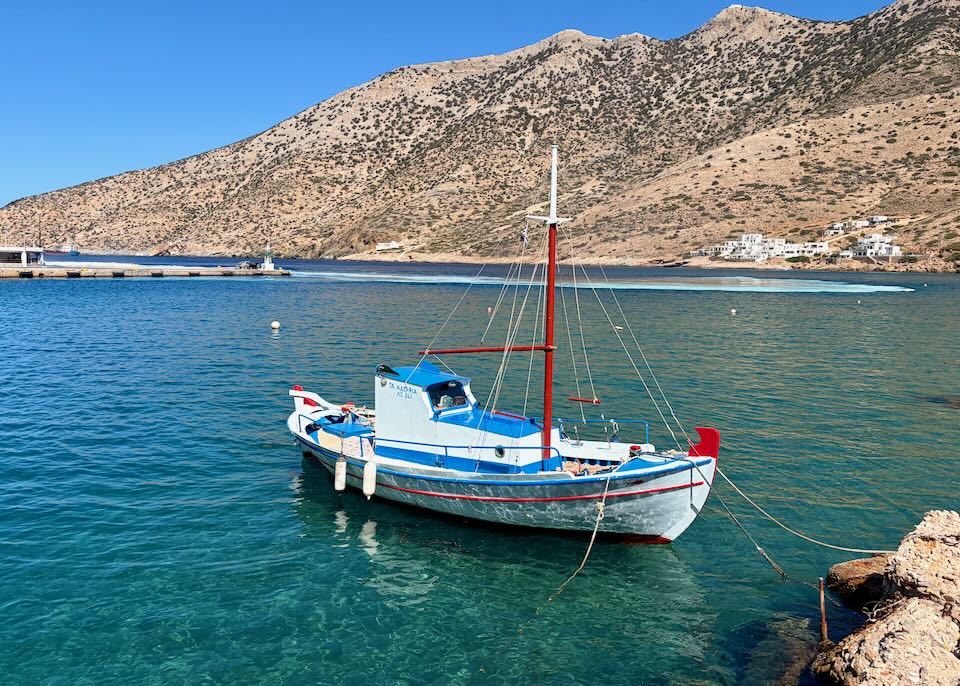
The Cyclades are the best island group for a first trip to Greece, with famous islands like Santorini and Mykonos, beautiful beaches, easy ferry connections, and quieter islands like Sifnos, pictured here.
Best Greek Islands at a Glance
- Best first island: Santorini
- Best all-around island: Crete
- Best beaches and families: Naxos
- Best nightlife and beach clubs: Mykonos
- Best for couples: Paros
- Best scenery and boat tours: Milos
- Best history: Rhodes and Crete
- Best food: Crete, Naxos, and Sifnos
- Best hiking: Sifnos, Crete, and Folegandros
- Best quiet island: Folegandros or Sifnos
- Best close to Athens: Hydra
- Best for island hopping: The Cyclades
My Favorite Greek Islands
1. Santorini
Santorini is my favorite island in Greece and the one I would choose for a first visit. The Fira-Oia hike, a caldera boat tour, wineries, Akrotiri, and time enjoying the view from your hotel are the highlights.
The drawbacks are real. Santorini is expensive, crowded, and not a great beach island. Stay in Imerovigli for views and a quieter atmosphere, Fira for restaurants and transportation, or Oia for beauty and high-end hotels.
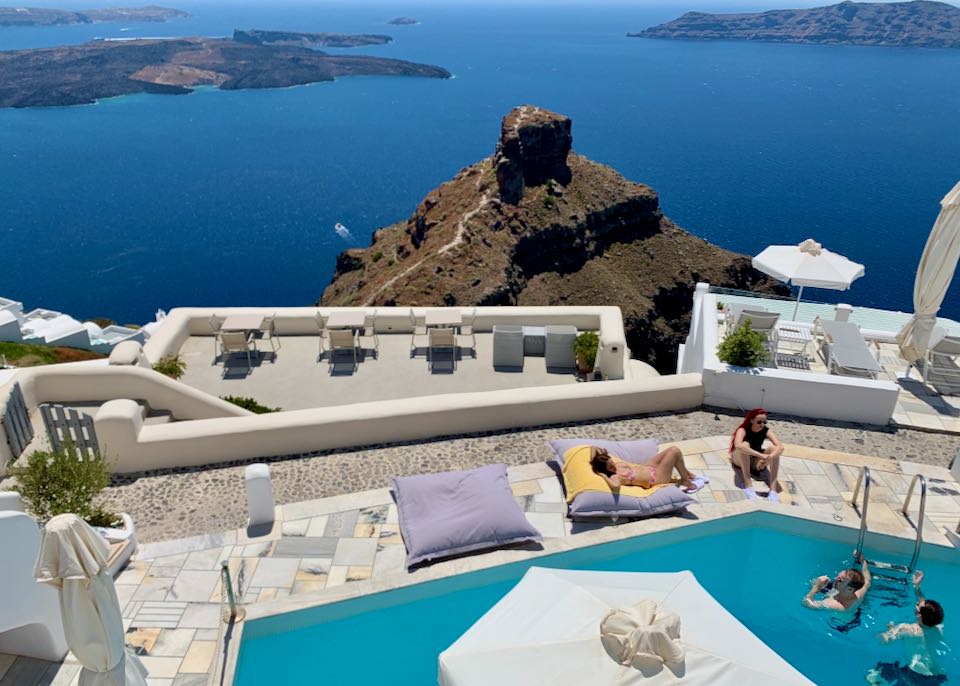
Santorini has the most spectacular scenery in the Greek islands. See my guide to the best hotels in Santorini.
2. Naxos
Naxos is the island I recommend most often. It has long sandy beaches, excellent food, family-friendly hotels, a lively main town, mountain villages, hiking, and better value than Santorini or Mykonos.
Families can stay near shallow, sandy beaches and still walk to restaurants and shops. Rent a car for a day or two to explore Halki, Filoti, Apeiranthos, and the inland countryside.
Stay near Agios Georgios for easy access to Naxos Town, or at Agios Prokopios, Agia Anna, or Plaka for a beach-focused stay.
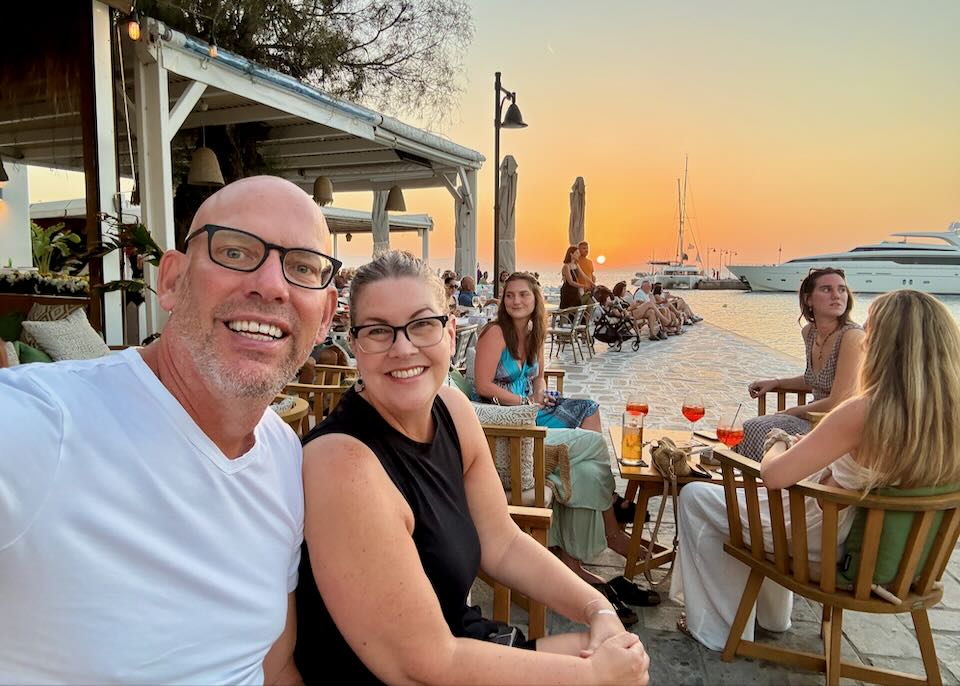
My wife and I in Naxos Town (Chora).
3. Crete
Crete is the best choice if you want to spend a week or longer on one Greek island. It has excellent beaches and food, important archaeological sites, real cities, mountain and gorge hikes, and traditional villages.
It is also enormous. Give Crete at least five nights and focus on one region. Chania is the best base for a first stay in western Crete. Heraklion is best for Knossos and the archaeological museum. Rethymno has an attractive old town and easy beach access. Elounda has some of the best beach resorts in Greece.
A rental car is useful outside the cities. Do not treat Crete like a small Cycladic island that can be covered in two nights.
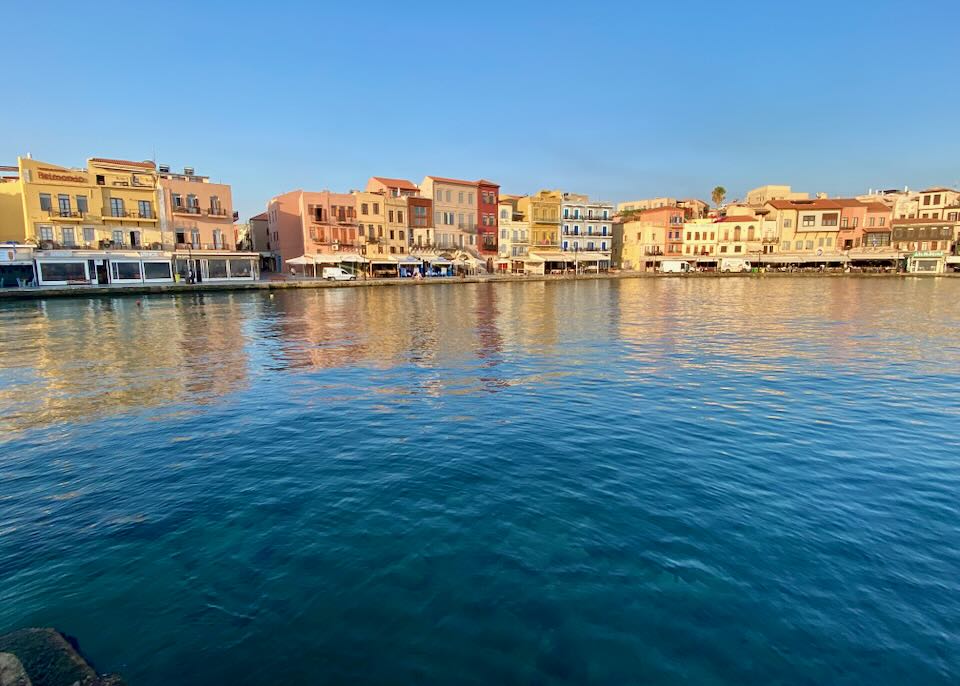
4. Paros
Paros sits somewhere between Naxos and Mykonos. It has good beaches and villages like Naxos, but more stylish hotels, shopping, restaurants, and nightlife. It feels livelier than Naxos without the prices and party scene of Mykonos.
Naoussa is the prettiest and most fashionable base. Parikia is more practical for ferries, buses, and a wider range of hotels. Families and beach-focused travelers should also consider Aliki, Piso Livadi, or Golden Beach.
I especially like Paros for couples and groups who want beaches, good restaurants, shopping, and nightlife without going to Mykonos.
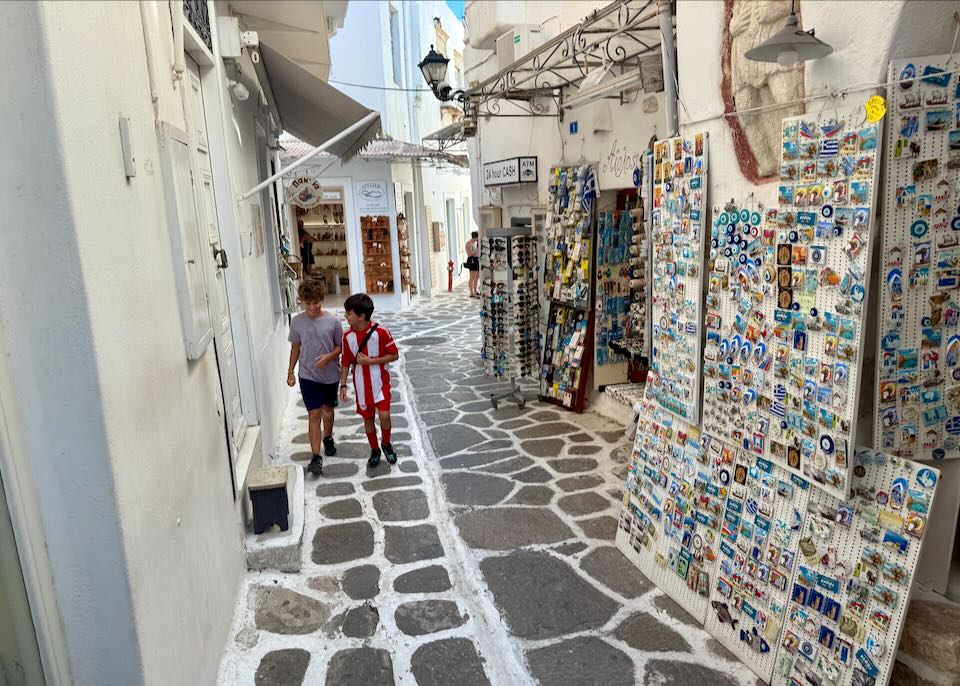
Parikia is the ferry port and most practical base in Paros.
5. Milos
Milos has an unusual volcanic coastline, excellent beaches, and some of the best boat tours in Greece. Sarakiniko gets most of the attention, but a boat tour is essential for seeing the coast.
A boat tour to Kleftiko reaches caves, cliffs, and swimming spots that are difficult or impossible to see by road. The colorful fishing villages of Klima, Mandrakia, and Firopotamos are also highlights.
Milos is less convenient than Naxos or Paros without a car. Stay in Adamas for transportation, Pollonia for a quieter seaside base, or Plaka for atmosphere and sunset views.
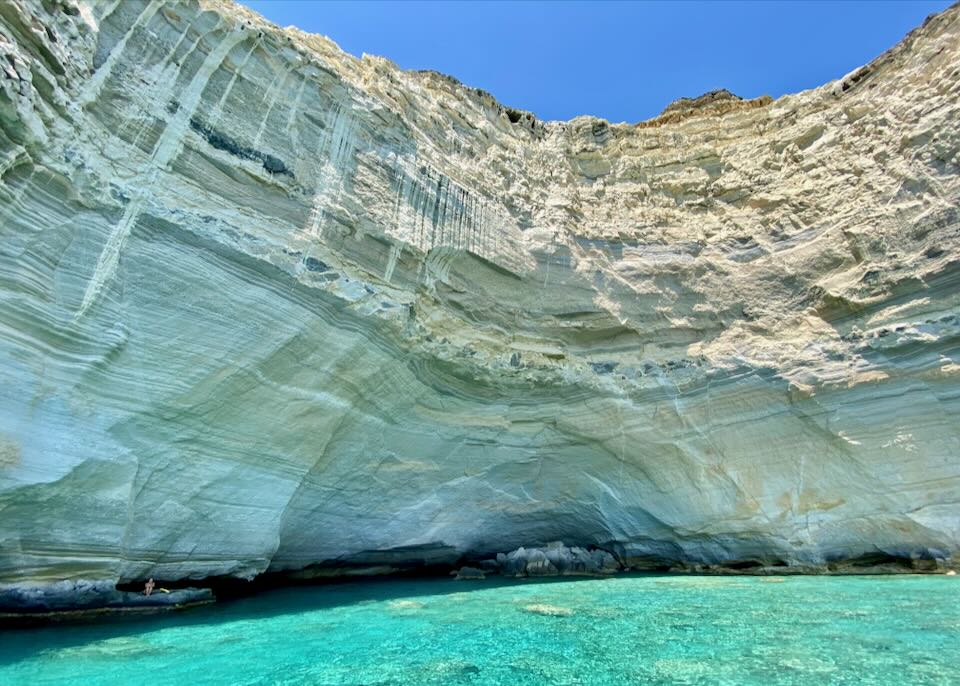
The Kleftiko boat tour in Milos.
6. Mykonos
Mykonos is the best Greek island for nightlife, beach clubs, luxury hotels, and shopping. Mykonos Town is beautiful, the beaches are excellent, and the island is easy to combine with Paros, Naxos, or Santorini.
It is also expensive, crowded, windy in summer, and not especially relaxing in peak season. Mykonos is fun if you want what it does well, overpriced if you do not.
Stay in Mykonos Town for nightlife and restaurants, Ornos for families and resort convenience, or Platis Gialos for the beach and water-taxi connections.

My wife and I at the Mykonos windmills. Mykonos is known for nightlife, beaches, and beach clubs.
7. Rhodes
Rhodes has excellent beaches, easy logistics, a long swimming season, and one of the most impressive old towns in Greece. Rhodes Town and Lindos make it especially good if you want both beaches and history.
Rhodes is large enough for a full week without changing islands. Stay in Rhodes Town for history and restaurants, Lindos for beauty and romance, or along the east coast for beaches and resorts.
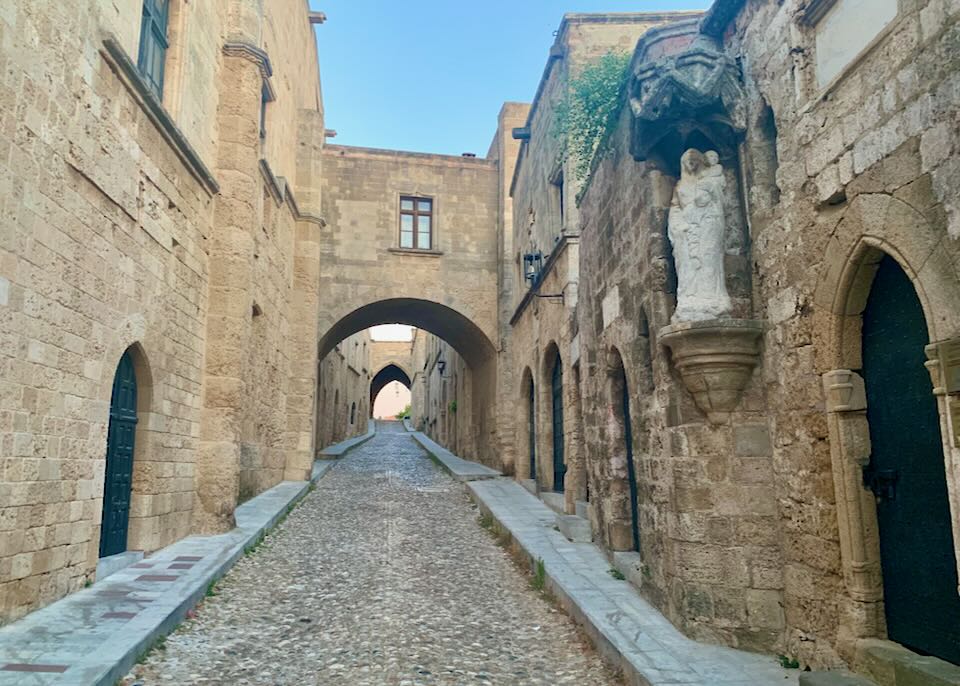
A quiet medieval street in Rhodes Old Town, one of the best-preserved walled cities in Europe.
8. Corfu
Corfu looks and feels completely different from the Cyclades. It is green, wooded, and heavily influenced by its Venetian past. Corfu Town is one of the most attractive towns in Greece, and the island has good beaches, villages, resorts, and scenic drives.
Corfu does not combine efficiently with Santorini, Mykonos, or the other Cycladic islands, so make it the main island stay or pair it with mainland Greece.
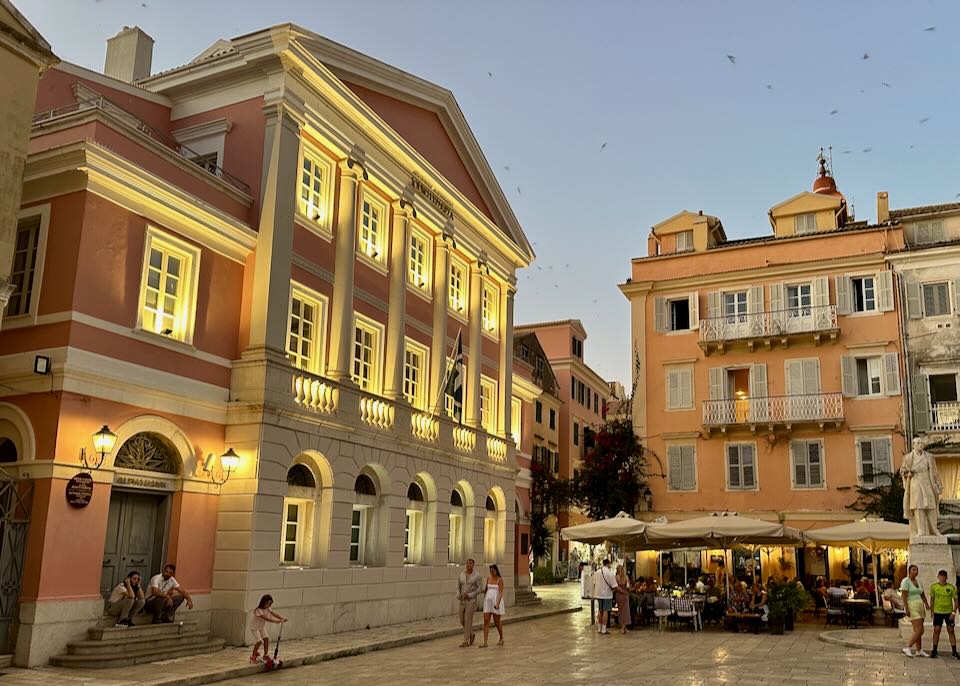
Corfu Town comes alive after sunset.
9. Sifnos
Sifnos is one of my favorite smaller Greek islands. It has excellent food, beautiful villages, good beaches, and the best trail network in the Cyclades. It is much quieter than Santorini, Mykonos, Naxos, or Paros.
Apollonia is the best base for restaurants, bars, and exploring the island. Kamares is the ferry port and has an excellent sandy beach. Platis Gialos is best for a beach-focused stay. Buses connect the main villages and beaches, and a rental car is useful but not essential.
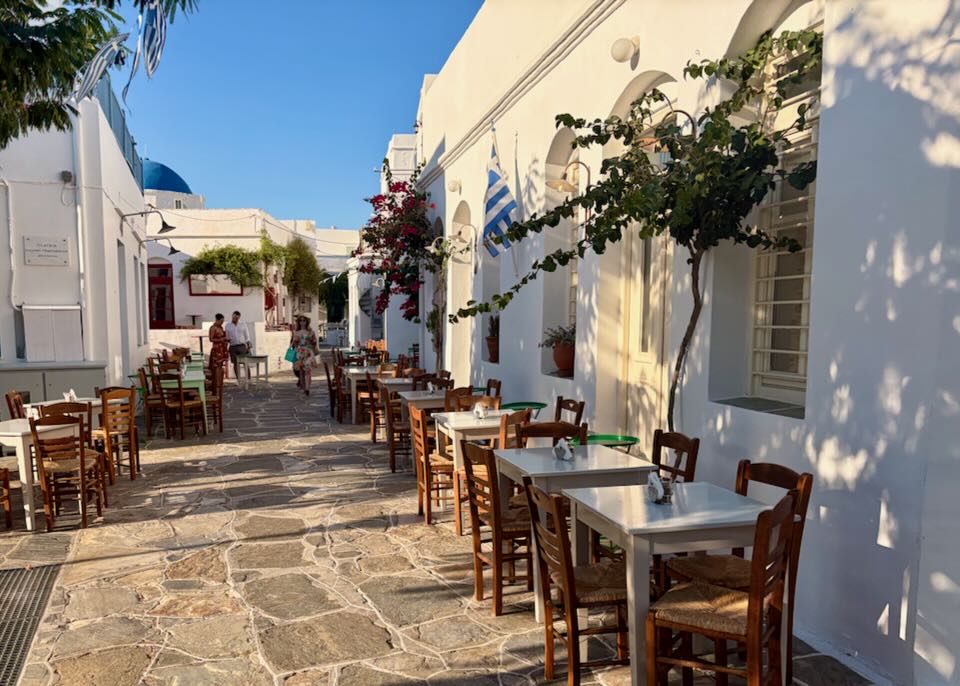
A quiet morning in Apollonia, the capital of Sifnos and my favorite base on the island.
Best Greek Island by Travel Style
Best Greek Island for First-Time Visitors: Santorini
Three or four nights is enough for the caldera villages, Fira-Oia hike, boat tour, wineries, and Akrotiri. For a longer trip, combine Santorini with Naxos or Paros rather than adding Mykonos automatically.
Best Greek Island for Families: Naxos
Naxos has shallow sandy beaches, family-friendly hotels, casual restaurants, and a main town that is easy to explore without a car.
Best Greek Island for a Honeymoon: Santorini
No other island matches Santorini for caldera views, private plunge pools, sunset dinners, and romantic hotels. Stay in Imerovigli or Oia and spend enough time at the hotel to enjoy what you are paying for. See my guide to the best honeymoon hotels in Santorini.
Best Greek Island for Couples: Paros
Paros has great restaurants, cocktail bars, beaches, shopping, and stylish hotels without the prices and intensity of Mykonos. Naoussa is the best base for couples who want busy evenings without staying on a party island.
Best Greek Island for Nightlife: Mykonos
Mykonos has Greece’s biggest beach clubs, most fashionable bars, and strongest late-night scene. Ios is younger and cheaper. Paros has good nightlife without making it the focus of the whole trip.
Best Greek Island for Beaches: Naxos
Naxos is my favorite beach island. Agios Prokopios, Agia Anna, and Plaka form a long stretch of beautiful sand with clear water and plenty of restaurants and hotels. Mykonos is better for fully serviced beaches and beach clubs. Crete has spectacular individual beaches, but many take more effort to reach.
Best Greek Island for Food: Crete
Crete is my first choice for food. Naxos is also excellent, especially for local cheese, potatoes, meat, and family-run tavernas. Sifnos has a long culinary tradition and is my favorite smaller island for food.
Best Greek Island for History: Rhodes or Crete
Choose Rhodes for its medieval Old Town, Lindos, and easy sightseeing. Choose Crete for Knossos, the Heraklion Archaeological Museum, Venetian towns, monasteries, and World War II history. Santorini also has Akrotiri, one of the most important prehistoric sites in the Aegean.
Best Greek Island for Hiking: Sifnos
Sifnos has more than 100 km of well-marked trails connecting villages, monasteries, beaches, and countryside. Crete is better for serious mountain and gorge hikes. Folegandros is excellent for shorter walks with dramatic views. Santorini has the single most famous island walk, the Fira-Oia hike.
Best Greek Island for Quiet: Folegandros
Folegandros has a beautiful main town, dramatic cliffs, walking paths, and far less development than Santorini or Mykonos. Sifnos is better if you also want great food, beaches, and hiking.
Best Greek Island for Luxury: Santorini or Mykonos
Santorini is better for caldera views, private terraces, honeymoon suites, and quiet time at a great hotel. Mykonos is better for villas, beach clubs, shopping, and nightlife.
Best Greek Island for Teens: Paros
Paros has beaches, shopping, boat trips, attractive towns, and enough going on for teenagers without the prices and nightlife of Mykonos. Naxos is better for younger families. Rhodes is excellent for teens interested in beaches and medieval history.
Best Greek Island for Biking: Kos
Kos is flat and has dozens of kilometers of bike lanes and cycling routes. In July and August, ride early before the heat becomes uncomfortable.
Best Greek Island Near Athens: Hydra
Hydra is car-free, beautiful, easy to reach from Piraeus, and much better as an overnight stay than a rushed day trip. Stay at least two nights if possible. See my guide to the best hotels in Hydra.
Which Greek Island Group Should You Choose?
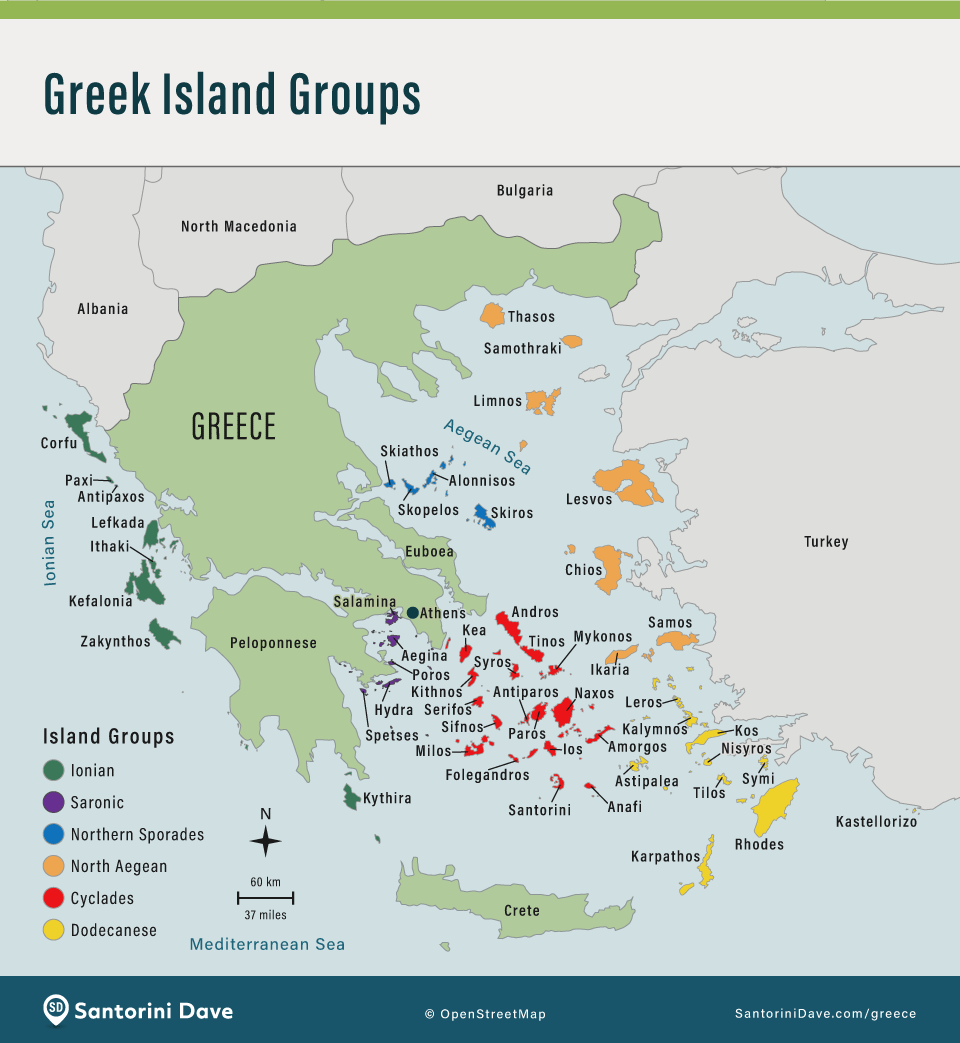
The Cyclades
Main islands: Santorini, Mykonos, Naxos, Paros, Milos, Ios, Sifnos, and Folegandros.
A good first route is:
Athens → Naxos or Paros → Santorini
The Cyclades have the whitewashed villages, blue-domed churches, rocky terrain, and dry landscapes most people associate with the Greek islands. They are the easiest group for a first island-hopping trip, with good ferry connections between the major islands.
The Ionian Islands
Main islands: Corfu, Kefalonia, Zakynthos, Paxos, and Lefkada.
The Ionian Islands are greener than the Cyclades, with turquoise water and a strong Venetian influence in places such as Corfu. There are no practical direct ferry connections between the Ionian Islands and the Cyclades. Do not try to combine Corfu and Santorini on a short trip.
The Dodecanese
Main islands: Rhodes, Kos, Patmos, and Symi.
The Dodecanese lie near the Turkish coast and are known for medieval towns, castles, neoclassical harbors, beaches, and a long warm-weather season. Fly to Rhodes or Kos, then use regional ferries for nearby islands. Do not add them to a short Cyclades trip.
The Saronic Islands
Main islands: Hydra, Aegina, Poros, and Spetses.
The Saronic Islands are the easiest islands for a short trip from Athens. Hydra is my favorite for scenery, architecture, and a car-free stay.
The Sporades
Main islands: Skiathos, Skopelos, and Alonissos.
The Sporades are green and pine-covered, with beautiful beaches and clear water. Skiathos is the easiest to reach and has the most hotels and beach facilities. Skopelos is quieter. Alonissos is best for nature and the marine park. Getting here takes more planning than a Cyclades trip, with most ferries leaving from mainland ports north of Athens.
Crete
Crete is in a category of its own. It has several airports and ferry ports and connects well with Santorini during the main travel season. It can easily fill a week or two. Do not add it as a two-night afterthought.
Best Greek Islands for Island Hopping
The Cyclades are the easiest group for first-time island hopping. My favorite combinations are:
- Santorini + Naxos: My favorite first-trip combination. Santorini for the caldera, then Naxos for beaches and a slower pace.
- Santorini + Paros: An easy pairing with good ferry connections and very different islands.
- Mykonos + Paros: A good choice if you want nightlife but do not want the entire trip to be Mykonos.
- Paros + Naxos: One of the easiest two-island trips, with frequent ferry connections in summer.
- Milos + Santorini: Best if scenery and boat tours matter more than beaches and nightlife.
- Santorini + Crete: Spend three or four nights in Santorini, then give Crete at least five nights.
Ferry schedules change by season. Confirm the route before booking nonrefundable hotels.
See my Greek ferry guide and Greece itinerary guide.

My wife and I boarding a ferry in Mykonos. Ferries are the best way to travel between nearby islands.
How to Choose the Right Greek Island
Stay Longer in Fewer Places
Every island change uses time for packing, checkout, getting to the port, waiting for the ferry, sailing, another transfer, and hotel check-in. Give most islands at least three nights. See my guide to how many days you need in Greece.
Keep the Route Logical
Stay within one island group unless you have enough time to fly between regions. Do not plan Corfu, Mykonos, and Rhodes in the same short trip. Something that looks easy on a map can cost most of a day once you check the actual ferry and flight schedules.
Choose the Right Month
May, June, and September are my favorite months for the Greek islands. June and September are best for warm swimming weather without the peak crowds of July and August. May is excellent for sightseeing, hiking, and lower prices, though the sea is cooler.
July and August are hottest, busiest, and most expensive, and the Meltemi can make the Cyclades very windy. In April, October, and early November larger islands with substantial towns and year-round populations work better. Crete and Rhodes are especially good late in the season, and Santorini still works well for sightseeing even when beach weather is less reliable.
Greek Islands FAQ
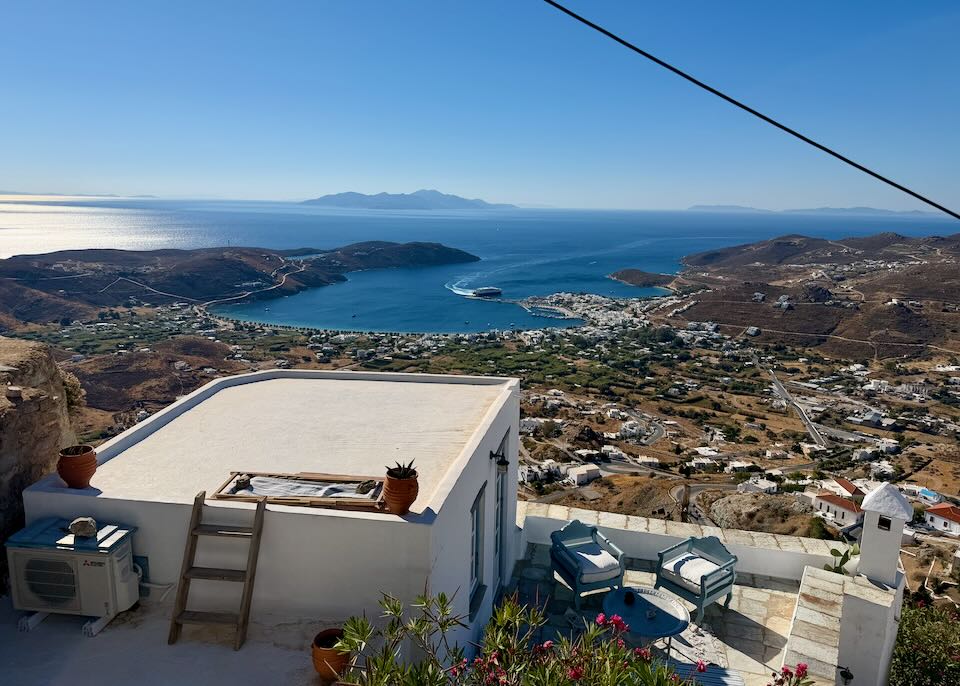
The view from our hotel in Chora, Serifos.
What is the best quiet Greek island?
Folegandros, Sifnos, and Serifos are my favorites. Folegandros has the most dramatic setting, Sifnos is best for food and hiking, and Serifos has excellent beaches and feels less developed than most of the better-known Cycladic islands.
How many Greek islands should I visit?
Visit one island in a week, two islands in 10 days, or two to three islands in two weeks. More islands usually means more time in ports and less time enjoying the places you came to see.
Is Santorini or Mykonos better?
Santorini is better for views, romance, sightseeing, wineries, and unique hotels. Mykonos is better for beaches, nightlife, shopping, and beach clubs. See my complete comparison of Santorini or Mykonos.
Is Naxos or Paros better?
Naxos is better for families, sandy beaches, villages, food, and value. Paros is better for couples, restaurants, shopping, stylish towns, and nightlife. See my complete comparison of Paros or Naxos.
Do I need a car on the Greek islands?
No car is needed for a central stay in Santorini or Mykonos. A car is useful for part of a stay in Naxos, Paros, and Milos. I strongly recommend one for exploring Crete outside the main towns.
Should I fly or take the ferry?
Take the ferry between nearby islands with direct routes. Fly from Athens to distant islands or when crossing between island groups. See my Greek ferry guide for schedules, luggage, and ferry advice.
What is the best month to visit the Greek islands?
June and September are my favorite months. The weather is warm, the sea is comfortable for swimming, and most seasonal hotels, restaurants, tours, and ferry routes are operating without the peak crowds of July and August. May is excellent for sightseeing and lower prices, though the water is cooler. October works best on larger southern islands such as Crete and Rhodes.
What is the biggest Greek island mistake?
Trying to visit too many islands. A trip with two islands and four nights on each is almost always better than a trip with four islands and two nights on each.
Should I rent an ATV?
No. ATVs offer little protection, handle poorly on paved roads, and are especially dangerous on busy, steep, and poorly lit island roads. Rent a small car instead.
Are Greek island cruises worth it?
Greek cruises suck. Cruises visit during the hottest and most crowded part of the day, then leave before dinner and sunset. You miss the quiet mornings and long evenings that make the islands special.
 Santorini Dave was started in 2011 when I posted a short guide to visiting Santorini with kids. Now, my site publishes regularly updated guides to
Hi Dave!
Great guide, thanks for sharing all your insights!. My soon to be wife and I are planning our honeymoon (first time in Greece) from Oct.1st to the 19th and are torn between Milos/Paros/Naxos. We are starting Athens for 3 days, then planning to fly to one of those islands for 3 days. This will be followed by a ferry to Santorini for 3 days and then a ferry to Heraklion. We are going to rent a car and spend our time on Crete based in Chania (from where we fly home at the end of the trip). For choosing between Milos/Paros/Naxos – we are leaning towards Milos due to the unique landscape, swimming, beaches and exploring the coast of the island with a boat. But we have been reading online that the island may start closing during our trip (some of the hotels we looked at are closed when we are there). Would either Paros or Naxos be a safer pick for early October? We aren’t really into nightlife and would prefer a quieter vacation but still enjoy a lively evening with good food and drink options. My other concern is that if the weather isn’t great and Milos is closing then there may not be many other options for activities at that time of year – maybe one of the other islands is a better option?
Thanks!
I think you’ve picked a great time to visit Greece. Early October is one of my favorite times of year. The weather is usually still warm enough for swimming, the sea is at its warmest after the summer, and the crowds are dramatically smaller than in July and August.
Of the three islands, here’s how I’d look at it:
Milos is the most memorable if your priorities are scenery, beaches, and exploring by boat. It feels more rugged and unique than anywhere else in the Cyclades. Sarakiniko, Kleftiko, Firiplaka, Tsigrado, and the colorful fishing villages make it a fantastic honeymoon destination.
That said, your concern is a valid one. While Milos doesn’t “close” in early October, it definitely starts winding down sooner than Paros or Naxos. Many restaurants, hotels, and beach businesses remain open through the first half of October, but some seasonal hotels and beach clubs will already have closed. If you happen to get two or three windy or rainy days, there are simply fewer backup activities than on the larger islands.
Paros is probably the safest all-around choice. Parikia and Naoussa both stay lively well into October, there are lots of excellent restaurants, wineries, cafés, and shops, and you’ll have more choices if the weather isn’t ideal. It still has beautiful beaches, charming villages, and plenty to explore with a rental car. It feels relaxed in October without ever feeling empty.
Naxos falls somewhere in between. It has wonderful beaches, mountain villages, excellent food, and some of the best hiking and driving on any Greek island. Because it’s larger and has a substantial local population, it feels less seasonal than Milos. It’s probably the best choice if you enjoy exploring inland as much as sitting on the beach.
One thing I’d pay attention to is the boat trip. If you choose Milos, try to schedule the Kleftiko sailing for your first full day rather than your last. Wind can cancel boat trips, and booking it early gives you another day or two to reschedule if necessary.
Since you’re already spending three days in Santorini and then renting a car to explore Crete, you’ll have no shortage of sightseeing later in the trip. That makes me lean even more toward Milos if it’s the island that excites you the most. Even if a handful of seasonal businesses have closed, the dramatic coastline and beaches are still there, and that’s what makes Milos special. I think you’ve put together a terrific itinerary.
Dear Dave. I’m planning a trip to Athens, Santorini, and one more island in December 2026 with my two teenage kids for about 10 – 12 days. I’m so happy to chance upon your website. The information is fabulous and rich in content, and it saved me a lot of planning.
I noted from your website that December is a ‘dead’ winter season, the recommended alive islands are Crete, Rhodes, and Corfu. If I’m planning to go to Santorini (in the Cyclades), which island should I choose to visit next? We wish to do some hiking on the two islands too.
Thank you in advance.
Clement Chong
Hi Clement. December is an underrated time to visit Greece if you enjoy hiking and authenticity, but you are right to be cautious about “dead” islands.
For your third island, the best choice by far is Naxos.
Why Naxos?
• It is “Alive” in Winter: Unlike the smaller tourist islands (like Mykonos or Milos), which empty out, Naxos has a large permanent population. The main town (Chora) remains active with cafes, bakeries, and tavernas open for locals.
• Best Hiking in the Cyclades: Since you specifically asked for hiking, Naxos is the winner. The weather in December (crisp, often sunny, around 13-16°C) is actually better for climbing Mount Zas (the highest peak in the Cyclades) than the scorching heat of July. You can also hike the village-to-village trails in the Tragea Valley (e.g., Chalki to Moni) which are green and lush in winter.
• Proximity to Santorini: This is the most practical reason. Naxos is one of the few islands with a guaranteed, daily, year-round ferry connection to Santorini (via Blue Star Ferries). It takes about 2 hours.
Why not Crete, Rhodes, or Corfu?
• While those islands are indeed “alive” in winter, they make no sense logistically for a 10-12 day trip combined with Santorini.
• Crete is too big for a quick 3-day add-on, and there are rarely ferries from Santorini to Crete in December (and if there are, they are unreliable in rough seas). You would likely have to fly Santorini -> Athens -> Crete.
• Corfu is on the complete opposite side of Greece (Ionian Sea) and has different weather patterns (rainier in December).
Suggested 11-Day Winter Itinerary
The key to winter island hopping is to leave Athens for the end of the trip. If a ferry is delayed by winter storms (rare but possible), you don’t want to miss your flight home.
• Day 1: Arrive in Athens. Fly immediately to Santorini.
• Day 2: Santorini (Hike Fira to Oia – perfect in winter).
• Day 3: Santorini (Explore Pyrgos and Akrotiri).
• Day 4: Santorini (Wine tasting – Santo Wines is open year-round).
• Day 5: Ferry to Naxos (Blue Star Ferry, usually leaves around 15:30).
• Day 6: Naxos (Hike Mount Zas and explore Filoti village).
• Day 7: Naxos (Explore Naxos Town/Chora and the Portara).
• Day 8: Naxos (Hike the Tragea Valley/Chalki village).
• Day 9: Ferry Naxos to Athens (Blue Star, roughly 5 hours).
• Day 10: Athens (Acropolis, Acropolis Museum, and Plaka).
• Day 11: Athens (National Museum or Lycabettus Hill). Fly home.
Important Winter Tips
• Pack Layers: December can be sunny and 16°C (60°F) or windy and 8°C (46°F). Bring a good windbreaker/rain jacket for the hikes.
• Ferries: In winter, stick to Blue Star Ferries. They are large, stable ships that rarely get cancelled. Avoid the smaller high-speed catamarans (Seajets) even if they show up on schedules, as they are bumpy and frequently cancelled due to wind.
• Stay Centrally: In Naxos, stay in Naxos Town. In Santorini, stay in Fira. Do not stay in the beach resort towns (like Plaka in Naxos or Kamari in Santorini) as they will be completely shut down and deserted.
• One Alternative: If you want a more “city” vibe rather than nature/villages, Syros is the capital of the Cyclades and very lively in winter. However, for hiking and dramatic scenery, Naxos is superior.
I hope that helps. Good luck.
Hey Dave, I’m finding your content super helpful! I would love to pick your brain for a few questions:
1. A group of four of us (women) are planning to go September 22nd-30th from the U.S.. Those date include travel days, this will be our first time to Greece, what two islands would you recommend that we visit? We are looking for some beach time, great restaurants, the ability to see some historical sites, get a feel for real Greek villages, etc.
2. It would seem that we would want to stay south so that it is warmer during our visit. Are the seas rough at this time of year to be able to use the ferries from island to island?
Planning a first trip to Greece can be overwhelming, but you’ve picked the absolute best time of year to go. Late September offers fantastic weather, warm seas, and fewer crowds than the summer high season.
Weather and Ferries in Late September
Your instinct to stay south is correct. The Cyclades islands are the perfect choice for late September, as the weather will be warm and sunny, and the sea will still be holding the heat from the summer.
Regarding the ferries, the seas can occasionally be windy in September, but it’s generally not a major issue. The Greek ferry system is robust, and the large, modern high-speed ferries handle choppy water very well. Outright cancellations are rare but can happen. It is never a good idea to plan a ferry trip on the same day as an international flight home, but for island hopping, you should be fine. I would not let a fear of rough seas deter you from using the ferries.
The Best Two Islands for Your Group
With only about six full days on the ground in Greece, you need two islands that are close together and offer a perfect blend of your interests. For a first-time visitor, the combination of Santorini and Naxos is unbeatable. They are on the same ferry line and offer two completely different but equally incredible Greek experiences.
1. Santorini (Spend 3 nights)
You have to see Santorini on your first trip. It is every bit as breathtaking as the photos suggest. While it doesn’t have the best beaches, it delivers on your other interests in a world-class way.
Why Santorini? For the sheer “wow” factor. The views from the caldera villages of Oia, Fira, and Imerovigli are incredible. The restaurants here are some of the best in Greece, many with stunning views. For history, you can visit the remarkably preserved prehistoric city of Akrotiri, often called the Minoan Pompeii.
2. Naxos (Spend 3 nights)
After the dramatic intensity of Santorini, Naxos will feel like a relaxing exhale. It is the perfect complement, offering the authentic, laid-back Greek island experience you’re looking for.
Why Naxos? It has some of the best beaches in all of Greece. The long, golden sand beaches of Agios Georgios, Agios Prokopios, and Plaka are exactly what you imagine when you think of a Greek beach holiday. For authentic villages, you can rent a car for a day and explore the mountainous interior, visiting towns like Halki, Filoti, and Apiranthos. The food is fantastic and more traditional, and you can see history at the giant Portara (Door) next to the main town.
A Workable Itinerary
Your time is tight, so logistics are everything. Flying into one island and out of another is the most efficient way to maximize your time.
• Day 1 & 2: Travel from the U.S. Arrive at Athens Airport and take an immediate connecting flight to Santorini. Don’t waste time going into Athens. Get straight to the islands. Check into your hotel in Oia or Fira.
• Day 3 & 4: Explore Santorini.
• Day 5: Take a morning high-speed ferry from Santorini to Naxos. The trip is short (about 1.5 to 2 hours). Check into your hotel, perhaps near St. George Beach, which is walkable to Naxos Town.
• Day 6 & 7: Explore Naxos. Spend one day at the beaches and another exploring the inland villages.
• Day 8: Take a short flight from Naxos Airport back to Athens to connect with your international flight home.
• Day 9: Arrive back in the U.S.
This itinerary gives you the iconic, dramatic beauty of Santorini combined with the beaches and authentic culture of Naxos, making for a perfect first trip to Greece
Hi Dave – I’m trying to decide between Naxos and Nafplio. Food is the most important factor, followed by general sightseeing and wandering. Beaches aren’t important. Time of year would be the middle of October. I understand Naxos is one of the best places for food, but how does Nafplio compare?
Given the time of year and your interests, I’d lean towards Nafplio. Great small city with lots to keep you interested. Good food, too.
Hi Dave, this site is amazing and so grateful to have found you. Thank you!
We’re traveling to Greece for the first time during last week of September/first week of October. We want to see Meteora, Santorini, and do some hiking, sightseeing and relaxing. Thoughts on the following itinerary:
~ 4 days on Mainland: 1 day Athens, 1 day Delphi, 1 day Meteora (hike to monestaries), 1 day Zagori (Bridges/Villages walk). I was going to hire a travel agency, but sounds like we can rent a car and do this on our own.
~ 4 nights/3 full days Naxos (is it too late in season to swim?). We’re on the fence on Naxos.
~ 4 nights/3 full days Santorini
Depending on our flight times back to the US, we might be able to add a day to Athens at the end. I realize from your site that you highly recommend two days in Athens.
Thank you!
Jennifer
Sounds great. I would switch the order so that you visit Naxos first when you want some hotter weather and the mainland last when cooler is probably best. At that time of year even two weeks can make quite a difference in temps.
SD Team — we just got back from our honeymoon in Greece and it was fantastic. Our 12 day trip to Athens, Paros, Naxos, and Santorini was completely inspired by your excellent recommendations. Your hotel, restaurant, bars, and activity recommendations were spot on and very helpful. My friend Shaun recommended your site to me and I’m so glad I listened. Thank you for making our honeymoon special.
Jeremy and Abby Bush
Great to hear. Thank you so much for the wonderful comment.
Hi Dave
Your website is fantastic and I have really enjoyed reading the questions and your replies. I am looking to go to Greece for 14-18 days in September and hope to visit Athens and the islands Santorini, Crete, Mykonos and Rhodes. I am in my 60’s and maybe travelling on my own or with a friend. We love walking, seeing historic sights, enjoy the beach and a little bit of shopping. I also love watching beautiful sunsets and sunrises. Love travelling on boats. If you think we should change any islands or can suggest how many days we should spend on each island, it would be greatly appreciated.
Thank you
Sue
Given your interests, and the other islands you’ve chosen, I’d recommend replacing Mykonos with either Naxos or Paros. You could fly directly to Rhodes, then ferry to Crete, ferry to Santorini, ferry to Naxos/Paros, then ferry to Athens. All of these routes have plenty of service (though do book Rhodes-Crete first as this will have the least number of options).
Hi! Looking to go on our honeymoon end of May. Have 10 nights, would love to hit 3 islands if it’s doable. Would you change this itinerary at all? We are in our upper 20s, want some relaxing/some exploring town, beaches, good food and wine.
Day 1: arrive in Athens and fly to Santorini (night 1)
2: full day in Santorini
3: full day in Santorini
4: full day in Santorini
5: boat to Naxos early
6: full day Naxos
7: full day Naxos
8: boat to Paros
9: full day Paros
10: full day Paros
11: travel from Paros to Athens and fly home
That looks perfect. The only thing I’d mention is that it’s possible to fly directly to Santorini from many airports in Western Europe. If you could find a direct flight it would save you the time and money spent on the Athens-Santorini flight. Just an idea. Otherwise, looks like a great plan.
Hello Dave, my wife and I hope to be in Greece in mid-September. The tentative itinerary would start with 3 nights in Athens with a day tour to Nafplio, ferry to Mykonos for 3 nights, then Naxos for 4 nights with a day tour to Paros, on to Santorini for 3 nights, ferry to Crete for 4 nights, and finish by flying to back to Athens for 1 night for next day flight home. Would welcome any suggestions. Perhaps it may be better to drop an island and add time on another (if so, which ones). Your expertise is much appreciated.
That all sounds great. It’s a minor change but I might suggest dropping the day trip to Paros (ferry day-trips are not a great use of time, especially when you’re already doing plenty of ferry travel and seeing multiple islands) and add that day to Santorini, Crete, or an overnight stay in Nafplio (a wonderful town).
Hi Dave!
Wow – so glad I found your website! Definitely the most resourceful Greece planning site out there. I’m planning a 2 week trip to Greece in early September. My husband and I have never been to Greece and are looking for help determining what islands to go to. We appreciate history but prefer to not spend time in museums. We like places with outdoor activities (beach, swimming, hiking), places with great food, plan to splurge on a few luxurious hotels/experiences, and are not big into the nightlife and clubbing scene. We definitely want to spend time in Santorini and maybe 1-2 days in Athens when we land. What other islands should we build into our itinerary? I am having trouble choosing!!
-Naxos
-Paros
-Milos
-Crete
-Nafplion (worth a day trip from Athens?)
-Mykonos (is it better to visit Naxos/Paros/Milos/Crete than Mykonos?)
Thank you so much!!
Christina Cavanagh
Along with Santorini and Athens, I’d visit Naxos, Paros, and Milos; or Naxos and Crete. Crete is a large island so don’t go unless you have 4 full days (ideally more but with two weeks, 4 days is probably the most you can do). For destinations with outdoor history attractions, I’d rank them in this order: Athens, Santorini, Crete, Naxos, Milos. Nafplio and Mykonos are both wonderful but not sure you’ll have time.
Hi Dave – what a wonderfully informative website. There is so much information to wade through so was wanting your advice. 14 of us are planning a ladies (no husbands, children, etc.) island holiday to Greece in July this summer for 7 days. We’re coming from all over the world to arrive via Athens or Istanbul. Our budgets (the most important thing) also differ greatly! Our original thought was to visit Paros but I’ve since heard/read that this could be quite windy in July as well as a mini-Mykonos in terms of price.
Our interests would range from nightlife to beaches with everything in between. Greece in a nutshell, I suppose.
What are your thoughts?
I love the beaches, nightlife, and restaurants in Ios. The accommodations range from inexpensive and good value to 4-star and very nice. It’s probably your best choice. Naxos would also be good but a little more expensive and less nightlife.
Hi Dave!
Your website is incredibly informative and very helpful. My sis and I are planning a trip to Greece, just the to of us, and would like to go within the next 6 years when our kids are a bit older. I’ve done a ton of research of where we want to go and I have it narrowed down to begin in Athens and would love to end in Crete and visit the five main islands in between. My questions are: What would be the best time frame for this type of trip and are there travel agencies that you recommend to help us build the vacation we would like versus the preplanned destinations? I really appreciate your help.
Sincerely,
Abby
Late June or early September would be what I’d recommend for your trip (great weather everywhere but not the large crowds of summer). Much better to plan and book your trip on your own than to use a travel agency. Better hotels, better prices, more unique trip.
Hi Dave! First let me say a BIG TEXAS SIZED THANK YOU for all your information. Your write ups have been very helpful in planning which Islands we want to visit when coming to Greece this summer. I have a question that I have not been able to find an answer for that I wanted to ask you. For part of our trip we will be with 3 other families. There will be a total of 8 adults and 8 children, ranging in ages from 3 to 17. We are really wanting to book a large villa/home while in Crete for 6 nights. I have looked on Booking.com per your recommendation, however, most are showing villas or apartments with renting multiple units. We were really trying to book one large home for all of us during this portion of the trip. Is there a site that is unique or special to booking large homes in Greece? Or just go with the normal Airbnb or Flipkey? Any advise would be much appreciated! Thank you!!
Sorry, I don’t know of any website devoted to large group villas. There certainly are a few large villas on Booking and Airbnb – it’s just a matter of finding them.
Hi Dave, great website, I’m glad I found you, your expertise and knowledge has blown my mind.
I have a slightly different question than the ones above/below. I’m a writer, in my mid 40’s, single, living in England but am looking for a place to live on a Greek Island, not particularly a city, more a friendly village or town, think a more romantic scenario like The Durrells perhaps. I know it’s best I just travel around and see for myself with such a big commitment, but I just don’t have the time I’m afraid for that much traveling right now. So I thought there would be no harm in asking someone in the know for some ideas.
What I’m looking for in no particular order is:
Somewhere with a general sunny/warmish climate in the winter months.
Historical sites, mountains, coasts, forests, to visit/walk/hike.
Some nice beaches to relax for an hour or two or three.
Great local food and places to eat in the day or evening, all a good walk or short drive away.
Friendly atmosphere.
I would prefer to live closer to the coast than inland so somewhere not TOO touristy in the summer months if possible.
Surrounded by beautiful nature for relaxing and walks.
Be as specific as you like Dave, gimme a road name if something comes to mind. Wherever you suggest I will thoroughly research whether it’s 1, 2, or 20 islands/towns/villages. I’m just a jobbing writer, not wealthy but with a spirit for life, good food, and nature if that helps. So a big thanks for any help you throw my way Dave.
Crete has the warmest weather in the winter, a ton of history, great inland villages, wonderful hikes, and incredible food (no place in Greece has bad food). The large coastal towns and resorts do get a lot of tourists in summer but they are easy to avoid if you’re inclined. I would start there. But there are so many great places that you’d love: Ikaria, Sifnos, Folegandros, Hydra, Nafplio (on the mainland), Corfu Town. The list is long. Good luck.
What island is the hottest to visit in April? I want to go do for my 30th birthday on April 18 and experience the warm beaches. Also, who should I book through to island-hop?
Crete usually has the warmest weather in April but I wouldn’t call it hot. It’s possible you could be swimming and sunbathing but (on average) unlikely. Book ferries through ferryhopper.com and hotels through booking.com.
Hello,
I will go in June with my wife to Greece for 10 days. I will spend 1 day in Athens and then I will have 9 days to the islands.
I want to spend 2 days in Santorini and the other 7 days I want to pick up 2 of these 4 islands: Mykonos, Naxos, Paros, and Milos. What do you suggest? We are looking for beautiful beaches with clear water and travel around the island with moto.
Thanks,
Filipe
I love all four islands. Mykonos for nightlife and beaches, Naxos for beaches and traditional Greek villages, Paros for trendy restaurants and beaches, Milos for beaches and a wonderful boat tour around the island. All have great food.
Hi Dave,
Your website is fantastic! I’ve really spent some time scouring the information and have used it to come up with an itinerary, but would love your opinion and advice. We are two couples traveling together in our late 50’s, early 60’s, that love activity, tours, hiking or walking around, lots of history with a nice mix of a few days of relaxing/beach enjoying some really great food and wine. Shopping and culture are also things we love to do. We are planning a trip in early May to Mid May for 14 days to avoid the crowds. We are flying in and out of Athens, so we thought we would fly into Athens, rest up the first night, then see the sites there, spend another night and then ferry over to Mykonos the next morning. We want to spend 2 full days in Mykonos so we can take the day trip over to Delos and roam around the next day (3 nights), then ferry over to Santorini for 5 days and then ferry over to Crete for the last 4 days, then fly back to athens from there. The questions I have are 1. Is early May not a good time to visit Mykonos or other islands? I don’t want to be there and have all the restaurants/shops/beaches closed. 2. Is Crete a good way to end the trip? My friend who has been to Greece many times said that a better choice would be to go to Rhodes or to adjust days and fly back to Athens and go to Corfu, she said she even prefers Corfu over Rhodes. She said that she wouldn’t suggest Crete. What do you think about that? This will be our first trip to Greece, but we are good travelers, been all over the world and want to get the most out of our 14 days and don’t want to waste too much time traveling and being on the road. I know you mention Naxos alot, but she didn’t think there was much there for us.
I would change the order of your trip: Crete then Santorini then Mykonos. This will push your Mykonos visit forward 10 days which will make the difference between quiet and not-so-quiet. But if you would make your trip one week later that would be even better (ideally hit Mykonos May 20 to 25). Santorini and Crete will be busier earlier. They also have a larger local population so never are quite as dead. I much prefer all 3 of these islands to Rhodes and Corfu. Though beautiful both of those islands get lots of package tourism which is less than ideal.
Planning to travel to Greece with my girlfriend from May 13-May 24 (10 nights flying in/out of Athens). Trying to plan our itinerary and we have come up with the following:
Night 1: Athens
Night 2: Athens
Night 3: Santorini
Night 4: Santorini
Night 5: Santorini
Night 6: Santorini
Night 7: Naxos/Paros
Night 8: Naxos/Paros
Night 9: Naxos/Paros
Night 10: Athens
– What are your general thoughts?
– Should we take the ferry or airplane from Athens to Santorini?
– If we stay in Naxos can we take day trip to Paros (and vise versa)? Which one should we stay in if this was the plan?
– Is Mykonos worth visiting if not interested in the nightlife?
– Are there any other islands you would recommend adding to our itinerary?
Looks great. I would ferry to Santorini. The only way I’d recommend flying is if you flew directly to Santorini upon landing in Athens (and then leave all your Athens’ days til the end). But if you go into Athens you’re better off taking the ferry. Yes, a day trip is easy between Naxos and Paros. Probably stay in Naxos and day trip to Paros but no great difference. Mykonos is a great island (but don’t bother with a day trip.)
Looking for a Greek island with nice beaches and windsurfing. What one would you recommend?
I’d recommend Naxos or Paros. Both have great beaches and are popular windsurfing islands.
Hi Dave. In 12 days is it possible to do Athens (1 day), Milos, Naxos, Paros, and Santorini? Is this too much? Which would you remove if necessary?
I think that’s a lot for 12 days – but comfortably doable, for sure. If you had 10 nights on the islands do 3 nights in Naxos and Santorini, and 2 nights in Paros and Milos.
Hi, Dave! My husband and I will be going to Greece 8/26 – 9/4. We are flying into and out of Athens for cost efficiency. We really want to see Navagio Beach on Zakynthos for a day, and we realize this will likely be an overnight trip, or even 2 nights depending on the travel options. What is the best way to get from Athens to Zykanthos? What is the best way to get from Zakynthos to Santorini? Or is it best to just go from Zakynthos back to Athens and then to Santorini? We are trying to avoid additional flights but realize we may have to fly from Zakynthos to Santorini.
Our potential itinerary is:
8/26 – flight arrives in Athens at 12:15 PM, check into hotel near Acropolis and explore
8/27 – depart to Zakynthos via bus and ferry
8/28 – Blue Caves & Navagio Beach tour, return to Athens or depart to Santorini if possible
8/29 – Santorini
8/30 – Santorini
8/31 – Santorini
9/1 – Mykonos
9/2 – Mykonos
9/3 – Return to Athens
9/4 – Flight home
Any advice for traveling, places to see, places to stay would be appreciated!
We love food, sight-seeing, boat tours, beaches, entertaining night life (but not night clubs). Thank you!
You seem to have your heart set on Zakynthos but I have to say it’s not a good use of time for a sort-of overrated payoff. I think your time is much better spent (in my opinion) seeing another Greek island in the cyclades (maybe taking a ferry to Naxos or Paros sitting outside on the deck drinking a bottle of wine) rather than taking a bus and connecting flights. Zakynthos and Santorini/Mykonos are on opposite sides of the country and the only way from one to the other is by flying (or some combination of bus and ferry). So, my recommendation is to consider spending those Zakynthos days in Naxos, Paros, Milos, or some other Cycladic island.
Dear Dave,
My family of 5 (wife, myself, 14 yr., 12 yr. & 12 yr. old boys) will finish a trip to Turkey ending in Kusadasi. This will be mid-June. As 1st time travelers to the Greek islands, which islands do you recommend for a short trip of 5 days? I was thinking Santorini and Paros or Santorini and Crete.
What is the best way to get from Kusadasi to the Greek islands and from the islands back to an international airport to fly back to Atlanta? It seems difficult to fly or ferry from Turkey to Greece. Similarly, at the end of the trip it seems like almost all flights from Santorini must go through Athens except for one route nonstop through London.
Any other advice on hotels, villages, activities and logistics would be appreciated.
Thanks in advance.
I think the only ferry from Kusadasi to Greece goes to the Greek island of Samos. It’s a great island and certainly worth a few days. From Samos, there are usually direct ferries to Mykonos and Syros. These are very different islands that have a very different vibe – but both appealing in their own way. From Mykonos there will be direct flights to Western Europe (most likely Rome, Paris, Amsterdam, and London) though not every flight flies every day so requires some planning. Santorini would be another ferry ride from Mykonos. And Crete farther still. So you wouldn’t have time to get to either island.