Updated: October 27, 2026 • By Santorini Dave
My Favorite Hotels in Porto
- 5-Star: Pestana Vintage Porto
- 4-Star: The Editory House Ribeira Porto
- Affordable Boutique: Casa Carolina
- Families: Spot Family Apartments
- Couples: Torel 1884
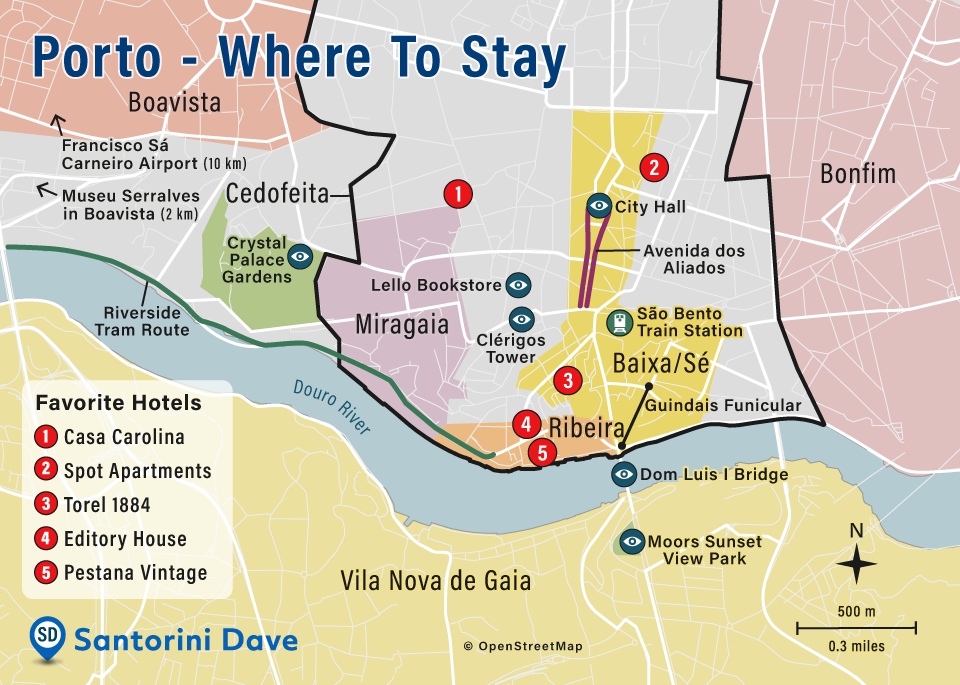
1. Casa Carolina • 2. Spot Family Apartments • 3. Torel 1884 • 4. The Editory House Ribeira Porto • 5. Pestana Vintage Porto
Where to Stay in Porto
Baixa and Ribeira are the best areas to stay in Porto for first-time visitors. Both are central, with excellent hotels, restaurants, and easy access to the main sights. I slightly prefer Baixa for its restaurants, nightlife, and transportation connections. Ribeira is better for river views and waterfront atmosphere, though it’s more touristy and reaching the upper city involves a steep climb.
Cedofeita is my favorite alternative to the busy historic center. It has good restaurants, independent shops, galleries, and boutique hotels. Stay in southern Cedofeita for the easiest walk to the main attractions.
Vila Nova de Gaia is best for luxury hotels with river views and wine tasting. Across the Douro from Ribeira, Gaia has Porto’s famous port wine cellars and some outstanding hotels, including The Yeatman. Choose a hotel near the waterfront or the Dom Luís I Bridge if you want to explore Porto on foot.
Porto is compact but very hilly. Walking is the best way to explore, but distances can be deceptive, particularly between Ribeira and the upper city. Uber and Bolt are useful for uphill journeys. I wouldn’t rent a car unless you’re exploring the countryside.

The Pestana Vintage Porto occupies historic buildings on the Ribeira waterfront, within Porto’s UNESCO-listed historic center. One of my favorite hotels for first-time visitors.
Porto Neighborhoods at a Glance
- Ribeira: Best for river views, historic atmosphere, and waterfront restaurants. Porto’s most touristy neighborhood, with crowds and nighttime noise. The waterfront is relatively flat, but the streets climbing toward Baixa are steep.
- Baixa & Sé: Best overall for sightseeing, restaurants, nightlife, and transportation. Home to São Bento station, Avenida dos Aliados, Clérigos Tower, and Porto Cathedral. My favorite base for most first-time visitors.
- Cedofeita: Best for boutique hotels, galleries, independent shops, and a quieter central location. Southern Cedofeita is particularly convenient for sightseeing.
- Vila Nova de Gaia: Best for wine lovers, luxury hotels, and views of Porto’s historic skyline. The waterfront is an easy walk across the lower deck of the Dom Luís I Bridge, but many hotels are farther uphill.
- Bonfim: Best for restaurants, coffee shops, and a more residential atmosphere. Western Bonfim is convenient for walking into Baixa; hotels farther east are better connected by Metro or taxi.
- Miragaia: Best for a quieter historic waterfront location close to Ribeira. Fewer hotels and restaurants, with steep streets leading up toward the Crystal Palace Gardens.
- Boavista: Best for larger luxury hotels, parking, and families who want more space. Good restaurants and Metro connections, but less convenient for exploring the historic center on foot.
- Foz do Douro: Best for oceanfront walks, beaches, seafood restaurants, and a quieter stay. Around 20 to 40 minutes from central Porto by public transport, depending on your destination.
Getting Around Porto
- Walking: Porto is compact but hilly. Most central sights are walkable, though getting from the Ribeira waterfront up to Baixa or Sé involves a steep climb. The Dom Luís I Bridge has two pedestrian levels: the lower connects the Ribeira and Gaia waterfronts; the upper has better views and connects the higher parts of both cities.
- Uber and Bolt: Both are inexpensive and useful for uphill journeys, airport transfers with luggage, and hotels away from Metro stations. For three or four people, a ride can cost about the same as public transportation.
- Metro: Line E connects Porto Airport to Trindade in about 30 minutes. The Metro also serves Boavista, Campanhã, and Gaia, but not the Ribeira waterfront. Line D crosses the upper deck of the Dom Luís I Bridge. Buy an Andante card and validate it before every journey and when changing lines. Contactless bank cards also work at selected stations, including the airport.
- Funicular and Cable Car: The Funicular dos Guindais connects Ribeira with Batalha, avoiding a steep climb. The Teleférico de Gaia runs between the Gaia waterfront and Jardim do Morro. The cable car is mainly for sightseeing, not transportation.
- Historic Trams: More of a sightseeing attraction than practical transportation. Line 1 follows the Douro River from Infante, near Ribeira, to Passeio Alegre in Foz. It’s a scenic ride, but slower and more expensive than regular public transportation.
- Rental Cars: Don’t rent a car for Porto. The historic center has narrow streets, restricted access, and expensive parking. Boavista is more convenient if you’re driving.
The Best Places to Stay in Porto
Gran Cruz House is a small boutique hotel overlooking the Douro River in Ribeira.
- Best Luxury Hotels in Porto
The Yeatman • The One Monumental Palace • InterContinental Porto • Torel Avantgarde • Pestana Vintage Porto- Best Boutique Hotels in Porto
Gran Cruz House • Torel 1884 • M Maison Particulière • 1872 River House • Rosa Et Al Townhouse- Best Affordable Boutique Hotels in Porto
Casa Carolina • ALIBI by YoursPorto • Gallery Townhouse & Home • Mo House- Best Hotel for Families in Porto
Spot Family Apartments
Where to Stay in Porto for…
- Best for First-Time Visitors: Baixa, Ribeira
Baixa is my first choice for most visitors. It’s central, has excellent restaurants and hotels, and is convenient for sightseeing and transportation. Ribeira is better if you want to stay directly on the river, but expect more tourists and a steep climb to the upper city. My favorite hotels are M Maison Particulière in Baixa and Pestana Vintage Porto in Ribeira.- Best for Nightlife: Baixa
The streets around Galerias de Paris and Rua de Cândido dos Reis have Porto’s biggest concentration of bars and late-night activity. Stay a few streets away if you want to sleep without the noise. Bonfim has good craft beer bars, while Gaia is better for port wine tastings than nightlife.- Best for Food and Restaurants: Baixa
Baixa has the widest choice of restaurants within easy walking distance, from traditional Portuguese cooking to modern restaurants and casual places to eat. Cedofeita is another good choice, particularly around Rua de Cedofeita and the streets toward Miguel Bombarda. For fine dining with river views, consider Gaia.- Best for Families: Baixa, Boavista, Foz do Douro
Baixa is the most convenient base for sightseeing with kids, particularly near São Bento or Avenida dos Aliados. Boavista has larger hotels, more space, and good family facilities. Foz is a good choice for families who prefer beaches, parks, and a quieter neighborhood, but it’s less convenient for central sightseeing. Spot Family Apartments is my favorite central option for families who want apartment-style accommodation.- Best for Couples: Ribeira, Baixa, Vila Nova de Gaia
Ribeira has waterfront boutique hotels and river views. Baixa has more restaurants, bars, and luxury hotels within walking distance. Gaia is my choice for a quieter luxury stay with wine tasting and views across the river. My favorites are Torel 1884 in Baixa and The Yeatman in Gaia.- Best for a Quieter, More Residential Stay: Cedofeita, Bonfim
Cedofeita is the better choice if you still want to walk to the main sights. Bonfim has good restaurants and coffee shops, with better accommodation value, but the location matters. Western Bonfim is much more convenient for sightseeing than hotels farther east.- Safety in Porto
Porto is generally safe for visitors, including in the central neighborhoods recommended here. Pickpocketing is the main concern in crowded tourist areas, particularly around Ribeira, São Bento, and on busy public transportation. Use normal precautions at night and avoid leaving valuables unattended.The Best Neighborhoods in Porto for Tourists
Torel Avantgarde is a luxury boutique hotel above the Douro River, near the Crystal Palace Gardens.
1. Ribeira
Ribeira is Porto’s historic waterfront neighborhood, with colorful houses, riverside restaurants, and views across the Douro to the port wine cellars of Vila Nova de Gaia. The promenade is busy throughout the day, particularly around Praça da Ribeira and the Dom Luís I Bridge. Nearby attractions include Palácio da Bolsa and São Francisco Church.
Ribeira is a great location if you want to stay on the river, but choose your hotel carefully. Waterfront rooms can be noisy, and reaching Baixa or the cathedral involves a steep uphill walk. The riverside promenade is relatively flat, but the surrounding streets are not ideal for travelers with limited mobility.
- Best Hotels: 1872 River House • Pestana Vintage Porto • The Editory House Ribeira Porto • Gran Cruz House
2. Baixa/Sé
Baixa is Porto’s downtown district and my favorite area for first-time visitors. It includes Avenida dos Aliados, São Bento station, the streets around Clérigos Tower, and the main restaurant and nightlife areas. The adjoining Sé district contains Porto Cathedral and some of the city’s oldest streets.
The Clérigos Tower has excellent city views, while São Bento station is worth visiting for its azulejo tile panels. Livraria Lello is also nearby. Avenida dos Aliados and the surrounding streets have several of Porto’s best luxury hotels, including The One Monumental Palace and InterContinental Porto.
For train day trips to Braga, Guimarães, or the Douro Valley, staying near São Bento is convenient, though some services and connections use Campanhã station. The streets around Galerias de Paris are lively late into the night, so choose a quieter side street if nightlife isn’t a priority.
- Best Hotels: Torel 1884 • Torel Palace • InterContinental Porto • NH Collection Porto Batalha • M Maison Particulière • The One Monumental Palace
3. Cedofeita
Cedofeita is northwest of Baixa and known for its independent shops, galleries, and restaurants. Rua de Miguel Bombarda is the main gallery street, while Rua de Cedofeita has shops, cafes, and restaurants. The Museu Nacional Soares dos Reis and Crystal Palace Gardens are nearby.
I particularly like southern Cedofeita for its boutique hotels and quieter streets. You can walk into Baixa without staying directly in the busiest tourist area. Hotels farther north, toward Boavista, are less convenient for sightseeing on foot.
- Best Hotels: Rosa Et Al Townhouse • Casa do Conto • Tipografia do Conto
4. Bonfim
Bonfim is east of central Porto, with residential streets, independent restaurants, specialty coffee shops, and craft beer bars. Jardim de São Lázaro, Porto’s oldest public garden, is near its western edge. The neighborhood has fewer major attractions than Baixa, but it’s a good alternative for travelers who prefer staying outside the busiest tourist areas.
Location matters here. Western Bonfim, near Campo 24 de Agosto, is within walking distance of much of central Porto. Farther east, around Heroísmo, you’ll probably use the Metro or taxis more often. Campanhã, Porto’s main intercity bus terminal and an important train station, is farther east.
The 4-star NH Collection Porto Batalha is in central Porto, west of Bonfim.
- Best Hotel: Timbre Heroísmo
5. Miragaia
Miragaia is immediately west of Ribeira, with colorful waterfront buildings, narrow streets, and fewer tourists. It’s a good choice if you want to stay near the river without the crowds around Praça da Ribeira.
The lower waterfront is relatively flat, but streets climbing toward the Crystal Palace Gardens are steep. There are fewer hotels and restaurants than in Ribeira or Baixa, and Metro access is limited. Walking and rideshares are the easiest ways to get around.
- Best Hotels: Torel Avantgarde • Miragaia House
6. Foz do Douro
Foz do Douro is Porto’s seaside neighborhood, where the Douro meets the Atlantic. It has beaches, waterfront restaurants, gardens, and long walking and cycling routes along the coast. The promenade around Passeio Alegre and the oceanfront streets toward Matosinhos are particularly good for walking.
Foz is a good choice for a quieter stay with ocean views and seafood restaurants. It’s less convenient for sightseeing, with most central attractions around 20 to 40 minutes away by bus or taxi. The Atlantic beaches are attractive, but the water is cool and conditions can be windy, so I wouldn’t choose Foz primarily for swimming.
- Best Hotel: Hotel Boa-Vista
7. Boavista
Boavista is northwest of the historic center and has some of Porto’s largest luxury hotels. The neighborhood centers around Rotunda da Boavista and Casa da Música, Porto’s striking modern concert hall. The Gallery of Biodiversity is another good attraction, particularly with kids. The Serralves Museum and gardens are farther west and easily reached by taxi or bus.
Boavista is a good choice if you want a larger hotel with a pool, spa, or parking. Metro and bus connections make central Porto accessible, but it’s not as convenient for walking to the main historic sights. I prefer Baixa for a first visit unless hotel facilities or parking are priorities.
- Best Hotels: Porto Palácio Hotel & Spa • Sheraton Porto Hotel & Spa
8. Vila Nova de Gaia
Vila Nova de Gaia is a separate city directly across the Douro from Porto’s historic center. Its waterfront is lined with port wine lodges offering cellar tours and tastings, and the views back toward Ribeira are excellent. Vineyard visits in the Douro Valley are a separate excursion.
The lower deck of the Dom Luís I Bridge connects Gaia’s waterfront with Ribeira. The upper deck connects the higher parts of both cities near Jardim do Morro. Gaia is hilly, so check your hotel’s exact location before booking.
My favorite hotel here is The Yeatman, one of Portugal’s finest luxury hotels, with outstanding river views, excellent dining, and extensive facilities. Gaia is particularly appealing for couples and wine lovers who want a luxury stay rather than a hotel in the middle of Porto’s busiest streets.
- Best Hotels: The Yeatman • Caléway Hotel


About Santorini Dave