Greece › Island Hopping
Updated: August 30, 2026 • By Santorini Dave
See Also
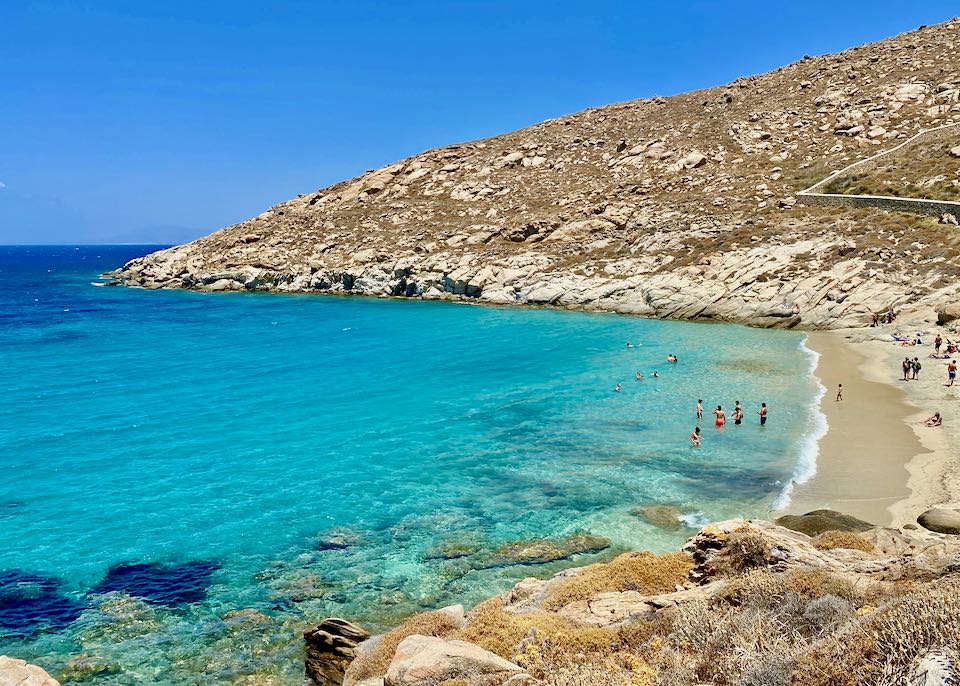
The beaches of Mykonos are a highlight of Greek island hopping.
Island Hopping Guides
- Athens Travel Guide
- Crete Travel Guide
- Mykonos Travel Guide
- Naxos Travel Guide
- Paros Travel Guide
- Santorini Travel Guide
- Athens Ferry Port Guide
- Heraklion Ferry Port Guide
- Mykonos Ferry Port Guide
- Santorini Ferry Port Guide
My wife and I in Santorini.
Island Hopping Essentials
- Best Time to Visit the Greek Islands
- Best Beaches in Greece
- Best Greek Islands
- Greek Islands with Kids
- Greek Ferry Guide
- Paros or Naxos?
- Crete or Santorini?
- Mykonos or Santorini?
Where to Stay

Greek Island Hopping: Tips and Information
Greece is the best destination in the world for island hopping, but do not try to see everything. Every island change takes time, and the islands that look close on a map do not always have convenient ferry connections. For most trips, choose 2 or 3 islands with good ferry links and spend your time enjoying them instead of moving between them.
My wife and I waiting for a ferry in Naxos.
These are the most important things to know when planning a Greek island-hopping trip.
1. Book Hotels Early and Ferries Once Schedules Are Live
For travel from June through September, book the best hotels as early as you can. Top places in Santorini, Mykonos, Crete, Paros, and Athens can sell out many months ahead. Ferry schedules appear in phases, with some routes posted months before others. Once your dates and route are set, book ferries on Ferryhopper or directly with the ferry company. For July and August, do not leave popular routes to the last minute.2. Do Not Try to Visit Too Many Islands
The biggest mistake first-time visitors make is trying to see too much. Every island change means packing, checking out, getting to the port, boarding, arriving, and checking in again. For most trips, 2 or 3 islands is better than rushing through 4 or 5. The Cyclades are especially easy for island hopping because many of the main islands have frequent ferry connections.3. Plan Your Route Around the Ferries
Plan around the ferry routes that actually run often, not the islands that look close on a map. In the Cyclades, Mykonos, Paros, Naxos, and Santorini are particularly easy to combine. Milos also works well on many itineraries, but connections to smaller islands can be less frequent. Before booking nonrefundable hotels, make sure the ferry route you want runs on your travel dates.4. Know Which Athens Port You Need
Do not assume every ferry leaves from Piraeus. Piraeus is the main port for Santorini, Naxos, Paros, Crete, and many other islands. Rafina is closer to Athens Airport and is especially useful for Mykonos, Andros, and Tinos. If you are flying into Athens and going directly to an island, check both ports before booking.5. Pack Light and Keep Essentials With You
Island hopping is much easier with light luggage. You will be rolling bags over uneven pavement and lifting them on and off ferries. On ferry days, keep your passport, wallet, phone, medications, and valuables in a small bag with you. Large bags are normally left in designated luggage racks near the boarding level.6. Carry a Little Cash
Cards and Apple Pay are widely accepted at hotels, restaurants, and shops, but I still carry some cash for buses, kiosks, taxis, and small businesses. You do not need much, but I would not island hop with no cash at all.7. Download Your Ticket and Get to the Port Early
Most major Greek ferry companies support e-tickets, though the exact boarding procedure depends on the operator. Follow the instructions on your booking and download your ticket or boarding pass before leaving for the port. I aim to arrive about 45 to 60 minutes before departure at Piraeus and 30 minutes early on the islands. Arrive earlier with a car.8. Expect Wind and Ferry Delays
The Meltemi can make the Aegean rough in July and August. Large conventional ferries are more stable; high-speed ferries save time but are more sensitive to rough seas. If you get seasick, choose a larger conventional ferry when possible. Most importantly, do not take a ferry back to Athens on the same day as an international flight. Spend your final night in Athens or fly home from your final island if the route works.Island Hopping Itineraries
Taking the ferry from Paros to nearby Antiparos makes for a great day trip.
For a first island-hopping trip, I recommend the Cyclades. The ferry connections are good, and it is easy to combine islands that feel very different from one another.
If the flights work, fly into one end of your itinerary and home from the other instead of backtracking through Athens. For example, you can fly into Mykonos, travel by ferry through the Cyclades, and fly home from Santorini.
7 Days: Santorini & Naxos
Santorini and Naxos make an excellent two-island trip. Santorini has the caldera views, villages, wineries, and boat tours; Naxos has long sandy beaches, a lively main town, mountain villages, and some of the best food in Greece.
• Day 1: Arrive in Santorini. Transfer to your hotel in Fira, Firostefani, Imerovigli, or Oia and spend the evening exploring your village.
• Day 2: Fira to Oia Hike. Walk the caldera trail from Fira to Oia. Allow 3 to 4 hours, longer if you stop frequently for photos or lunch.
• Day 3: Caldera Boat Tour. Take a daytime or sunset catamaran cruise, then have dinner back on the caldera.
• Day 4: Ferry to Naxos. Ferry to Naxos and stay in Naxos Town, Agios Georgios, Agios Prokopios, Agia Anna, or Plaka.
• Day 5: Naxos Town. Explore the Old Town and Kastro, then walk to the Portara for sunset.
• Day 6: Mountain Villages. Rent a car for the day and visit Halki, Filoti, and Apeiranthos, with lunch somewhere in the interior.
• Day 7: Depart. Fly from Naxos to Athens or ferry back to Athens if your schedule allows.10 Days: Mykonos, Paros, & Santorini
This is a good first-time route if you want three famous Cycladic islands without spending too much of the trip in transit.
• Day 1: Arrive in Mykonos. Stay in Mykonos Town for restaurants and nightlife or at Platis Gialos for easier beach access.
• Day 2: Mykonos Town. Explore the lanes, windmills, Little Venice, shops, and waterfront.
• Day 3: Delos or Beach. Take a morning trip to Delos, then spend the afternoon at the beach.
• Day 4: Ferry to Paros. Ferry to Paros and stay in Naoussa or Parikia.
• Day 5: Naoussa & Kolymbithres. Spend the morning in Naoussa, then head to Kolymbithres or another nearby beach.
• Day 6: Antiparos. Take the short ferry from Pounta to Antiparos for the day.
• Day 7: Ferry to Santorini. Ferry to Santorini and check into a caldera-view hotel if your budget allows.
• Day 8: Oia & the Caldera. Explore Oia early, then visit Imerovigli, Firostefani, or Fira later in the day.
• Day 9: Caldera Boat Tour. Take a daytime or sunset sailing cruise.
• Day 10: Depart. Fly from Santorini to Athens or directly to another European city when seasonal flights are available.14 Days: Mykonos, Paros, Naxos, & Santorini
With two weeks, four islands works well as long as you keep the route simple.
• Days 1-3: Mykonos (3 Nights). Explore Mykonos Town, visit Delos, and spend a day at the south-coast beaches or quieter Agios Sostis.
• Days 4-6: Paros (3 Nights). Stay in Naoussa or Parikia. Visit Lefkes, spend time at the beaches, and take a day trip to Antiparos.
• Days 7-10: Naxos (4 Nights). Spend time in Naxos Town and at Agios Prokopios, Agia Anna, or Plaka. Rent a car for a day or two to visit Halki, Filoti, Apeiranthos, and the Temple of Demeter. The food in Naxos is the best in the Cyclades.
• Days 11-13: Santorini (3 Nights). Do the Fira to Oia hike, take a caldera boat tour, and visit one or two wineries.
• Day 14: Depart. Fly from Santorini to Athens or directly to your next destination.Greek Island Hopping FAQ
1. What is the best time for island hopping in Greece?
June and September are my favorite months. The weather is warm, ferries run frequently, and nearly everything is open. July is excellent but busier. August has the biggest crowds, highest prices, and strongest Meltemi winds. May and early October are good for sightseeing and lower hotel rates, but the sea is cooler and ferry schedules are less extensive.
2. How many days do I need for a good island-hopping trip?
Best for most travelers:
- 5 to 7 days: 2 islands.
- 8 to 10 days: 2 or 3 islands.
- 10 to 14 days: 3 or 4 islands.
I would rather spend three nights each on three islands than two nights each on four or five.
3. Which island group is best for first-timers?
The Cyclades. Santorini, Mykonos, Naxos, Paros, and Milos are easy to combine, ferry service is good, and there is plenty of variety between islands.
4. Should I book ferries in advance or buy tickets at the port?
Book ahead once your route is set. July and August ferries can sell out, particularly popular high-speed departures and vehicle spaces. There is more flexibility in May, June, September, and October, but I still book once my hotels are confirmed and the schedule I want is available. I use Ferryhopper to compare routes and book tickets.
5. When do Greek ferry schedules come out?
Schedules are released in stages. Some routes appear 6 to 8 months ahead, while others are added only a few months before travel. If your summer ferry is not showing yet, it does not necessarily mean the route will not operate. It is normal to book hotels before all ferry schedules have been posted.
6. Is it better to fly between Greek islands or take the ferry?
Usually, take the ferry. Direct flights between islands are limited, and many require a connection in Athens. Ferries are normally the easiest way to travel between islands in the same group.
7. Should I start in Athens or fly directly to an island?
If a flight directly to your first island works with your international itinerary, take it. Mykonos, Santorini, and Crete have many seasonal international flights. An efficient trip might fly into Mykonos, ferry through the islands, and fly home from Santorini, with Athens at the beginning or end only if you want to visit it.
8. Can I visit several islands as day trips from one base?
Not really. Ferry schedules are designed primarily for transportation, not day trips, and the departure and return times often do not work well.
Day trip do work for:
- Delos from Mykonos
- Antiparos from Paros
- Hydra or Aegina from Athens
For a real island-hopping trip, stay overnight on each main island.
9. How much do Greek ferry tickets cost?
There is no standard fare. Prices depend on the route, ferry company, vessel, and seat class. Conventional ferries are normally cheaper; high-speed ferries cost more but save time. Check my Greek Ferry Guide or Ferryhopper for current fares on your route.
10. Are high-speed ferries worth the extra cost?
They are worth it when they save several hours on a travel day. I prefer the large conventional ferries when the schedule works: they are cheaper, more stable in rough seas, and have outdoor deck space. If you are prone to seasickness, choose the larger ferry.
11. What happens if my ferry is delayed or canceled because of wind?
Delays happen, particularly during windy summer weather, and high-speed ferries are more weather-sensitive than large conventional ships. If a sailing is canceled, contact the ferry company or booking agent for the available rebooking or refund options. This is why I never recommend taking a ferry to Athens on the day of an international flight.
12. Do I need a rental car on every island?
No. A car is very useful for exploring Naxos, Milos, Crete, and Rhodes, but you do not need one every day. On Santorini and Mykonos, buses, taxis, transfers, and tours work well for many visitors, especially in summer. Hydra has no private cars. I normally recommend renting separately on each island instead of taking the same rental car on ferries.
13. Can I take a rental car on the ferry?
Sometimes, but never assume you can. Rental-company rules vary, and some require advance permission or do not allow their cars on ferries. Unless you have a good reason to keep the same vehicle, renting separately on each island is easier.
14. Can I island hop with young children?
Yes, but keep the route simple. Naxos and Paros are especially good with kids because of their sandy beaches and family hotels. Large conventional ferries are more comfortable than small high-speed boats when traveling with children and lots of luggage.
15. What is the biggest mistake first-time visitors make?
Trying to do too much. Choose islands with easy ferry connections and give yourself enough time on each one. Two or three islands done well is better than racing through five.
 Santorini Dave was started in 2011 when I posted a short guide to visiting Santorini with kids. Now, my site publishes regularly updated guides to
Hi Dave! My wife and I are looking to book our trip this coming May. 6th-16th. We would like to visit Santorini, Hydra, and Athens. Fly into Santorini? Fly to Hydra, and then fly out of Athens back home? Tips/advice? Thanks Dave!
Hi Michael. There’s a logistical catch you should know about right away: Hydra has no airport. It is a car-free island where the only way in is by sea.
Since you are traveling in May, the weather will be perfect – warm enough for outdoor dining and hiking but without the crushing heat or the peak summer crowds.
The Best Route: Santorini → Hydra → Athens
I almost always recommend doing Athens at the end of a trip. It’s a built in buffer and less stressful to be in Athens the night before your international flight home to avoid any ferry delays or weather issues that could make you miss your flight.
1. Fly into Santorini (JTR) – Don’t bother flying into Athens first just to take a ferry. Look for a flight that connects through Athens or another European hub (like London or Frankfurt) directly to Santorini.
• May 6–10 (4 Nights): Stay in Oia or Imerovigli for the best caldera views. In early May, you won’t need a pool to be heated, but it’s still nice to have.
2. Santorini to Hydra – There are no direct ferries between the Cyclades (Santorini) and the Saronic Islands (Hydra). You have to go through the port of Piraeus (Athens).
• The Fast Way: Fly from Santorini to Athens (50 minutes), take a taxi to Piraeus (45–60 minutes), then hop on a high-speed ferry to Hydra (1.5 to 2 hours).
• The Scenic Way: Take a high-speed ferry from Santorini to Piraeus (about 5 hours), then transfer to the Hydra ferry. It’s a long day of travel, but easier than dealing with airport-ferry-port transfers.
• May 10–13 (3 Nights): Hydra is magical. Since there are no cars, you’ll walk or take a water taxi. Stay near the harbor so you don’t have to haul luggage up too many stone steps.
3. Hydra to Athens – This is the easiest leg.
• May 13–16 (3 Nights): Take the high-speed ferry back to Piraeus. It’s a short trip. From Piraeus, it’s a quick taxi or metro ride into central Athens (stay in Plaka or Psirri to be near the Acropolis).
• May 16: Fly out of Athens International (ATH).
A Few Tips for Your Trip
• Ferry Tickets: For the Piraeus to Hydra leg, you definitely want to book in advance. Those boats are smaller “Flying Dolphins” or “Catamarans” and they do sell out, even in May.
• Hydra Luggage: Since there are no cars, your “taxi” from the ferry to your hotel might be a donkey or a handcart. It’s charming, but keep your bags manageable!
• Santorini Hiking: May is the absolute best month to do the Fira to Oia hike. It takes about 3 hours and the wildflowers are still blooming. In July it’s too hot; in May it’s perfect.
• Athens Logistics: If you have an early flight home on the 16th, stay at a hotel like A for Athens – you’ll be right in the heart of things but close to the metro.
Hi Dave
Looking at approximately 17 nights dedicated to the Cyclades for me, my Mum, and 16-year-old twin daughters. What are your thoughts on:
Paros/Anitparos 3 / 4 nights
Milos 3 / 4 nights
Syros 3 nights
Santorini 3 nights
Crete 4 nights
If we fly out from Crete back to Athens for our departure to Australia all on the same day, is that too risky?
Would love your advice.
Michelle
I think that’s a great itinerary. I would check ferry schedules and likely make Syros my first stop, otherwise looks great. One night in Athens before the flight home would be what I recommend. Lots to see in central Athens too!
Hi Dave, My wife and I are flying in from London & planning 1 month island hopping from mid August. Which is best island to fly into to start? Which islands do you suggest? We would like to visit one of the smaller remoter islands too while we are there. Hoping to do mix of self catering and hotel. Like to do some mild hiking mixed with beach days and lots of historic sightseeing.
Thanks in advance
Joe & Kay
I would fly into Mykonos and out of Crete or vice versa. In between there are popular islands like Santorini, Paros, and Naxos and less popular islands like Milos, Folegandros, Sifnos, and Serifos (most of these in the Western Cyclades). If you wanted a shorter trip you could arrive and depart from Santorini and Mykonos and save Crete for a visit of its own.
Hi Dave!
I am planning my honeymoon and flying from Los Angeles, CA. We have 14 days and we want to do Santorini, Mykonos, Paros, & Milos. Do you think this is enough time for all 4 islands? What’s the best route/order to do for these?
With 14 days I typically recommend visiting 3 or 4 islands. So, you’ll be moving around a bit but it’s completely doable. There are so many different routes for those 4 islands that there is no “best order”. You’ll just have to do the research on ferry schedules and see what works with your dates.
Hi Dave,
Do ferries run from Santorini to Mykonos in November? Couldn’t find one on Ferryhopper.
Thanks!
Ferries between Santorini and Mykonos run until the end of October (for sure) and sometimes into the first week of November. After that you’ll need to travel via Naxos, Paros, or Syros.
Hi!!!! This page is AMAZING!!! I have some questions since I’m building my first trip to Greece.
I think I could do 10-12 days last 2 weeks of August and would love to visit Athens, Santorini, Mykonos, Zakynthos, Naxos and/or Corfu or Milos, not sure if this is possible. From there then fly to Croatia.
My question is what would be the best routes/island for this?
Thank you!
I recommend dropping Zakynthos and Corfu as they’re a long ways from Athens and the Cyclades. I think you’re better to focus on Santorini, Mykonos, Naxos, and Milos with only 10 to 12 days. Try flying directly into Santorini from a large airport in western Europe, then ferry to Milos or Naxos (you won’t have time to do both), ferry to Mykonos, and ferry to Athens. From Athens, you’ll be able to fly to Croatia.
Hi Dave, we have 9 nights for island hopping and will be leaving from Athens. Can you suggest a good itinerary ending with our last night in Santorini, as we will fly out from there. I have been to Santorini and Ios before and want to steer clear of Mykonos as we are more into the less touristy islands. Thinking of 2 nights per island. Thanks
I recommend Paros to Naxos to Santorini. Milos if you want to do a boat tour (similar to a Santorini caldera boat tour but with more snorkeling). Or Sifnos if you want something off the beaten track.
Hi Dave. Such a great website, thanks. We’re coming from London I’m looking for two weeks in Greece with kids 6 and 8. I really want to see the white-washed buildings against bright blue seas and skies. We’re thinking of doing an inclusive resort for 1 week so the kids can make friends and have kids club, then looking for hotels/villas for a little island hopping. We’re not really sure where to start. Any recommendations? Is Crete a good base for the resort week?
There are very few all-inclusive resorts on the Greek islands. Crete might have a few, but Santorini, Mykonos, Naxos, and Paros have none that I know of. All the Cycladic islands are great for kids and families. Check out Antiparos if you’re looking for something smaller and quieter where you’ll almost know everyone on the island after a week.
For first-timers, would you recommend Naxos, Paros, Crete, or Corfu? We are definitely flying into Athens to explore and then Mykonos and Santorini.
I find Paros to be the most like Mykonos. Crete really deserves a week or more (and I’m assuming you just have a few more days to fill). Corfu is a long way from Mykonos and Santorini (and would require flying via Athens). So I would go with Naxos. Great beaches, local food, and small traditional villages.
Hello,
We are planning an ‘island hopping’ trip next year with our three young (Ranging 2-12) , but well travelled children. We’re after a mix of beaches, nice hotels with pools, and a few days exploring towns. Would you please be able to recommend the islands best suited to this. We’re after a duration of around two weeks, probably staying 3/4 nights most places and would be flying from London.
Many thanks 🙏- this site has been such a source of travel inspiration!
My favorite islands for kids and island hopping: Naxos, Paros, Milos, Sifnos, Serifos. Santorini and Mykonos are also good but busier and more expensive. Both Santorini and Mykonos have direct flights from western Europe which makes them great bookends to your trip. Fly into one. Island hop through a few other islands. Then finish at the other and fly home.
My friend and I would like to do 10 days in Greece on our way to Turkey in May. We will fly into Athens and would like to do Mykonos, Santorini, Crete, and Sifnos if possible. Which route would you recommend?
I recommend ferrying from Athens to Sifnos to Mykonos to Santorini to Crete. Could also fly to Crete to start and then ferry back to Athens in reverse order as above. (Most likely you’ll need to fly from Athens to Turkey.)
HELP!!!
We are a family of four in need of island transfer from Crete, preferably Chania but at this point any port will do, to Paros on May 2nd. I prefer to ferry rather than fly but am having difficulty finding a company that does this route. Is it too early, perhaps they don’t start until June ?? We’d also be up for going to Santorini, spending the day, and ferry to Paros in the evening.
Can you point me in the right direction?
Thanks so much for your help.
There should be a daily Heraklion to Paros ferry (with stops in Santorini and Naxos) in early May. I would check Ferryhopper.com for details. You would need to spend the night in Santorini to have time to see the island (as there is no evening ferry on this route).
I have found your information so helpful! Starting with 4 days in Athens, and then 10 nights in the Cyclades. Travelling with 2 adults and well traveled 9yo. For the “islands” portion of our trip (10 nights), I am wondering if just Naxos/Santorini will be a little too long at 5 days each. Maybe cut down to 4 nights each with two nights somewhere else. Plan is to fly back to Athens from Santorini. Any insight very much appreciated!
I don’t think that’s too long on Naxos and Santorini. But yes, you could easily add a two-day stop in Paros, Mykonos, or Ios. Or if you’re wanting to do a boat tour then Milos and do the full day boat tour around the island.
We are taking a short trip for my big 4-0 birthday. It is on my bucket list to see the Greek islands. Santorini is too on the list. What itinerary would you recommend from Chicago for 7 days in Greece?
I recommend Santorini for 3 days, Naxos (beaches and traditional villages), or Mykonos (beaches and trendy nightlife and restaurants) for 3 days, and 1 day in Athens.
Hi Dave
We have set our hearts on Athens to Hydra for 2 days then Spetses for 2 days then back to Athens for our flight home. But can’t find any ferries, is that because its not doable.
Karen
The Athens/Hydra/Spetses ferries run year round. If you’re looking too far in advance they might not be listed yet. But there will definitely be ferries running that route. I recommend booking tickets a month or two in advance just to be safe but there are many daily ferries and they rarely sell out.
Hi Dave,
We’re planning a honeymoon in Greece through Athens (1-2 Nights), Santorini (3 Nights), Mykonos (3 Nights), and Kreta or Rhodos (3-4 Nights), but we’re not sure which island is better and which island has more beautiful beaches: Kreta or Rhodos? How would you divide and plan the route from Germany ?
Thanks
Both Rhodes and Crete have great beaches and interesting towns. The biggest difference (for your itinerary) is that Crete is a short daily ferry ride from Santorini and Rhodes is a long 2/weekly ferry ride from Santorini. So I would definitely do Crete (ferry to Heraklion and then spend most of your time in Chania). Then fly home from either Heraklion or Chania airports – hopefully without having to fly via Athens.
Hi Dave, We are a family of 6 going to Greece for the first time. I am flying into Athens. I want to see Santorini and Mykonos. What do you recommend as far as which Island to go first and what means of transportation to use, Ferry or fly. We have 8-9 days to spend in Athens, Santorini and Mykonos. We will be flying back to U.S. after vacation. We have kids as young as 6.
Thank you.
I would ferry from Athens to Mykonos, ferry from Mykonos to Santorini, then either fly Santorini to Athens or (even better) fly Santorini to Western Europe (Paris, London, Amsterdam, or Rome) and fly directly home from there.
Hello. We will be visiting Greece in January. We would like to do some Island Hopping from Athens. What Islands do you recommend at this time of year. We would like to see Santorini, do you think we should? If so, what islands should we stop at along the way? We want to visit islands for about 7 days. We have to finish in Athens because we are flying to Morocco next. Thank you very much for your help.
I’d recommend Santorini and Naxos or Paros in January, mainly because of the ferry connections.
Hi Dave,
We’ve narrowed down our islands to Naxos, Santorini and Milos. We’re able to stay 3-nights on 2 of those islands and 4-nights on 1 off them. Which island would you recommend to spend the 4-nights on? I’m thinking Naxos or Milos. Of those 2, what has more to do where an extra day would be beneficial? Thanks so much.
Of Naxos and Milos, I think Naxos has more to see and do. Though Milos has more interesting boat tours.
Hi Dave.
Quick question on how would you divide and route flying to Greece from San Francisco? 14 nights in Athens, Santorini, and Mykonos and would it be sufficient time to see most highlights of Greece. Thanks a bunch. Any info is greatly appreciated.
It of course depends on what flights are available which varies greatly depending on the time of year. But most likely you’ll need to fly via London, Paris, or Amsterdam. From these western European hubs I would recommend flying to Athens but returning from Mykonos or Santorini – or even Heraklion in Crete. For example, fly SFO to London, fly London to Athens, ferry to Mykonos, ferry to Santorini, fly Santorini to London, fly London to SFO. This does require a fair bit of flight searching to see what’s available on each route – but it’s worth the effort so that you don’t have to retrace your steps to Athens and waste time and money. 14 days is enough time to see some of the highlights of Greece – but all of them? Not even close. I recommend focusing on 3 or 4 destinations so you don’t feel rushed.
Hello, I am traveling from New York to Greece for the 2nd time. I traveled to Greece about 5 years ago and split my trip between Athens, Mykonos, and Santorini. This year I’m in between Paros, Ios, and Crete and confused if I should all three or which to do and the order. Was hoping you can provide expert travel advice and let me know what would be ideal for us to do. We are looking to relax on the beach, nightlife, party, and restaurants. Have about 10 days. Thank u
I’m thinking you love Greece and will likely make another visit in the coming years. If that’s accurate then visit Paros and Ios on one trip (best for the high season summer months of late May to early September) and Crete on the other trip (great in summer but also fine in the shoulder season of April, early May, late September, October, and early November). Both are good destinations for 10 days but visiting all 3 in ten days would be rushed.
We are planning a honeymoon through the Cyclades. Our plan is to stop in Santorini, Mykonos, Naxos, Paros, and Ios. Is there a “best-route” for these 5 islands. We have not booked any flights or ferries yet so are open to any itinerary. We’ll be flying from NYC and visiting London and Paris on the same trip.
My recommended route would be
• Paris fly to Athens
• Athens ferry to Mykonos
• Mykonos ferry to Paros
• Paros ferry to Naxos
• Naxos ferry to Ios
• Ios ferry to Santorini
• Santorini fly to London
The reverse order is fine too. This has the quickest, most direct ferry routes and the largest choice of flights.